

Lucrezia de’ Medici: Portrait, Marriage, and Myth
Lucrezia de’ Medici survives less as a speaking voice than as a face, a marriage contract, a medical case, and a character later writers reinvented. Her famous portrait rewards close looking, but it cannot confirm the fear or sadness that fiction often gives her. Following the dated record reveals a teenage duchess caught between Florence and Ferrara, while showing exactly where fact ends and story begins.
Who Was Lucrezia de’ Medici?
Lucrezia de’ Medici, commonly dated 1545 to 1561, was the fifth child of Cosimo I de’ Medici and Eleonora di Toledo. She became the first wife of Alfonso II d’Este and, after his accession, Duchess of Ferrara. Her significance rests on more than the brevity of her life. Her marriage joined two powerful Italian courts, while her portrait, medal, tomb, and literary afterlife show how a dynastic woman could acquire several sharply different public identities.

Lucrezia was not an artist, and the surviving evidence does not provide an intimate autobiography. Instead, her life appears through the systems that surrounded her: family strategy, diplomatic negotiation, court portraiture, medical reporting, and commemoration. Understanding those systems places her within the political culture that shaped Italian Renaissance art without turning her into a symbol detached from her short, documented life.
The Younger Lucrezia
The Medici family reused names, so identifying the correct Lucrezia matters. The Duchess of Ferrara was the daughter of Cosimo I and Eleonora di Toledo. She should not be confused with Lucrezia di Lorenzo de’ Medici, born in 1470, who married Jacopo Salviati and died in 1553. That older Lucrezia was the younger duchess’s paternal great-grandmother.
The distinction prevents two biographies separated by generations from collapsing into one. References to Alfonso II, Ferrara, a 1558 marriage, or a death in 1561 point to the younger Lucrezia. References to Jacopo Salviati point to her paternal great-grandmother.
Why Her Birth Year Is Disputed
Authoritative records disagree about Lucrezia’s birth. A scholarly biographical record gives 14 February 1544, while museum and Italian national catalog records generally use 1545. For that reason, 1545 to 1561 remains the most familiar modern convention, but the precise year should not be treated as completely settled.
A small object adds valuable contemporary evidence. Pastorino da Siena’s gilded-bronze medal of 1558 identifies Lucrezia as the thirteen-year-old princess of Ferrara. That inscription is consistent with a 1545 birth year, although it is not a complete birth record and cannot eliminate the conflicting 1544 date by itself. The medal is especially useful because its date and age statement belong to Lucrezia’s lifetime rather than to a later retelling.
A Medici Daughter Promised to Ferrara
Lucrezia’s marriage emerged from an effort to improve political relations among Cosimo I, Ercole II d’Este, and Philip II of Spain. The match involved the interests of Florence and Ferrara, not merely a family celebration. The proposed Medici bride was initially Lucrezia’s elder sister Maria.
 Portrait of Alfonso II d’Este, Duke of Ferrara and Lucrezia de’ Medici’s husband, by Cesare Aretusi. Image by Studio of Cesare Aretusi via Wikimedia Commons, licensed under Public domain.
Why Maria’s Match Became Lucrezia’s
Maria de’ Medici died in November 1557 before the planned marriage could occur. The negotiations then shifted to Lucrezia, placing the younger sister in a role designed for Maria. Nothing in this sequence establishes Lucrezia’s private response. What the chronology does show is how quickly a dynastic plan could be reassigned when death altered a ruling family’s options.
Alfonso was the son of Ercole II d’Este and the future ruler of Ferrara. For Cosimo, the match connected the Medici with the Este court while broader discussions involved the Spanish king. Lucrezia consequently entered the documentary record most clearly at the moment when her identity became useful to an alliance.
The Wedding in Florence
The marriage contract was executed on 13 April 1558. It specified a dowry of 200,000 gold scudi, and surviving archival records also document payments connected with that dowry. A ring ceremony followed on 11 May, marking another formal stage before the wedding.
Lucrezia and Alfonso married on 3 July 1558 in the chapel of the ducal palace in Florence. The setting belonged to the courtly world that also shaped art in Florence, where architecture, ceremony, clothing, and portraiture made rank visible. Yet the marriage did not immediately create a shared household. Alfonso departed for France three days later.
Waiting Under Her Mother’s Roof
While Alfonso was away, Lucrezia remained in Florence with her sister Isabella. Ferrarese diplomatic correspondence describes the sisters living in a closely controlled part of Eleonora’s household. This detail is more reliable as evidence of court organization than as a window into either sister’s emotions.
The delay also separates three events that simplified biographies can blur together: the contractual agreement, the wedding ceremony, and Lucrezia’s actual move to her husband’s court. She was married in July 1558 but did not enter Ferrara until 1560.
Arrival at the Este Court
Ercole II died in October 1559, and Alfonso assumed the duchy. Lucrezia made her formal entry into Ferrara on 17 February 1560. She was now the first duchess of Alfonso’s reign, but she would live at the Este court for little more than a year.
The marriage produced no children. Alfonso later married twice more, but neither later marriage produced a legitimate heir. That outcome helps explain why records of Lucrezia’s marriage continued to matter in histories of the dynasty, even though her own time in Ferrara was brief.
How Portraits Made Lucrezia Visible
Lucrezia’s best-known likeness belongs to a court culture in which portraits did political work. They carried carefully arranged images of family identity, rank, and wealth across distance. The surviving painting is therefore both an image of a person and a carefully organized public object.
Allori, Bronzino, and a Changing Attribution
The North Carolina Museum of Art currently attributes the portrait to Alessandro Allori and dates it to 1559 to 1560. Painted in oil on a poplar panel, it measures 82.6 by 62.9 centimeters and carries the accession number G.64.35.4. These catalog facts identify the particular object rather than every related version of Lucrezia’s likeness.
Older labels and related workshop versions have connected the composition with Agnolo Bronzino. Allori was adopted and trained by Bronzino, a documented relationship that helps explain why both names appear in the attribution history. It does not make their attributions interchangeable. The clearest wording for the North Carolina painting is the museum’s present one: attributed to Alessandro Allori.
Such revisions are normal in the study of portrait artists. Scholars compare physical objects, workshop practices, documents, and related paintings, then adjust an attribution when the evidence warrants it. The word “attributed” signals an informed judgment rather than uncertainty about the sitter’s identity.
Dress, Jewelry, Gesture, and the Globe
Start with what is visible. Lucrezia stands at half length and turns three-quarters to the left. Her dark court dress creates a broad, restrained field of color, while white linen frames the upper body. Both hands remain in view. One crosses her chest; the other rests beside a table and globe.
Gold and pearl ornaments appear in her hair, necklace, earrings, and jeweled belt. Their repetition draws the eye around the figure and presents costly materials associated with rank and Medici wealth. They do not prove that Lucrezia personally chose the ensemble or tell us how she felt while wearing it. Court portraits were constructed presentations, not unguarded snapshots.
The globe is the composition’s most tempting invitation to symbolic speculation. It is safe to identify its presence and its place beside Lucrezia’s hand. It is not safe to use it, her closed mouth, or her pose as proof of private knowledge, fear, illness, or ambition. A responsible close reading moves in three steps: inventory the visible feature, check the object record, and separate the resulting fact from a possible interpretation.
This distinction is useful far beyond Lucrezia’s likeness. Many well-known portrait paintings encourage viewers to read personality into a fixed expression. Clothing, gesture, and setting can reveal how a sitter was presented, but they rarely provide direct access to an inner life.
A Portrait Designed to Circulate
The museum identifies this as Lucrezia’s best-known likeness and suggests that it may have been made for her brother Francesco. Its interpretation also connects the work with the Medici practice of commissioning portrait copies for diplomatic presentation. The museum further points to a portrait of Francesco in which he appears to hold a jewelry pendant bearing Lucrezia’s face. A version of a family face could travel where the sitter could not.
 Pastorino da Siena’s 1558 portrait medal of Lucrezia de’ Medici provides another official likeness beside the painted portrait. Image by Pastorino dei Pastorini via Wikimedia Commons, licensed under CC0.
That purpose changes the way the image reads. The controlled pose, visible jewelry, and sharply organized costume helped make Lucrezia recognizable as a Medici daughter and Este bride. The painting presented continuity between family identity and marriage alliance. It did not need to narrate her daily experience to perform that role.
Pastorino’s 1558 medal offers a second, compact likeness. At 6.77 centimeters in diameter, the gilded-bronze object was far smaller than the painted panel, yet its inscription fixed Lucrezia’s identity, age, and connection to Ferrara in durable form. Painting and medal together show how one teenager could be presented through different media while the marriage negotiations were reshaping her public status.
Illness, Death, and the Poisoning Story
Lucrezia died in Ferrara on 21 April 1561 after an illness lasting about two months. The surviving record includes reports from a physician sent by Cosimo I, and the biographical account describes Alfonso keeping vigil during her final illness. These details support a prolonged medical crisis, not a sudden unexplained death.
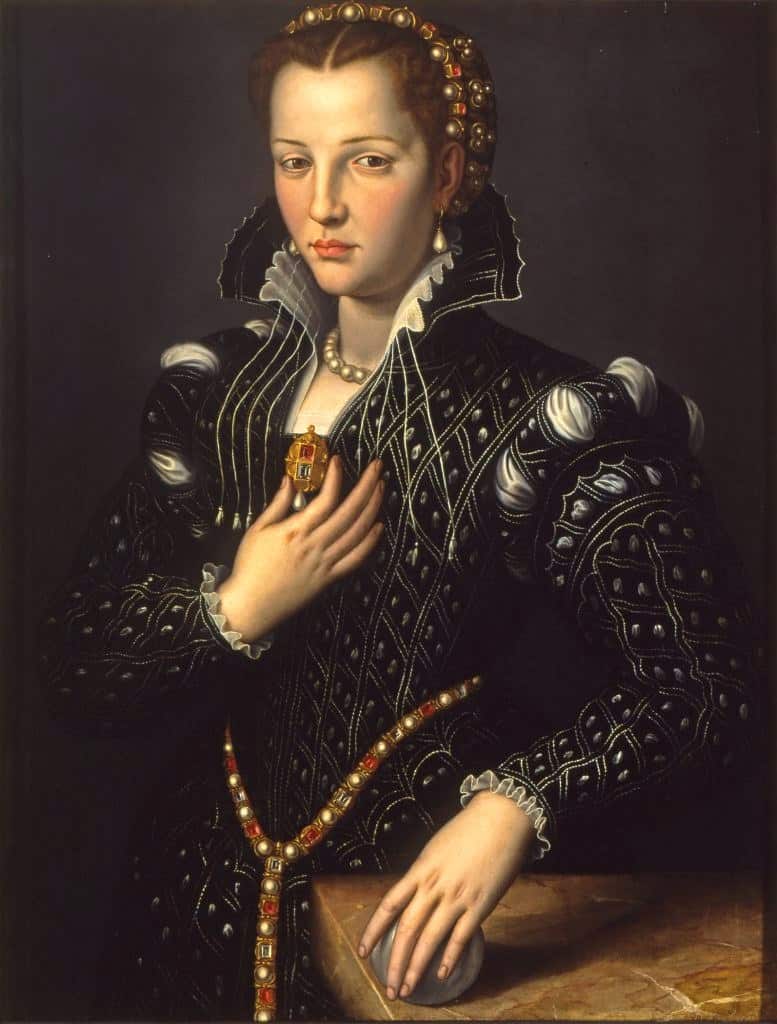 Lucrezia de’ Medici appears in black court dress and pearl jewelry in the portrait now attributed to Alessandro Allori. Image by Alessandro Allori via Wikimedia Commons, licensed under Public domain.
What the Final Illness Records Support
Modern descriptions do not agree on one diagnosis. Museum interpretation calls tuberculosis the most likely cause, while an Este heritage account describes a pneumonic infection. Neither label should be converted into certainty. They are retrospective descriptions attached to a sixteenth-century illness whose surviving documentation does not supply everything a modern physician would require.
More importantly, the institutional and scholarly records behind the documented chronology do not establish poisoning. The poisoning story gains dramatic force when Lucrezia’s death is read backward through later literature, but dramatic plausibility is not evidence. The responsible conclusion is narrower: she endured a lengthy illness, contemporary medical reporting existed, and its exact modern diagnosis remains unsettled.
Her Tomb at Corpus Domini
Lucrezia was buried in the church of Corpus Domini in Ferrara. Her sixteenth-century tomb slab survives there in Botticino marble. Its heraldry combines the Medici and Este arms, joining the two families in the material record just as the marriage contract had joined them politically.
The slab supplies no narrative of her character or death. Its value lies in something more concrete: it locates her burial and preserves the dynastic identity under which she was commemorated. Where later stories invite a murder mystery, the tomb returns attention to a young duchess whose public identity remained bound to both houses.
How My Last Duchess Changed Her Afterlife
Robert Browning published My Last Duchess in 1842. The poem uses a Duke of Ferrara, and literary scholarship identifies Alfonso II and Cosimo I’s daughter as important historical cues. That connection explains why Lucrezia is routinely called Browning’s last duchess, but it does not turn the poem into testimony about her life.
Browning’s Historical Prompt
Browning stages the poem as the duke’s speech while he discusses the portrait of a deceased wife. The speaker’s controlling manner and his reference to commands encourage troubling conclusions about what happened to her. The work gains much of its power by withholding a final, explicit explanation.
Several details belong to Browning’s invention. Fra Pandolf, named as the painter, and Claus of Innsbruck, named in connection with a sculpture, are fictional figures within the poem. The historical Lucrezia’s best-known painted likeness is instead currently attributed to Allori. That single comparison shows why the poem cannot be mined as if every proper name were an archival fact.
A Dramatic Speaker Is Not a Witness
The duke’s commands remain deliberately ambiguous. Readers can analyze what his language implies inside the poem, but those implications do not prove that Alfonso poisoned Lucrezia or ordered her death. Browning borrowed a place, a rank, and historical relationships, then built a dramatic speaker whose words demand interpretation.
Maggie O’Farrell extended this afterlife through The Marriage Portrait. She has described Browning’s poem and Lucrezia’s portrait as prompts for the novel. The book belongs to modern fictional reception, where gaps in the record become space for imaginative reconstruction. It may lead readers toward the historical Lucrezia, but its invented scenes cannot serve as biographical evidence.
What Lucrezia’s Surviving Record Can Tell Us
The surviving evidence falls into distinct categories: diplomatic negotiations show why the marriage mattered; financial records document the dowry; correspondence tracks Lucrezia’s delayed move; medical references mark her final illness; and a painting, medal, and tomb preserve different public identities. Each category answers a different question.
The record becomes most detailed when Lucrezia was being made a bride, circulated as an image, treated as a patient, or commemorated as a deceased duchess. That pattern reveals the priorities of dynastic institutions more clearly than it reveals her private beliefs. Silence about her emotions is not permission to invent them.
A practical way to assess any claim about Lucrezia is to ask three questions. What kind of evidence supports it? What does that evidence establish directly? What has a later interpreter added? The method leaves some mysteries unresolved, but it restores the difference between a visible gesture, a dated event, a medical possibility, and a novelist’s compelling choice.
Frequently Asked Questions
These short answers preserve the qualifications that matter most when identifying Lucrezia and interpreting her surviving record.
How old was Lucrezia de’ Medici when she married?
She was approximately thirteen or fourteen when she married Alfonso II on 3 July 1558. Pastorino’s medal made that year calls her thirteen, supporting the conventional 1545 birth year. A scholarly biography instead gives 14 February 1544, which would make her fourteen.
Who painted Lucrezia de’ Medici’s portrait?
The North Carolina Museum of Art currently attributes her best-known portrait, dated 1559 to 1560, to Alessandro Allori. Bronzino’s name persists because Allori trained under him, older attributions connected Bronzino with the work, and related workshop versions exist. The current attribution for this specific panel is Allori.
Was Lucrezia de’ Medici poisoned?
Poisoning is not established by the surviving institutional and scholarly record. Lucrezia was ill for about two months before her death. Later descriptions propose tuberculosis or a pneumonic infection, but the evidence does not support a single certain modern diagnosis.
Is Lucrezia the duchess in My Last Duchess?
Lucrezia and Alfonso II supplied historical cues for Browning’s poem, but its duchess is a literary creation rather than a documentary portrait. Fictional names, an ambiguous speaker, and invented dramatic details make the poem evidence of Lucrezia’s later reception, not proof about her death.

Jaycene-Fay Ravenscroft is a writer, poet, and creative based in South Africa, boasting over 6 years of experience working in a contemporary art gallery. She earned her Bachelor of Arts degree with majors in Art History and Ancient History from the University of South Africa, supplementing her studies with courses in Archaeology and Anthropology. Driven by a passion for learning, Jaycene-Fay finds inspiration in symbology and the interconnectedness of the world. Trained to analyze and critique art, she is enthusiastic about delving into the meanings behind each artwork, exploring its ties to the artist’s cultural, historical, and social context. Writing serves as Jaycene-Fay’s means of researching, sharing knowledge, and creatively expressing herself. For artfilemagazine, Jaycene-Fay writes articles on art history with a focus on historical paintings.
Learn more about Jaycene-Fay Ravenscroft and about us.
Cite this Article
Jaycene Fay, Ravenscroft, “Lucrezia de’ Medici: Portrait, Marriage, and Myth.” artfilemagazine – Your Online Art Source. October 22, 2026. URL: https://artfilemagazine.com/lucrezia-de-medici/
Ravenscroft, J. (2026, 22 October). Lucrezia de’ Medici: Portrait, Marriage, and Myth. artfilemagazine – Your Online Art Source. https://artfilemagazine.com/lucrezia-de-medici/
Ravenscroft, Jaycene Fay. “Lucrezia de’ Medici: Portrait, Marriage, and Myth.” artfilemagazine – Your Online Art Source, October 22, 2026. https://artfilemagazine.com/lucrezia-de-medici/.