

18th-Century Art: Styles, Works, and Recognition Guide
A shoe flies from a garden swing, three Roman brothers reach toward raised swords, and three women appear in an Edo-period color woodblock print. All belong to the eighteenth century, yet they speak radically different visual languages. Learning to recognize those languages reveals a period shaped by overlapping styles, mobile designs, expanding audiences, and several regional histories unfolding at once.
What 18th-century art means
18th-century art is a chronological umbrella for visual culture made during the 1700s. It is not the name of a single movement, and its useful numerical boundaries do not function like walls. Styles that began earlier remained active, while developments associated with the century continued into the next one.
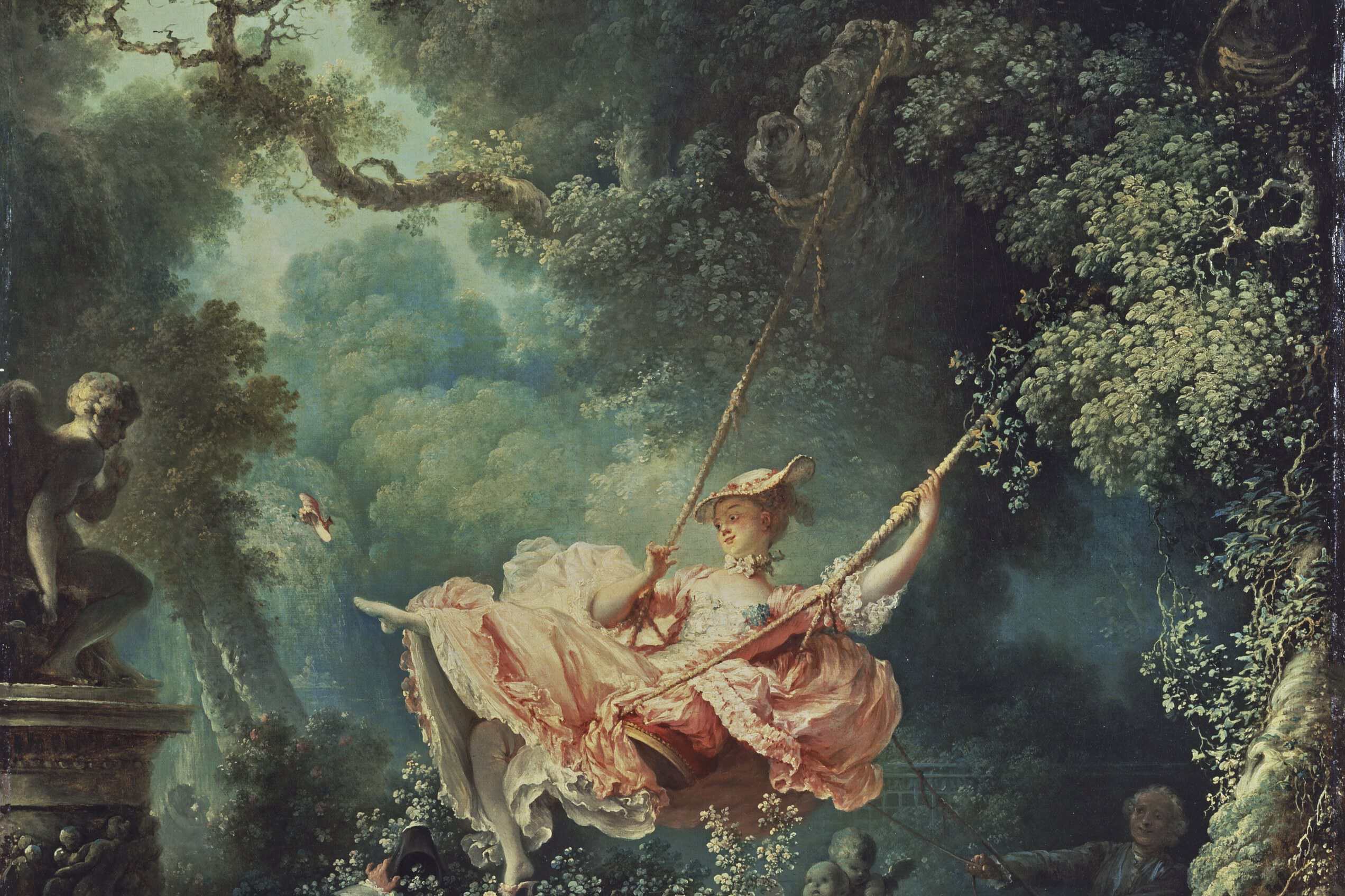 Jean-Honoré Fragonard’s The Swing, painted around 1767 to 1768, places a young woman between an older husband and a hidden lover. Image by Jean-Honoré Fragonard via Wikimedia Commons, licensed under Public domain, cropped.
The category includes painting and sculpture, but it becomes much clearer when architecture, furniture, silver, ceramics, lacquer, prints, and designed interiors enter the picture. It also covers different ways of funding, commissioning, making, and circulating art, from royal courts and academies to urban print markets and workshops using portable design books.
A date range, not a movement
Within Europe alone, revived Baroque art, Rococo ornament, classical revival shaped by archaeological study, and imaginative medieval-looking Gothic designs could coexist. The Enlightenment influenced subjects, institutions, criticism, and audiences, but it did not generate one consistent look. A dramatic church interior, a curling silver ornament, and a disciplined classical painting can therefore belong to the same broad period without belonging to the same style.
Geography makes the category still wider. This overview centers on influential European and Atlantic developments, then opens focused windows onto Qing China and Edo Japan. Those windows do not pretend to compress global art into one survey. They show why a French sequence of Rococo followed by Neoclassicism cannot stand in for everything made during the century.
Why the usual two-style sequence is too neat
A familiar account presents light, decorative Rococo giving way to serious Neoclassicism. That contrast helps with visual recognition, but it distorts the chronology when treated as a clean handoff. Baroque traditions remained active during Rococo’s development, and renewed classicism gathered force while Rococo design still circulated through objects, prints, and workshops.
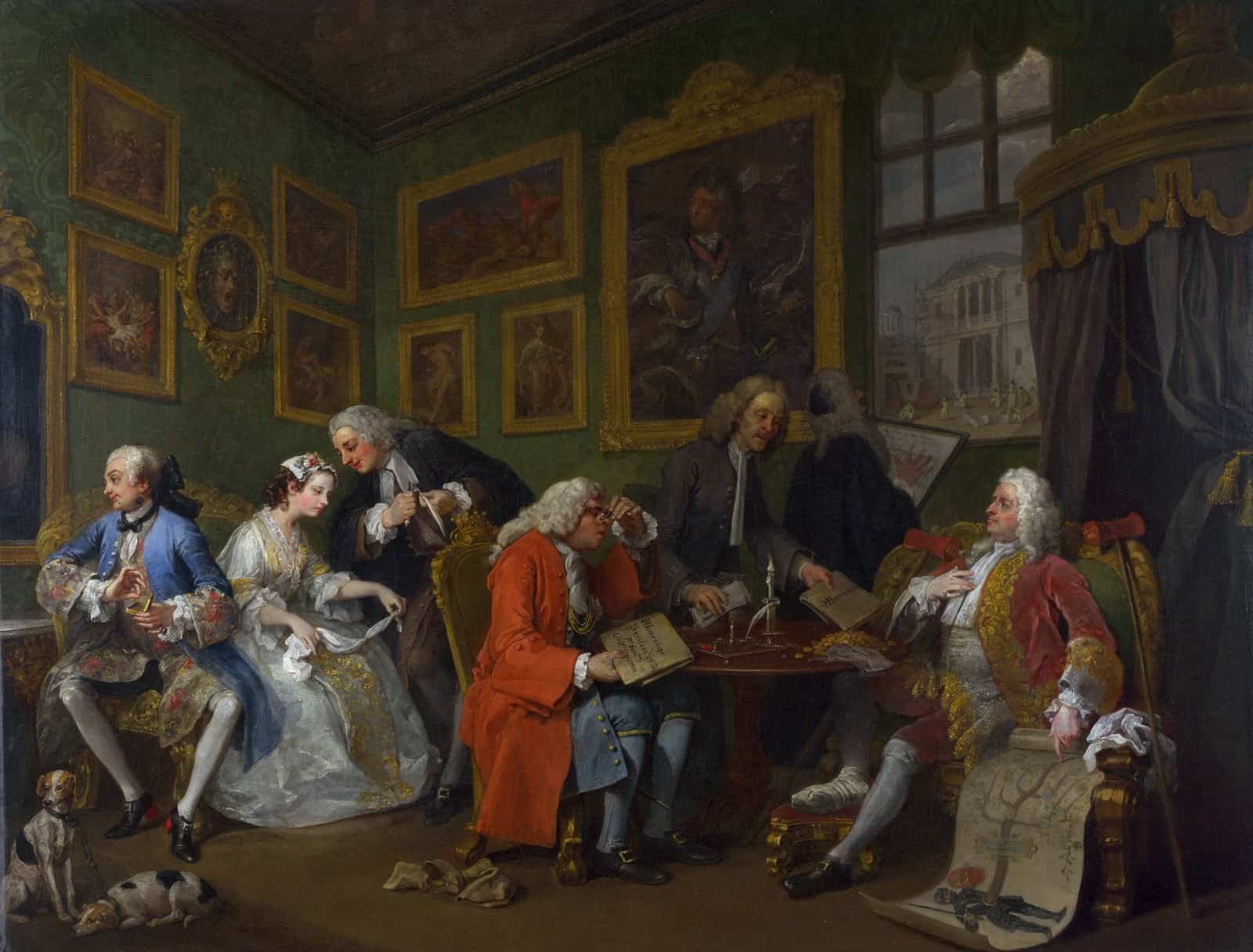 William Hogarth’s The Marriage Settlement, painted around 1743, satirizes an arranged marriage negotiated for money and rank. Image by William Hogarth via Wikimedia Commons, licensed under Public domain.
The boundaries also depend on what is being examined. A painter, cabinetmaker, architect, and silversmith did not necessarily respond to stylistic change at the same pace. Nor did every artist working in Paris, London, Philadelphia, Beijing, or Edo belong to a named movement. Movement labels organize evidence; they do not replace close looking.
A century of overlapping styles and turning points
The most useful chronology follows changes that altered how art was designed, understood, circulated, or displayed. It keeps several strands in view instead of declaring one style finished whenever another becomes prominent.
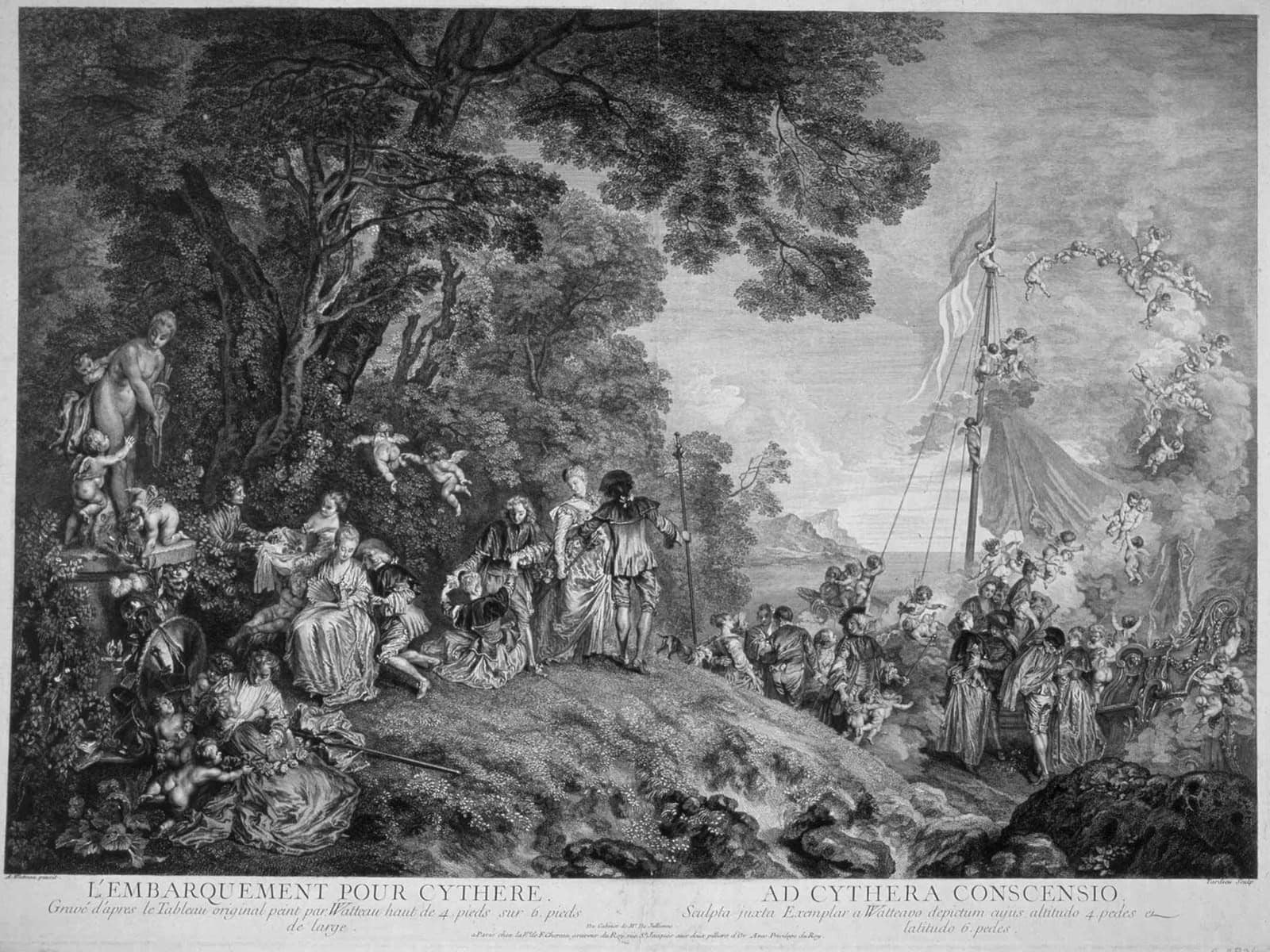 Antoine Watteau’s Pilgrimage to Cythera, painted in 1717, served as his reception piece for the French Royal Academy. Image by Tardieu, Nicolas-Henri (1674-1749) via Wikimedia Commons, licensed under CC BY 4.0.
1700s to 1730s: Baroque continuity and Rococo design
Baroque remained active through the first half of the century. Its artists and designers often integrated architecture, painting, and sculpture into dramatic ensembles, using movement and emotional address to shape a viewer’s experience. Local adaptations also developed as Baroque practices traveled beyond their earlier European centers.
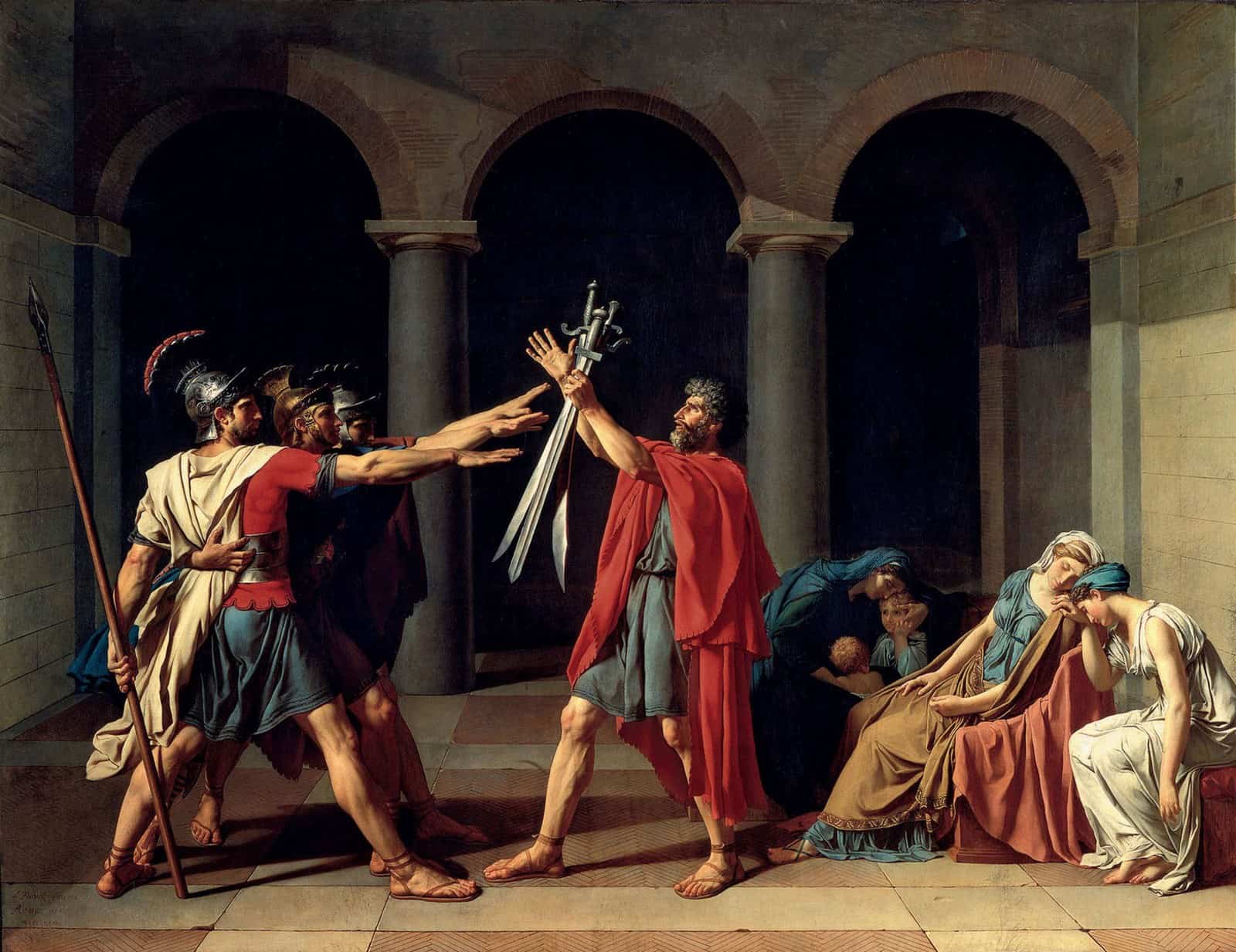 Jacques-Louis David’s The Oath of the Horatii was completed in Rome in 1785 and exhibited at the Paris Salon that year. Image by Jacques-Louis David via Wikimedia Commons, licensed under Public domain.
Against that continuing background, Rococo art took recognizable form in France during the 1720s and 1730s. Craftspeople and designers were central to that development, especially in furniture, silver, and ceramics. This development within designed surfaces and objects explains why Rococo cannot be understood through paintings alone.
Antoine Watteau’s Pilgrimage to Cythera marks an earlier institutional milestone. The 1717 oil painting, measuring 1.29 by 1.94 meters, served as his reception piece, the work he submitted for admission to the French Royal Academy of Painting and Sculpture. Its elegant social gathering belongs near the opening of the Rococo story, even though no single work can supply the movement with a fixed birth date.
1738 to 1768: archaeology, patterns, and academies
The first excavations at Herculaneum in 1738 and Pompeii in 1748 brought ancient sites into renewed view. Images and records on paper helped communicate discoveries that most people could not inspect directly. Along with travel, collecting, and study of surviving antiquities, archaeology strengthened the appeal of Greek and Roman models.
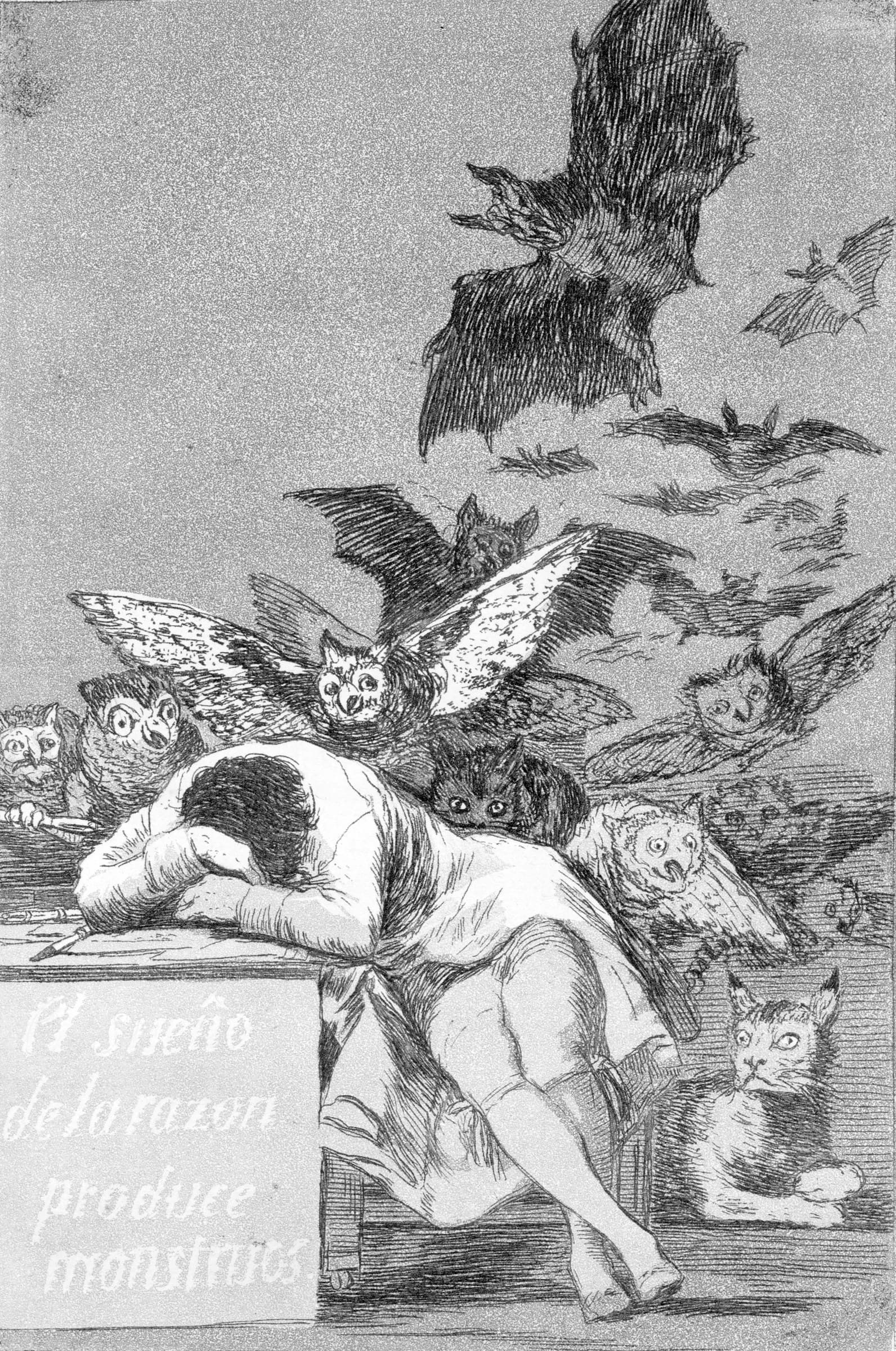 Francisco Goya’s 1799 print The Sleep of Reason Produces Monsters is plate 43 of the 80-work Los Caprichos series. Image by Francisco Goya via Wikimedia Commons, licensed under CC0.
This did not halt the movement of Rococo design. Pattern books made complex ornament portable, while imported objects and migrant artisans carried motifs between workshops and markets. The same middle decades could therefore support curling asymmetric decoration and increasingly archaeological approaches to classical order.
Institutions also gained authority. France’s Royal Academy had been established in 1648, while the English Royal Academy was founded in 1768. Through schools and exhibitions, academies helped train artists, organize public display, and influence taste and official patronage.
1770s to 1799: exhibitions, revolution, and critical printmaking
In the later century, official exhibitions became important settings for ambitious narrative painting. Jacques-Louis David completed The Oath of the Horatii in Rome in 1785 under a commission arranged through Louis XVI’s building administration. After showing it in his Roman studio, he exhibited it at the Paris Salon that year. The work joined an ancient Roman subject to the institutional visibility of a large public painting.
The French Revolution began in 1789 and changed the political setting in which collections and cultural institutions operated. On August 10, 1793, the Muséum central des arts opened to the public at the Louvre, placing works associated with the former royal palace within a new public museum.
Yet the century did not end in calm classical order. Francisco Goya published the 80 aquatint etchings of Los Caprichos in 1799. The series is generally understood as social criticism. Plate 43 surrounds a sleeping artist with bats, owls, and a lynx, bringing reason, satire, anxiety, and fantasy together in one image.
Rococo, Baroque, and Neoclassicism: how to tell them apart
Begin with what can actually be seen: the direction of the lines, the balance of the composition, the source of the motifs, the type of object, and the way the work addresses its viewer. These checks are more dependable than assuming every garden scene is Rococo or every ancient subject is Neoclassical.
Rococo: curves, asymmetry, and crafted surfaces
Rococo frequently announces itself through curved, asymmetric ornament. Look for S and C shapes, shells, acanthus leaves, marine forms, and rocaille, a term for rock- and shell-like decoration. These motifs can merge so freely that the border between plant, wave, shell, and abstract flourish becomes hard to locate.
Scale and medium matter. Rococo often excels in a room or handheld object where ornament can run across a frame, handle, tabletop, or ceramic surface. Painting forms part of that environment rather than defining the whole style. Fragonard’s The Swing, made around 1767 to 1768, provides a memorable painted anchor: motion, concealment, elite leisure, and erotic implication unfold within a garden scene.
Neoclassicism: antiquity, proportion, and structural clarity
Neoclassicism drew on direct study and reproduction of Greek and Roman works. Archaeological discoveries added momentum, but artists and designers also learned through monuments, collections, travel, and works on paper. The resulting language favored harmony, simplicity, proportion, and clearer structural order.
These principles crossed media. They shaped architecture, sculpture, painting, furnishings, and decorative objects. In a Neoclassical work, antique clothing or architecture may establish the setting, but the deeper clue is organizational: figures and forms tend to occupy measured relationships that make an action legible. David’s Oath of the Horatii supplies the strongest comparison with Fragonard because its Roman subject and controlled grouping turn attention from playful concealment toward disciplined public action.
Baroque and Rococo: where the boundary blurs
Baroque and Rococo share movement, elaborate craftsmanship, and a willingness to coordinate several arts. This is why Rococo is sometimes treated as a late expression of Baroque rather than an entirely separate system. Calling the two identical, however, erases useful differences.
| What to compare | Baroque tendency | Rococo tendency |
|---|---|---|
| Composition | Movement may coordinate architecture, painting, and sculpture into one dramatic whole | Curves and asymmetry often animate an object’s surface or a more intimate scene |
| Scale and setting | Frequently effective in integrated architectural ensembles | Especially legible in interiors, furniture, silver, ceramics, and relatively intimate paintings |
| Viewer address | Often aims for forceful drama and emotional involvement | Often rewards close attention to ornament, motion, glances, and concealment |
| Media relationship | Architecture, painting, and sculpture can operate together | Designed objects and crafted surfaces are as important as painting |
| Motif test | No single motif is decisive; look first for integrated drama and movement | Shells, rocailles, acanthus, and S and C curves provide specific clues |
| Practical anchor | A coordinated architectural ensemble that directs the viewer toward a dramatic event | Fragonard’s The Swing, where motion and concealment structure an intimate garden scene |
These are tendencies, not mechanical rules. A practical test is to ask where the movement goes. Baroque movement may organize a large ensemble around a dramatic event, while Rococo movement can travel across a chair back, silver handle, porcelain body, or garden painting as an ornamental rhythm.
Six works that make the century visible
Representative works are most useful when they demonstrate relationships, not when they merely populate a list of famous names. The following paintings and prints show changing subjects, institutions, media, and audiences across different parts of the century.
Watteau, Pilgrimage to Cythera, 1717
Across Watteau’s wide landscape, couples gather in small clusters. Their leaning bodies, turns, and steps lead the eye from pair to pair rather than fixing it on a single dramatic climax. Repeated gestures make graceful social interaction the painting’s organizing action and help explain why it stands near the emergence of Rococo painting without marking a precise beginning.
The painting’s institutional role adds another layer. It was Watteau’s reception piece, meaning the work submitted for his admission to the French Royal Academy. The painting therefore placed his treatment of elegant sociability before an institution that operated a school and exhibitions and influenced artistic taste and patronage.
Fragonard, The Swing, around 1767 to 1768
A young woman swings between an older husband and a concealed young lover. That triangular arrangement turns the garden into a stage of unequal knowledge: one man powers the motion while the other occupies the privileged viewpoint. The moving dress, airborne shoe, foliage, and hidden bodies make looking itself part of the joke.
The painting’s relatively intimate size, 81 by 64.2 centimeters, suits its private play. Unlike a monumental Baroque ensemble designed to overwhelm a public viewer, The Swing rewards close attention to glances, concealment, and implication. It demonstrates Rococo through movement and social theater rather than through ornament alone.
Hogarth, The Marriage Settlement, around 1743
This is the first of six paintings in William Hogarth’s Marriage A-la-Mode. The series attacks elite greed and marriages arranged for money and rank. In the opening scene, the social transaction matters more than affection, so the crowded domestic setting operates as evidence in a visual argument.
Hogarth planned the paintings for reproduction as engravings. Published in 1745, the prints carried the satire to a much wider audience than the owner of the painted series. The work therefore links close observation of social behavior with one of the century’s central changes: reproducible images could move criticism through a broader market.
David, The Oath of the Horatii, 1785
David organizes a Roman story around a decisive gesture. The brothers extend their arms toward the swords held by their father, creating a firm visual center and making the action immediately legible. Clear divisions, controlled poses, and an antique setting demonstrate the structural order associated with Neoclassical painting.
The work also joins style to institutions and patronage. It began as a royal commission, was completed and displayed in Rome, and then appeared at the Paris Salon of 1785. Its exhibition gave viewers a shared setting in which to assess an ancient story presented through a modern official commission. A separate analysis examines David’s The Death of Marat.
Utamaro, Three Beauties, early 1790s
Kitagawa Utamaro’s Three Beauties of the Kwansei Period, dated around 1791, is a woodblock print made with ink and color on paper. Three half-length figures form a compact group. Their repeated oval faces unify the image, while shifts in head angle, hairstyle, and patterned clothing distinguish one woman from another. The composition invites comparison among subtle variations instead of building a dramatic narrative.
The medium and design shift the frame away from European court painting. The work belongs to Edo urban print culture, where ukiyo-e developed as a distinct artistic mode. It should not be relabeled as a Japanese equivalent of Rococo merely because it depicts fashionable beauty. Its format, production, audience, and local artistic relationships belong to Edo-period Japan.
Goya, The Sleep of Reason Produces Monsters, 1799
Plate 43 of Goya’s Los Caprichos shows a sleeping artist beset by nocturnal creatures. Aquatint supplies broad areas of tone while etching defines linear forms, allowing darkness and sharp detail to work together. The image presents the absence of reason not as a tidy philosophical proposition but as a disturbing encounter.
The plate belongs to an 80-print series generally interpreted as social criticism, connecting private imagination with public circulation. It also resists a misleading choice between rational Neoclassicism and decorative Rococo. At the century’s end, printmaking could combine scrutiny, satire, fantasy, and unease within the same project.
The eighteenth century beyond a French style story
No short overview can represent every region equally. Focused comparisons can still expose the limits of a France-centered narrative, especially when they distinguish the circulation of European ornament from artistic systems operating in Qing China and Edo Japan.
Atlantic circulation and American Rococo
Rococo reached colonial America through engraved designs, imported objects, and immigrant artisans. Boston, New York, Charleston, and Philadelphia became documented centers. Craftspeople applied its motifs to interiors, furniture, silver, and other objects, adapting an international ornamental language within local workshops and markets.
John Singleton Copley’s Watson and the Shark reveals a different form of Atlantic connection. The American artist’s 1778 painting was exhibited at London’s Royal Academy that year. A preparatory sketch rendered the sailor at the composition’s apex as white, but the finished painting depicts him as a Black man. The sailor’s model remains unidentified. Museum interpretation connects Copley’s change to the presence and labor of Black sailors in the Atlantic world, an argument grounded in the documented alteration.
This example offers useful close-looking guidance. Changes between preparation and finished work can carry historical significance, while exhibition history can show how an American painting entered a British institutional setting. Neither geography nor artistic identity remained confined to a single shore.
Qing court art and selective exchange
The Qing emperors Kangxi, Yongzheng, and Qianlong were major arts patrons whose reigns span the eighteenth century. Court production included porcelain, jade, lacquer, and metalwork. Traditional forms and archaizing works, meaning objects deliberately modeled on older traditions, remained important. Trade and contact with Europeans also encouraged selective combinations of Chinese and Western motifs.
Selective exchange is the crucial phrase. Contact did not make Qing court art an Asian branch of Rococo or Neoclassicism. Objects could incorporate foreign elements while operating within Chinese materials, patronage, technical traditions, and historical references. The result was combination and adaptation, not the replacement of one artistic culture by another.
Edo Japan and urban print culture
Edo-period Japan likewise supported several modes at once. Urban culture fostered ukiyo-e, while nanga developed during the eighteenth century in response to Chinese literati culture, the artistic traditions associated with educated scholars. Rinpa, ukiyo-e, and nanga remained distinct but nonexclusive approaches rather than mandatory steps in a single sequence.
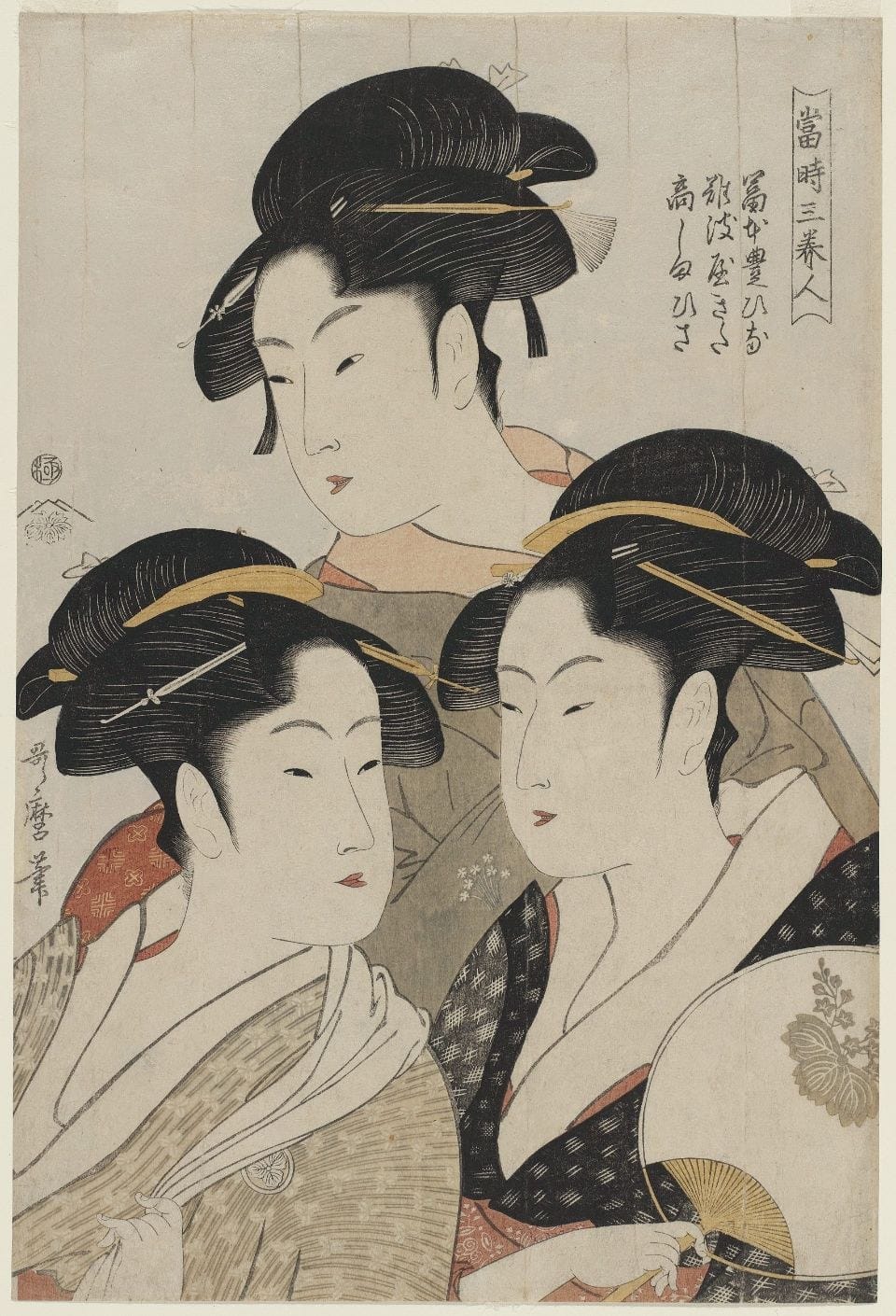 Kitagawa Utamaro’s Three Beauties of the Present Time, a 1793 color woodblock print, presents three celebrated women of Edo-period Japan. Image by Kitagawa Utamaro via Wikimedia Commons, licensed under Public domain.
Utamaro’s print belongs within this local plurality. It demonstrates how a color woodblock image could make contemporary urban beauty its subject without needing a European label. Readers seeking a wider view of Japanese art styles should therefore attend to local media, audiences, and lineages before drawing cross-cultural similarities.
Chinoiserie is not a substitute for Chinese art
European chinoiserie grew partly from enthusiasm for imported East Asian luxury goods, but it was an adaptation shaped by European desire and imagination. Eighteenth-century designers often combined elements identified as Chinese, Japanese, and Indian within invented settings. Some also mixed this imagery with Rococo or Gothic forms.
Chinoiserie can reveal how European makers imagined Asia and transformed imported models. It cannot provide a reliable summary of Qing visual culture. Keeping the categories separate prevents a common error: treating a European fantasy of the East as evidence for what Chinese artists and court workshops were actually making.
How the eighteenth century changed art’s public
Style tells only part of the period’s story. Designs and images traveled through reproduction, institutions organized encounters between works and viewers, and collections entered new public settings. Together, these changes help explain why the century matters to the later structure of the art world.
Patterns, prints, and portable designs
Pattern books converted difficult ornamental forms into designs that could be carried, copied, and adapted. Imported objects and migrant craftspeople supplied additional routes of transmission. Rococo could consequently appear in distant workshops without every maker visiting France or encountering the same original object.
Prints moved arguments as well as ornament. Hogarth’s engraved Marriage A-la-Mode extended a painted satire beyond the paintings’ owner, while Goya issued Los Caprichos as an 80-print series. Reproduction changed the potential scale of an image’s audience and made sequences especially effective for sustained social criticism.
Academies and public exhibitions
Royal academies operated schools and organized exhibitions. By the late eighteenth century, the French and English institutions strongly influenced public taste and official patronage. Their schools and exhibitions joined artistic training to increasingly visible systems of public display.
Watteau’s 1717 reception piece and David’s appearance at the 1785 Salon show different points of contact with this system. The first marked admission to an academy; the second placed a royal commission before an exhibition audience. Copley’s 1778 London display shows that an artist identified with America could also exhibit within the English Royal Academy’s public arena.
From royal collection to public museum
The Louvre’s public opening in 1793 gave the century a major institutional turning point. Art associated with a royal palace and collection entered a museum presented to the public after the Revolution. The meaning of the works did not become politically neutral, but the conditions of access changed.
That transition joins the century’s other circulation systems. A design could travel in a pattern book, a satire through an engraving, an ambitious painting through an academy exhibition, and a former royal collection through a public museum. These routes did not produce one style. They created more settings in which art could be copied, judged, debated, and remembered.
Frequently asked questions
The answers below keep dates approximate where styles overlap and separate European movement labels from the wider century. They also show why medium and purpose matter as much as an artwork’s date.
Why does some eighteenth-century art still look Baroque?
Baroque remained active through the first half of the century, and styles did not change everywhere at once. Rococo also shared movement and integrated craftsmanship with late Baroque practice, so the boundary can be genuinely blurry rather than simply misidentified.
Did Neoclassicism replace Rococo overnight?
No. Classical revival shaped by archaeological study gained momentum while Rococo objects and designs were still being made and circulated. The two could overlap by date, place, and medium, even when their visual priorities differed sharply.
Which media mattered besides painting?
Architecture, sculpture, prints, furniture, silver, ceramics, porcelain, jade, lacquer, metalwork, and complete interiors all played important roles. Looking across media is essential because Rococo ornament, Neoclassical order, Qing court production, and Edo print culture developed through different kinds of objects.
Was Enlightenment art always rational and serious?
No single style corresponds to the Enlightenment. Goya’s The Sleep of Reason Produces Monsters makes the point especially clearly: a work concerned with reason can use fantasy, darkness, and unsettling animal imagery to pursue what is generally interpreted as social criticism.

Jordan Anthony is a Cape Town-based film photographer, curator, and arts writer. She holds a Bachelor of Art in Fine Arts from the University of the Witwatersrand, Johannesburg, where she explored themes like healing, identity, dreams, and intuitive creation in her Contemporary art practice. Jordan has collaborated with various local art institutions, including the KZNSA Gallery in Durban, the Turbine Art Fair, and the Wits Art Museum. Her photography focuses on abstract color manipulations, portraiture, candid shots, and urban landscapes. She’s intrigued by philosophy, memory, and esotericism, drawing inspiration from Surrealism, Fluxus, and ancient civilizations, as well as childhood influences and found objects. Jordan is working for artfilemagazine since 2022 and writes blog posts about art history and photography.
Learn more about Jordan Anthony and about us.
Cite this Article
Jordan, Anthony, “18th-Century Art: Styles, Works, and Recognition Guide.” artfilemagazine – Your Online Art Source. September 9, 2026. URL: https://artfilemagazine.com/18th-century-art/
Anthony, J. (2026, 9 September). 18th-Century Art: Styles, Works, and Recognition Guide. artfilemagazine – Your Online Art Source. https://artfilemagazine.com/18th-century-art/
Anthony, Jordan. “18th-Century Art: Styles, Works, and Recognition Guide.” artfilemagazine – Your Online Art Source, September 9, 2026. https://artfilemagazine.com/18th-century-art/.