

Spear Bearer Doryphoros: Reading the Naples Marble Copy
A marble figure appears to stand at ease, but each shift of weight contributes to a carefully coordinated pattern. The famous Doryphoros began as a lost Greek bronze design; the object examined here is the Roman marble survivor in Naples, inventory 6011. Reading it from the feet upward reveals both the structure of the design and the uncertainty introduced by copying, breakage, and restoration.
| Attribution/model: | After a lost model attributed to Polykleitos |
| Title: | Doryphoros (Spear Bearer) |
| Object type: | Roman marble copy after a lost Greek bronze |
| Copy date: | Late second to early first century BCE |
| Archetype date: | Approximately 450 to 440 BCE |
| Medium/support: | Luni, or Carrara, marble with an ancient base (plinth) and tree-trunk support |
| Dimensions: | Height 212 cm, including the ancient base |
| Collection: | National Archaeological Museum of Naples |
| Accession number: | 6011 |
| Reported findspot: | Pompeii, traditionally the Samnite Palaestra; the precise context is disputed |
| Restoration state: | Assembled from fragments; right arm and left hand restored; legs rejoined below the knees |
The Doryphoros begins with a lost bronze
The name Doryphoros often seems to identify a single ancient statue. It actually points to a design transmitted through multiple objects. The lost bronze model attributed to Polykleitos belongs to the mid-fifth century BCE, while the Naples statue was carved centuries later. Calling both works the Doryphoros is convenient, but it can hide the difference between an archetype and a surviving copy.
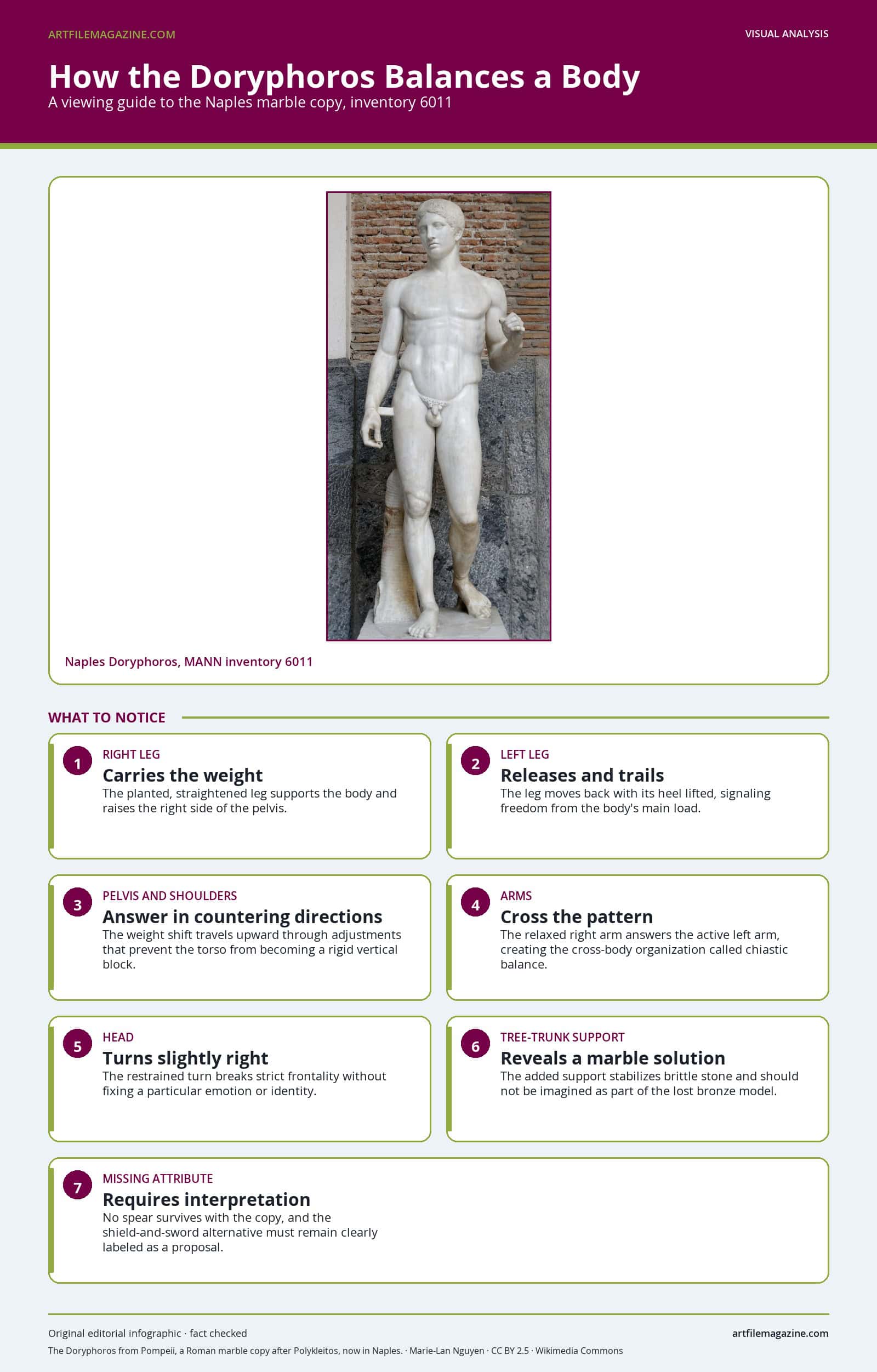
That distinction controls every other fact. The date around 450 to 440 BCE belongs to the missing Greek model. The later date, marble material, Pompeian history, accession number, restorations, and current location all belong to the Naples copy. Other Roman versions, fragments, and casts may help scholars compare the design, but their details cannot be transferred to inventory 6011.
Polykleitos and the High Classical body
The design attributed to Polykleitos coordinates the standing figure through unequal but related actions. One leg supports the body, the other releases, and the upper body responds to the shift instead of remaining rigid. These relationships, preserved in later versions, are central to understanding the Doryphoros.
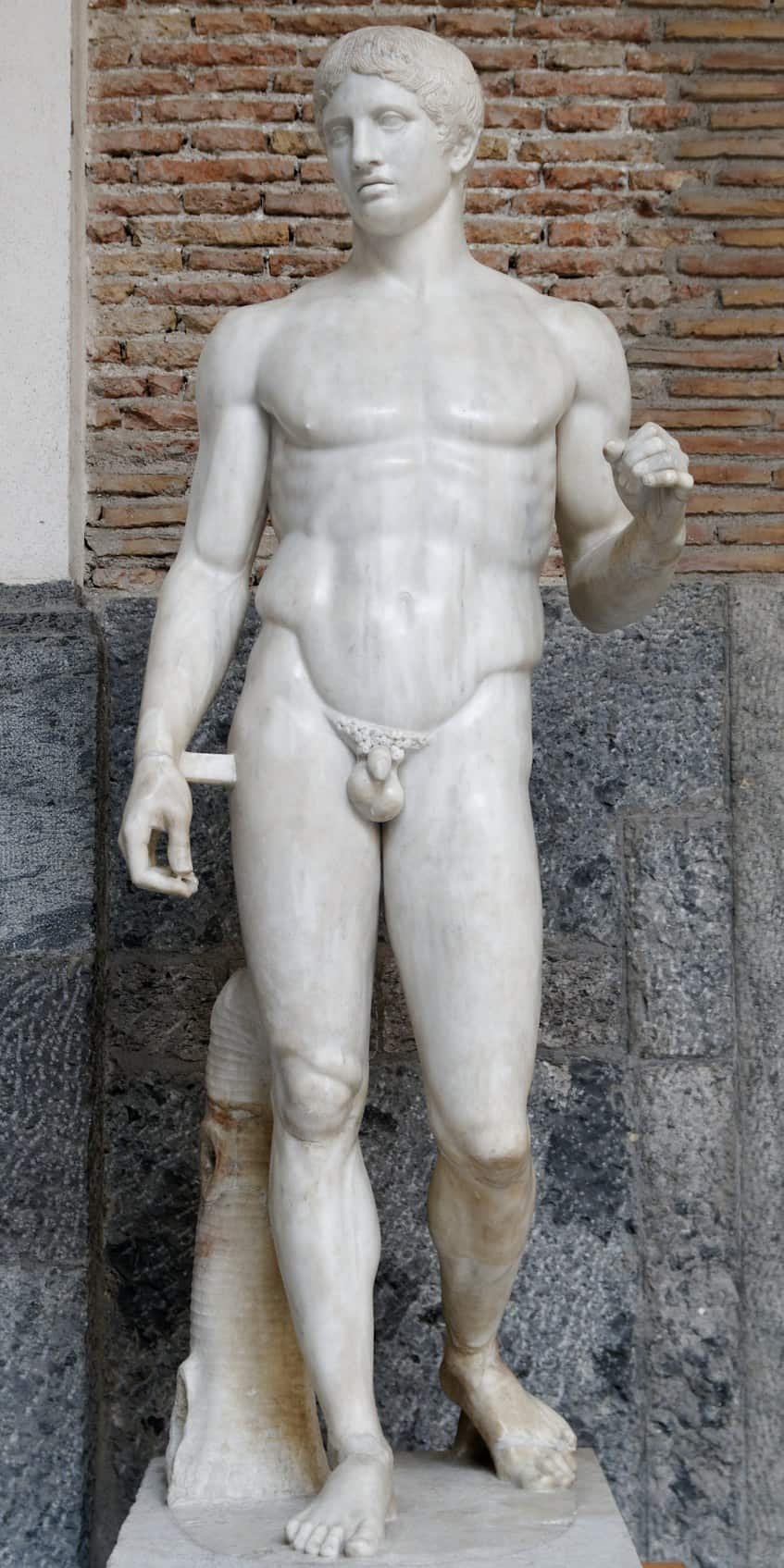 The Doryphoros from Pompeii, a Roman marble copy after Polykleitos, now in Naples. Image by Marie-Lan Nguyen via Wikimedia Commons, licensed under CC BY 2.5.
The design belongs to the period of Classical art in Greece, but the bronze itself has not survived. There is no original surface to inspect and no secure way to recover every detail of its pose, finish, or equipment. Modern understanding depends on later replicas, ancient testimony, and comparison among objects that agree in broad structure but differ in particulars.
The Naples marble is therefore not the Greek original in a new material. It is a Roman-period object that transmits a Greek design. Its value lies precisely in that layered identity.
The Canon without invented arithmetic
Polykleitos also wrote a work known as the Canon, a title meaning a rule or standard. Ancient testimony connects it with a proportional theory developed in the mid-fifth century BCE and reports that the sculptor demonstrated its principles in a statue likewise called the Canon.
The surviving evidence does not provide a complete numerical recipe. No securely established list of ratios allows a reader to reconstruct the sculpture simply by calculating the length of a finger, head, or limb. Exact modular systems presented today are scholarly attempts to recover a lost theory, not preserved instructions from Polykleitos.
It is also uncertain whether the statue called the Canon was specifically the Doryphoros. That identification has a long history, but it remains contested. The proportional theory and the statue can be discussed together without treating their identification as settled.
Why Roman copies carry the story
Multiple Roman versions preserve the broadly related design, but differences in material and surviving details show why the word copy needs care. The Naples statue also bears damage and later restoration that affect what can be observed in this individual object.
The tradition belongs both to the history of ancient Greek art and to Roman art. The lost Greek design is now studied through Roman objects. Those copies are indispensable evidence, yet no single example functions as a transparent replacement for the bronze.
How to read the balance
The pose becomes easier to understand when viewed as a chain of responses rather than a general impression of naturalism. Start low, identify where the weight falls, and then follow the consequences through the pelvis, torso, shoulders, arms, and head. Each region answers another.
Start at the feet
The right foot is planted, and the right leg carries the body’s main load. The left leg moves back with its heel raised, releasing it from the same supporting task. These legs are not doing equal work, even though the figure remains upright.
This distribution is the basis of contrapposto, a standing arrangement in which weight rests chiefly on one leg and the body adjusts around that choice. The term does not merely mean that one knee bends. Its real subject is the transfer of load and the connected changes that travel upward.
The pose can suggest a moment between rest and motion. The figure is stable enough to hold its ground, yet the freed leg creates the potential to move. That possibility gives the body energy without requiring a dramatic stride or gesture.
Follow the counterbalance upward
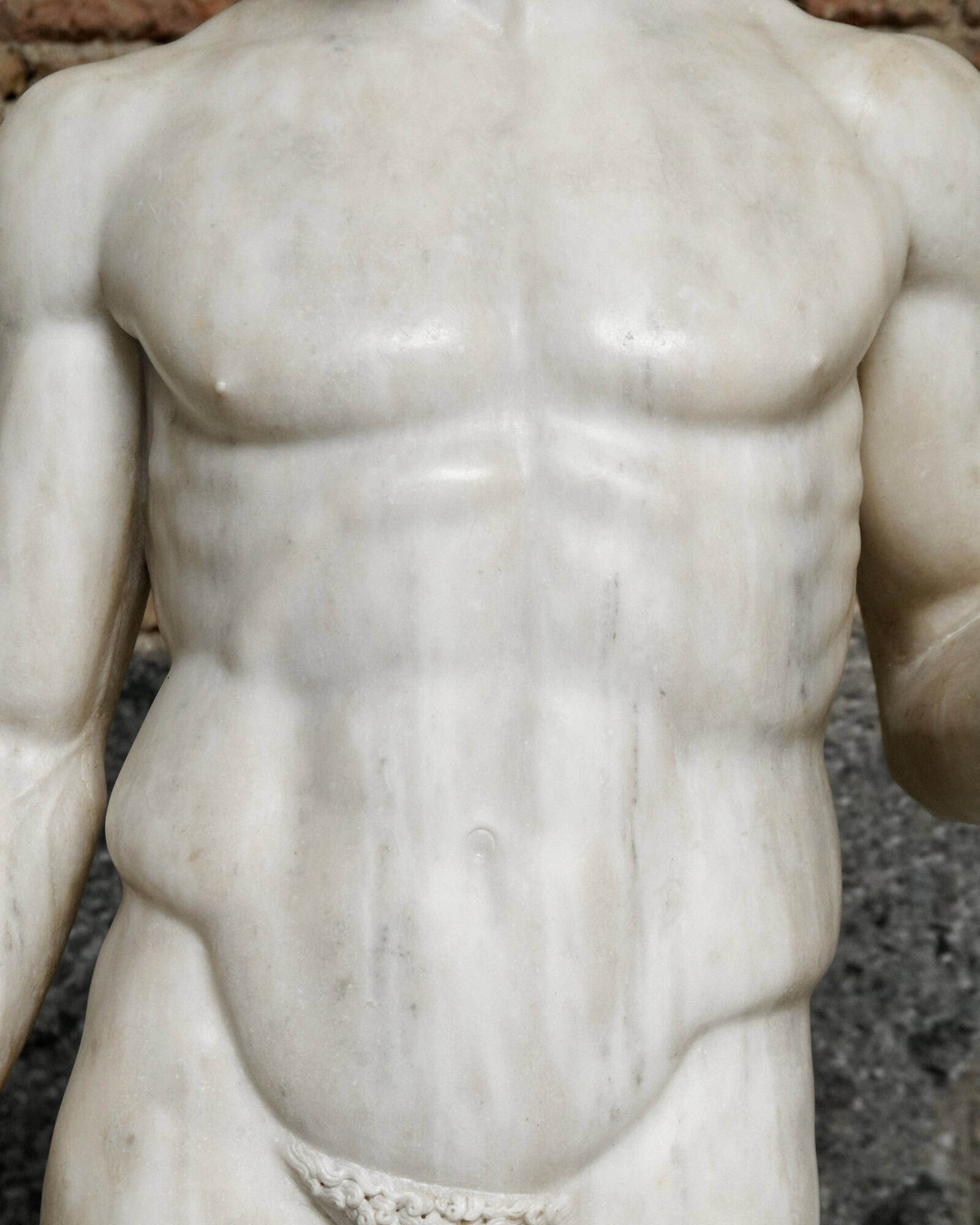
The weight-bearing right leg and released left leg affect the angle of the pelvis. Above them, the shoulders respond in a countering direction. The torso becomes the flexible link between these adjustments instead of behaving like a straight block placed on two legs.
In the statue’s present configuration, the restored right arm hangs while the left arm bends. This creates the familiar cross-body relationship between the active right leg and left arm, and between the released left leg and right arm. Because the right arm is restored, however, inventory 6011 cannot independently prove its precise ancient angle or action.
This crossed organization is called chiastic balance. It is not mirror symmetry. The two sides differ, but their differences are coordinated across the body. The opposing arm pattern is best understood as a reconstruction supported by the wider copy tradition, not as evidence preserved in the Naples right arm alone.
The result is order without stiffness. No individual tilt needs to be large because the effect accumulates from several related adjustments. The sculpture turns bodily balance into something a viewer can follow.
Notice the head and torso
The head turns slightly to the right, moving away from a strict straight-ahead pose. Its movement remains restrained, so it extends the body’s network of small asymmetries instead of competing with it. Nothing about the turn securely identifies a particular event, emotion, or person.
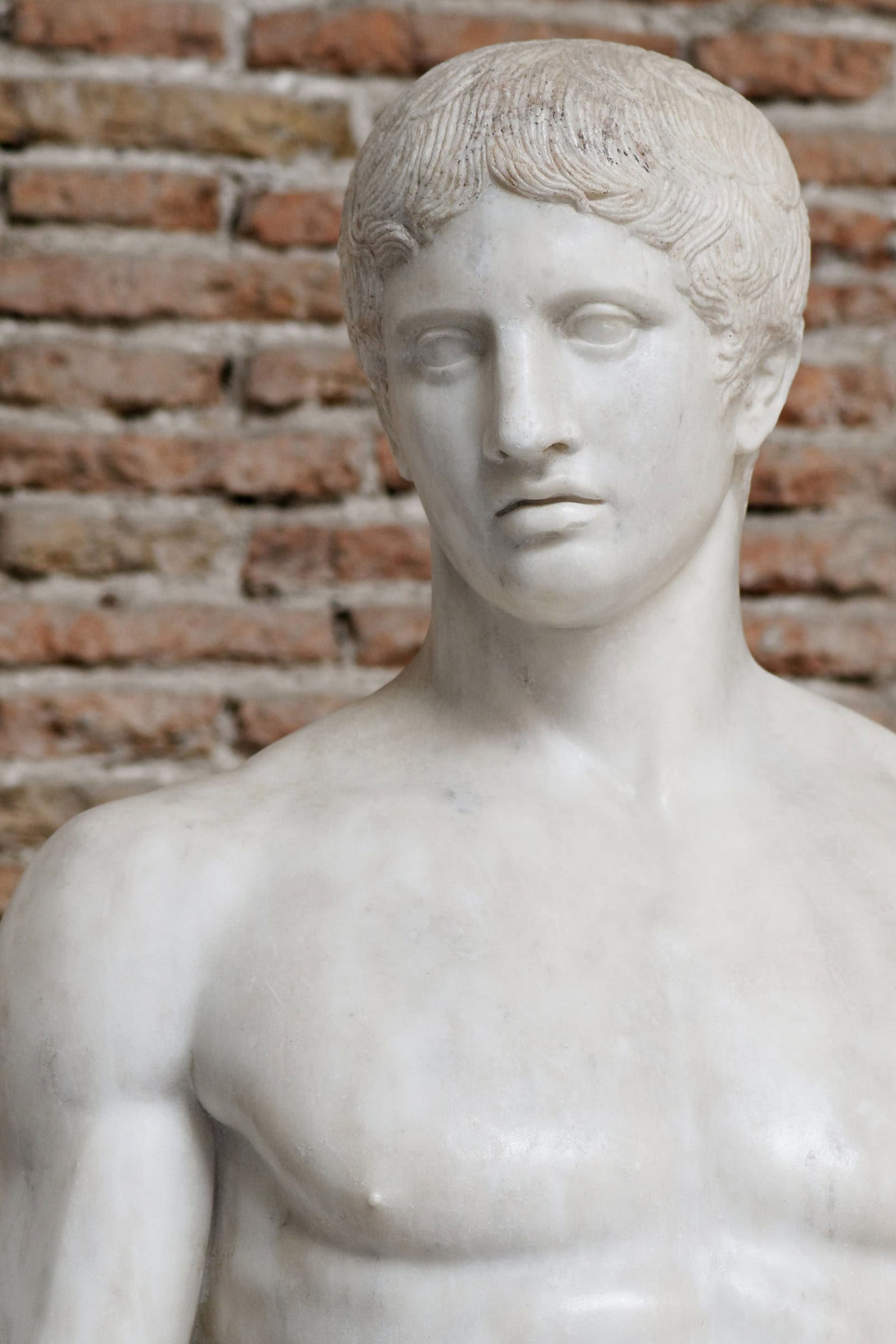 The calm, slightly turned head of the Naples Doryphoros. Image by Marie-Lan Nguyen via Wikimedia Commons, licensed under CC BY 2.5.
An early Naples museum guide noted that inventory 6011 holds its head higher than other known replicas. That observation is a useful warning. Even where copies preserve the same underlying scheme, the angle joining the head, neck, and torso may vary.
When viewing the statue, begin with the visible mechanics: load, release, counter-tilt, and turn. Keep the restored right arm and left hand separate from features preserved directly in the ancient marble.
What marble changes
The Naples Doryphoros does more than preserve a pose. Its stone, supports, fractures, and restored parts record how that pose reached the present. These features define what evidence this particular object can provide.
The support that gives away the copy
A tree-trunk form rises beside the weight-bearing leg. It helps stabilize the marble figure, which concentrates considerable stone above comparatively narrow ankles. The lost bronze model would not have required this support.
 The marble tree-trunk support beside the Doryphoros’s weight-bearing leg. Image by Marie-Lan Nguyen via Wikimedia Commons, licensed under CC BY 2.5.
The trunk should therefore not be interpreted automatically as part of the figure’s setting or identity. It is first a structural solution created by translating the design into marble. It thickens the connection between the figure and its base while helping the stone sustain the pose.
This is one of the clearest signs of the copy process. The human stance carries the inherited design, while the support reveals a practical demand of the surviving material.
Restoration and the statue’s present state
Inventory 6011 was assembled from fragments. Its right arm and left hand are restored, and joins run through the legs below the knees. The body seen in the museum combines ancient marble, reassembled sections, and later intervention.
Those facts place limits on close reading. The restored left hand cannot offer independent evidence for an original grip, and the restored right arm cannot settle its ancient position. The joins do not make the statue useless. They show which observations deserve the most confidence and which depend on reconstruction.
What another copy can and cannot prove
The Uffizi Galleries preserve a separate Roman Doryphoros torso made from dark basanite in the first half of the first century CE. Its polished stone could recall the appearance of bronze more readily than pale marble does. It therefore demonstrates how another material could change the presentation of the inherited design.
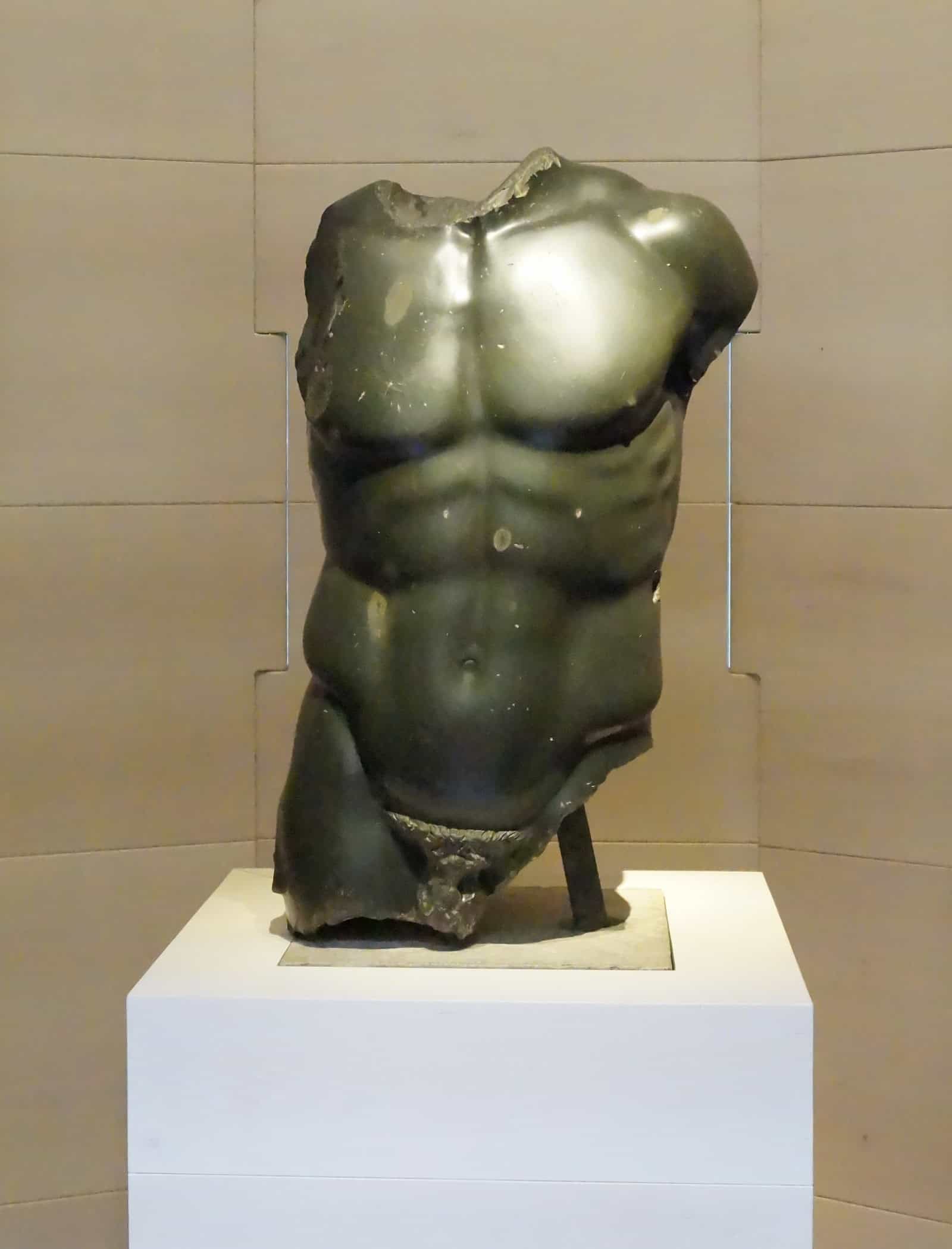 A Roman Doryphoros torso in dark basanite at the Uffizi Galleries. Image by Unknown author Unknown author via Wikimedia Commons, licensed under Public domain.
It is not a missing piece of the Naples statue. Its date, stone, surviving extent, and object history are its own. Nor can its details simply be inserted wherever inventory 6011 is damaged. Comparison can reveal recurring patterns and meaningful variations, but it cannot turn several replicas into one imaginary complete object.
The same rule applies to other torsos and statues associated with the design. Their number demonstrates broad transmission. Their differences preserve evidence about ancient replication rather than noise that should be edited away.
Who is the figure, and what did he carry?
The sculpture’s familiar name sounds more certain than the surviving evidence. It encourages viewers to picture a specific object in the raised hand and perhaps a particular person. Both conclusions require qualification.
Why Spear Bearer remains a useful title
Doryphoros means Spear Bearer, but no spear survives with the Naples copy. The title remains useful because it identifies the design across texts, collections, and scholarship. It should not be mistaken for a preserved label attached to an intact ancient attribute.
A spear is the traditional reconstruction, while an alternative proposal gives the figure a shield and sword. Both describe possible lost equipment rather than objects preserved with inventory 6011.
The statue’s restoration history adds another layer of caution because the left hand and right arm are restored. Absence does not prove that the ancient figure carried nothing, but the conventional title does not prove exactly what this copy held either.
Possible heroes, limited evidence
Achilles, Orestes, and Theseus have each been proposed as the figure’s identity. None has been established securely for the Naples marble. The restrained pose and missing attribute do not supply a unique narrative clue that selects one hero over the others.
The identity question must also remain separate from the equipment question. Even a convincing reconstruction of a spear, shield, or sword would not automatically name the person. Conversely, proposing a hero cannot create certainty about a missing object.
The soundest description is therefore modest: inventory 6011 is a Roman marble version of the design conventionally called Polykleitos’s Doryphoros. More specific names and equipment belong to the history of interpretation.
From Pompeii to room 33 in Naples
The statue’s documented modern history includes a reported discovery, restoration, museum display, and comparison with ancient texts and other replicas. Each stage has shaped how the object is understood.
A findspot with an asterisk
The statue was reportedly found at Pompeii in 1797. Tradition associates the discovery with the building known as the Samnite Palaestra.
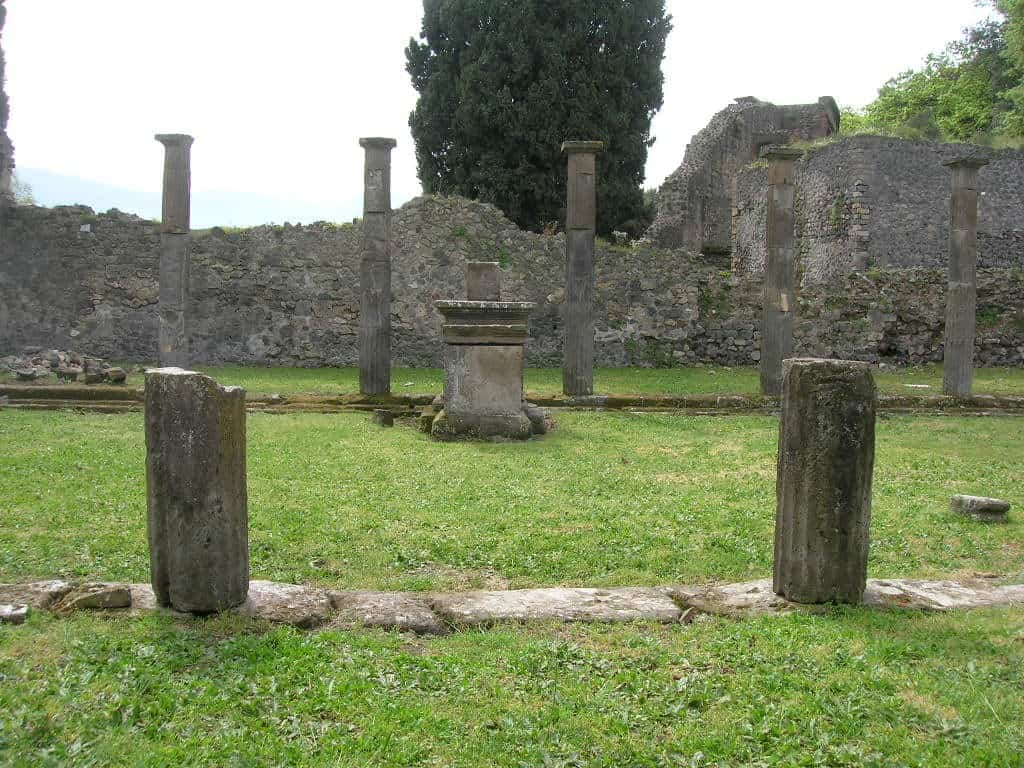 The Samnite Palaestra at Pompeii, the traditional findspot of the Naples Doryphoros. Image by Mentnafunangann via Wikimedia Commons, licensed under Public domain.
Scholars have raised doubts about both the exact findspot and the identification of that building as a palaestra. The traditional account remains part of the object’s history, but it should not be presented as an uncontested archaeological context. A secure setting could affect interpretations of whom the statue represented and how it was used, which makes the uncertainty important.
The 1863 identification
A major change came in 1863, when Karl Friederichs identified the Pompeii marble with the Doryphoros associated with Polykleitos in ancient literary testimony. That proposal connected a museum object with a famous sculptural design known through texts.
The identification did not restore the lost bronze or resolve every feature. It created a framework for comparing the Naples figure with other versions and for asking how their repeated pose might relate to Polykleitos. The object’s fame consequently rests on comparative work as well as on its physical completeness.
This history explains why the Naples statue has become a reference point among famous Greek statues even though it is Roman. It gives unusually substantial form to a Greek design that otherwise survives only indirectly.
Where to see it now
The canonical object discussed here belongs to the National Archaeological Museum of Naples and carries inventory number 6011. The museum’s 2026 visitor map places the Doryphoros in room 33, within the galleries devoted to Campania in the Roman period.
Why this copy matters
Its importance comes from two forms of evidence held together: a readable bodily design and a visibly altered Roman marble object. Looking at both prevents the copy from becoming either a simple stand-in for the bronze or only a damaged museum survivor.
A pose that organizes the whole body
The sculpture offers a practical lesson in how balance can be made visible. Stability does not come from making both sides equal. The right leg bears the weight while the left releases, and the pelvis, shoulders, torso, left arm, and head respond to that unequal stance.
This makes the pose legible from a distance and increasingly complex at close range. The basic stance appears calm, but following its internal relationships reveals controlled tension. The figure does not need a dramatic expression or narrative action because its structure supplies the event.
For a reliable recognition guide, begin with the planted right leg and trailing left foot. Follow the countering adjustments through the pelvis and shoulders, then notice the bent left arm and slight rightward turn of the head. Finally, mark the tree-trunk support, restored right arm, restored left hand, and leg joins as evidence specific to the surviving Naples object. The restored arm should not be treated as independent proof of the bronze model’s exact configuration.
A Greek idea preserved through Roman difference
Inventory 6011 matters because it is a comparatively complete witness, not because it cancels the loss of the original. It preserves enough of the design to make its crossed balance intelligible while openly displaying the conditions of transmission: Roman marble, structural support, fragmentation, and restoration.
The object’s double identity changes how it should be viewed. A visitor encounters an ancient Roman sculpture in Naples and, through it, evidence for a fifth-century BCE Greek bronze. Neither layer should erase the other.
That tension also explains why uncertainty is productive here. Variations among copies, doubts about the findspot, competing attribute reconstructions, and the incomplete evidence for the Canon show how knowledge of a lost design is built, tested, and revised through surviving objects.
Frequently asked questions
These practical questions help when reading catalog entries, comparing versions, or planning a museum visit.
Why do catalog dates for the Naples copy look different?
The dates reflect different degrees of precision rather than two separate objects. Some publications place inventory 6011 broadly in the second or first century BCE, while more recent exhibition material uses the narrower range of the late second to early first century BCE. In either case, that estimate belongs to the Roman marble, not the lost Greek bronze.
Does the listed height describe only the figure?
No. The published height of 212 centimeters includes the ancient plinth. Before comparing that number with the dimensions of another version, check whether the other catalog also counts its base.
What information distinguishes this object from another Doryphoros?
Look for the combination of the National Archaeological Museum of Naples, inventory 6011, Luni or Carrara marble, and a Roman date. A label that says only Doryphoros or “after Polykleitos” could refer to another ancient version, a fragment, or a modern cast.
How should visitors check whether the statue is on view?
Use inventory number 6011 when consulting current museum information. The museum’s 2026 visitor map places the statue in room 33, but gallery access can change, so check the current collection-opening plan shortly before a visit.

Jordan Anthony is a Cape Town-based film photographer, curator, and arts writer. She holds a Bachelor of Art in Fine Arts from the University of the Witwatersrand, Johannesburg, where she explored themes like healing, identity, dreams, and intuitive creation in her Contemporary art practice. Jordan has collaborated with various local art institutions, including the KZNSA Gallery in Durban, the Turbine Art Fair, and the Wits Art Museum. Her photography focuses on abstract color manipulations, portraiture, candid shots, and urban landscapes. She’s intrigued by philosophy, memory, and esotericism, drawing inspiration from Surrealism, Fluxus, and ancient civilizations, as well as childhood influences and found objects. Jordan is working for artfilemagazine since 2022 and writes blog posts about art history and photography.
Learn more about Jordan Anthony and about us.
Cite this Article
Jordan, Anthony, “Spear Bearer Doryphoros: Reading the Naples Marble Copy.” artfilemagazine – Your Online Art Source. September 17, 2026. URL: https://artfilemagazine.com/spear-bearer-doryphoros/
Anthony, J. (2026, 17 September). Spear Bearer Doryphoros: Reading the Naples Marble Copy. artfilemagazine – Your Online Art Source. https://artfilemagazine.com/spear-bearer-doryphoros/
Anthony, Jordan. “Spear Bearer Doryphoros: Reading the Naples Marble Copy.” artfilemagazine – Your Online Art Source, September 17, 2026. https://artfilemagazine.com/spear-bearer-doryphoros/.