

Existentialism Art: Meaning, History, and Key Works
In Giacometti’s The Nose, a long nose projects beyond the cage that holds a suspended head, while Pollock’s handprints interrupt a field of poured paint. The works look nothing alike, yet both have entered discussions of existentialism through different kinds of evidence. The useful question is not whether they share one existentialist style, but what their forms, histories, and ideas reveal about human existence.
What Does Existentialism Mean in Art?
Existentialism in art is primarily a philosophical and critical framework for interpreting artworks, not a coherent movement with a single style or settled membership list. It asks how people experience a world they did not choose, exercise freedom within limits, accept responsibility, and create meaning through decisions and relationships.
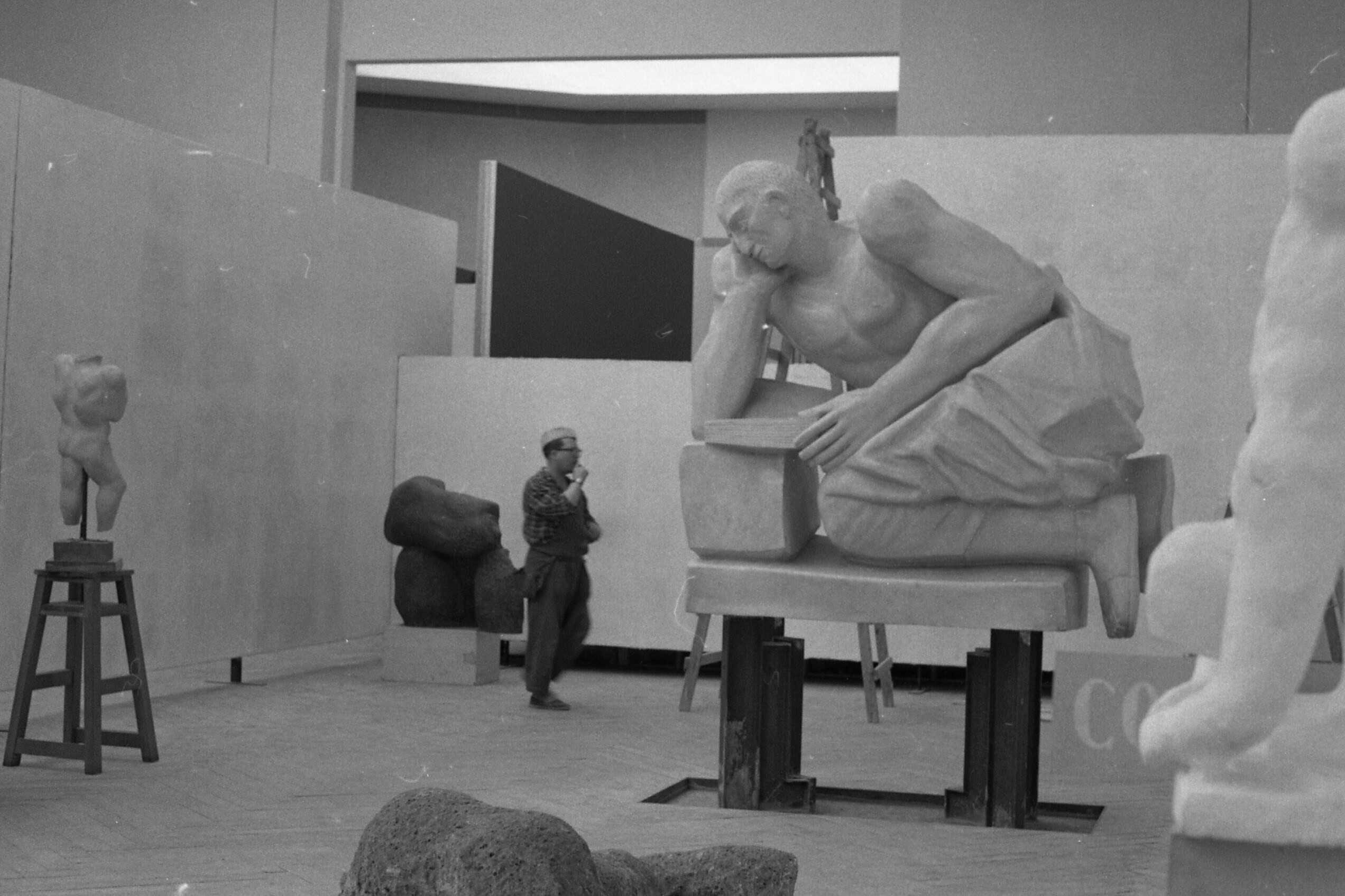 Works by Alberto Giacometti on display at the 1962 Venice Biennale. Image by Paolo Monti via Wikimedia Commons, licensed under CC BY-SA 4.0, cropped.
The label needs care because existentialism itself was never one unified doctrine. Gabriel Marcel introduced the term in 1943, but the thinkers later gathered beneath it did not form a consistent school. Among its central figures, Jean-Paul Sartre and Simone de Beauvoir were unusual in identifying themselves as existentialists.
A philosophical lens, not one visual style
No brushstroke, color, or subject automatically makes a work existentialist. The framework has been applied to thin, isolated figures, deformed bodies, enclosed rooms, gestural abstraction, sculpture, painting, and print narratives. That range makes the concept useful, but it also makes loose labeling easy.
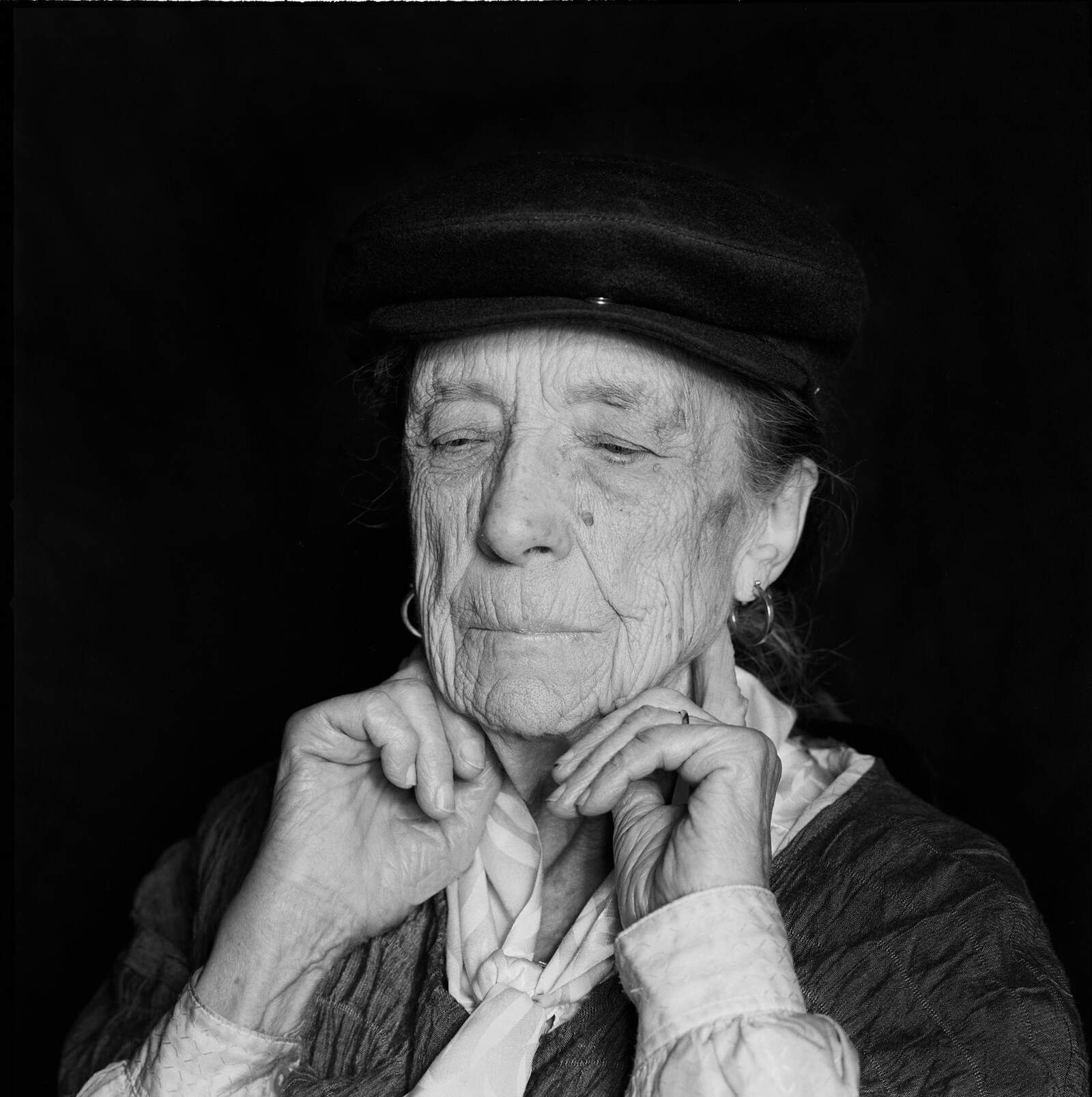 Louise Bourgeois in New York in 1996. Image by Oliver Mark via Wikimedia Commons, licensed under CC BY-SA 4.0.
Its reach includes abstract art when the interpretation focuses on embodied action, choice, material resistance, or the viewer’s encounter with an unfamiliar visual world. Historical evidence remains essential because these concerns do not create one shared style.
The ideas that matter when looking
Several philosophical ideas translate especially well into visual questions. “Existence precedes essence” means that a person is not born with a complete, predetermined identity. Identity takes shape through living and choosing. In front of an artwork, this idea can direct attention toward a figure caught in an unresolved situation rather than represented as a stable type.
Freedom, in this account, is never unlimited. People act from particular bodies, histories, places, and relationships. This is situated experience: the world appears from somewhere, not from a neutral position. Freedom therefore brings responsibility because a choice helps make the person who chooses it.
Authenticity means acknowledging that responsibility instead of hiding behind a fixed role or pretending there was no choice. “Being-for-others” describes another pressure. A person experiences other people not only as fellow subjects, but also through their judgments and objectifying gazes. Paintings and sculptures can stage that tension by controlling who looks, who is exposed, and who seems able to answer the look.
Existentialist aesthetics also treats art as a way to reveal or construct a world. An artist may act freely, but works through resistant materials, inherited signs, historical conditions, and expectations about an audience. Style is therefore more than decoration. A transformed viewpoint can reorganize what a body, room, or gesture means.
A three-level evidence ladder
A cautious attribution begins with documents and only then moves toward interpretation:
- Artist self-identification: The strongest level appears when an artist explicitly adopts the existentialist label or describes sustained engagement with its writers and ideas. Louise Bourgeois provides an unusually clear case.
- Documented exchange or contemporary framing: A recorded relationship between an artist and an existentialist thinker, or criticism written during the period, establishes a historical connection. Sartre’s writing for Giacometti belongs here.
- Later thematic interpretation: A viewer or critic may connect a work with freedom, isolation, the absence of a guaranteed script or necessary order, perception, or responsibility even when no direct affiliation is known. The reading can be illuminating, but it should remain an interpretation rather than a claim of membership.
This ladder prevents atmosphere from masquerading as proof. A dark painting may invite existential questions, but darkness alone says nothing about what its maker read, claimed, or intended.
How Existentialism Entered Modern Art
Existentialism reached its central cultural moment in mid-twentieth-century France, but it did not suddenly appear after World War II. Its longer intellectual background includes Søren Kierkegaard’s attention to individual choice, Friedrich Nietzsche’s challenge to inherited values, and phenomenology, the study of experience as it is lived from a particular viewpoint.
Nineteenth-century roots and phenomenology
These earlier sources supplied questions rather than a visual program. They asked how an individual confronts uncertainty, how meaning emerges without a guaranteed script, and how consciousness meets the world through a body. Later existential thinkers developed those problems in different and sometimes conflicting ways.
Phenomenology became particularly productive for art because looking is physical and situated. Distance, scale, movement, and viewpoint affect what a viewer can see. A sculpture may change as someone walks around it; a painting may place its spectator before a figure who appears to stare back. Maurice Merleau-Ponty’s emphasis on perception helped connect style with a transformed way of inhabiting and understanding the visible world.
Paris after World War II
World War II, mass death, and the atomic bomb gave questions about freedom, mortality, responsibility, and meaning unusual urgency. Existentialist writing became culturally prominent in this setting, while postwar artists searched for forms capable of addressing bodies and identities damaged by recent history.
A decisive art-historical junction came in 1948. For Alberto Giacometti’s first postwar solo exhibition at Pierre Matisse Gallery in New York, the artist asked Sartre to write the introduction. Sartre connected the sculptures with existentialism and humanism while attending to the spectator’s position and movement. This is more substantial evidence than a later resemblance based on mood: it records a direct intellectual exchange around the works at the time of their exhibition.
New York, Action painting, and New Images of Man
Existentialism also belonged to the intellectual atmosphere surrounding Abstract Expressionism, the varied American movement that developed during the 1940s and 1950s. Freedom offered critics an important connection, but the relationship was not a mass conversion to one philosophy. Willem de Kooning characterized it more as a shared mood than a direct influence.
Discussions of Action painting focused attention on artistic decisions made during creation. Pouring, sweeping, revising, and moving around a canvas could be interpreted as choices made within the limits of body and material. This helps explain why freedom became a critical link between existentialism and some accounts of Abstract Expressionism without making the movement an existentialist school.
Figurative art received a prominent institutional framing in 1959, when the Museum of Modern Art presented New Images of Man. The exhibition brought together 23 American and European artists. Its language emphasized solitude, anxiety, vulnerability, fate, and the human predicament, demonstrating how existential concerns helped museums and critics organize otherwise diverse postwar practices.
The framework survived that historical moment because its questions were not tied to one medium. Embodied perception, uncertain identity, responsibility, and the encounter between artwork and viewer remained available to later artists and audiences, even when the existentialist label itself became less culturally dominant.
How to Recognize an Existential Reading
Recognition does not mean matching an artwork to a fixed set of stylistic traits. It means gathering observable evidence, asking what those choices do, and checking whether documents or historical context support the interpretation. Four areas offer a practical starting point.
Body, distance, and exposed space
Begin with the body, or with whatever trace of a body the work provides. Is the figure elongated, fragmented, deformed, suspended, or reduced to a mark? Does it appear able to act, or does the surrounding space dominate it? These questions describe relationships rather than merely assigning an emotion.
Distance can carry meaning. An undersized figure on a large platform may seem unreachable, while a head thrust toward the spectator may turn viewing into confrontation. Giacometti and Francis Bacon repeatedly investigated human figures through deformation, fragmentation, physical tension, and enclosing structures, yet their distinct materials and working methods prevent those shared concerns from becoming a common style.
Cages, screens, and the viewer’s position
Look for spatial devices that regulate contact. Cages, shades, screens, arenas, platforms, and exaggerated gaps can separate one figure from another or block the spectator’s access. An enclosure may protect, imprison, display, or do several of these things at once.
Then notice where the work places you. Can you survey the scene safely, or does the composition make you feel watched and implicated? Does a barrier invite inspection while preventing entry? Existential interpretation becomes stronger when the work makes perception itself part of the problem, especially when historical writing confirms that viewpoint mattered to its original discussion.
Gesture, material, and the act of making
In an abstract work, the body may appear through evidence of action rather than a depicted person. Poured lines, handprints, rough modeling, revisions, and collisions between materials can register what happened during production. The viewer encounters decisions that remain visible in the object.
Chance does not erase agency. Paint may spread unpredictably, gravity may redirect a stream, and a material may resist the maker’s plan. What matters is the continuing exchange between intention and circumstance. This gives a concrete visual form to situated freedom: action occurs, but never in conditions created entirely by the actor.
What does not prove an existentialist connection
Dark color, solitude, violence, distortion, or anxiety cannot establish affiliation by themselves. Those qualities appear across many periods and movements. Nor does a postwar date automatically place an artist within an existentialist group.
A reliable reading should be able to answer three questions. What is visibly present? What documented relationship or historical context connects it to existentialism? Which part of the conclusion is interpretation? If only the first and third answers exist, describe the result as an existential reading, not an existentialist identity.
Four Works, Four Different Routes
The same viewing method can test materially different works. For each example, separate the object’s visible facts, its documented historical association, and the interpretation built from them. The strength and kind of attribution change from case to case.
Alberto Giacometti, The Nose, 1947 to 1949
The Nose suspends a skull-like head inside a metal cage. Hollow eyes withdraw into darkness, but the long nose projects beyond the grid. The work therefore sets opposing spatial pressures in motion: the head hangs captive while one feature crosses its boundary.
The cage does not function as a neutral display frame. It determines how the viewer approaches the head, measures its distance, and watches the nose break into surrounding space. The suspended body cannot leave, yet it is not contained completely. That unresolved relation between constraint and projection supports questions about agency, exposure, and the limits of a self.
The attribution rests on strong historical evidence. Giacometti asked Sartre to introduce his 1948 New York exhibition, and Sartre discussed the works through existentialism, humanism, distance, and the moving spectator. This does not turn every Giacometti sculpture into an illustration of Sartre, but it makes an existential reading of the postwar work historically grounded.
Francis Bacon, Painting, 1946
Bacon’s Painting is an oil-and-pastel work on linen measuring 197.8 by 132.1 centimeters. An anonymous public figure sits beneath an umbrella amid bunker-like window shades and suspended carcasses. The body appears caught within an arrangement that combines authority, display, flesh, and threat.
Unlike the projecting nose in Giacometti’s sculpture, Bacon’s figure seems pressed into a pictorial enclosure. The umbrella and shades divide the space, while the carcasses turn the surrounding flesh into something exhibited and vulnerable. The viewer faces the figure but receives no stable explanation of its role or setting.
An existential reading can focus on that trapped public identity, the body’s exposure, and the spectator’s uneasy position. The visible evidence is substantial, but the attribution is more interpretive than Giacometti’s documented exchange with Sartre or Bourgeois’s self-identification. Bacon should not be assigned to an invented existentialist membership list.
Jackson Pollock, Number 1A, 1948
Pollock’s Number 1A, 1948 measures 172.7 by 264.2 centimeters and combines oil with fluid commercial enamel. He worked around a canvas placed on the floor, allowing whole-body movement to direct poured and applied paint. Handprints interrupt the layered field as literal bodily traces.
No isolated figure appears, but the body remains present as evidence. Lines record changes of direction, differences in reach, and encounters between momentum, gravity, and the paint’s flow. The numbered title avoids supplying a narrative that would resolve those actions into a single story.
The existential connection belongs chiefly to historical context and criticism. Ideas of freedom circulated around Abstract Expressionism, and Action painting directed attention toward decisions made while creating the work. That setting can support an existential interpretation of agency and material constraint, but it does not prove Pollock adopted a complete existentialist position.
Louise Bourgeois, He Disappeared into Complete Silence, 1947
Bourgeois provides the clearest case of artist self-identification among these four examples. She rejected classification as a Surrealist in favor of the existentialist label and read Sartre, Beauvoir, and Albert Camus. She also named a sculpture after Sartre’s play No Exit.
In He Disappeared into Complete Silence, architectural images and paired narrative situations turn structures into settings for difficult human relations. Buildings suggest shelter and order, yet the stories frustrate easy communication or resolution. The viewer must negotiate the distance between an apparently stable construction and a human predicament that does not fit neatly inside it.
The work has been connected with meaningful choice and human frustration. Here, the visible tension between structures and stories aligns with the artist’s documented intellectual commitments. Self-identification does not dictate one final meaning, but it gives the existential attribution firmer footing than resemblance alone.
Existentialism Art vs Expressionism
Expressionism and existentialism can overlap, but they name different kinds of categories. Expressionism is a historical movement and style family. Existentialism is principally a philosophical and interpretive lens that can cross styles, media, and periods.
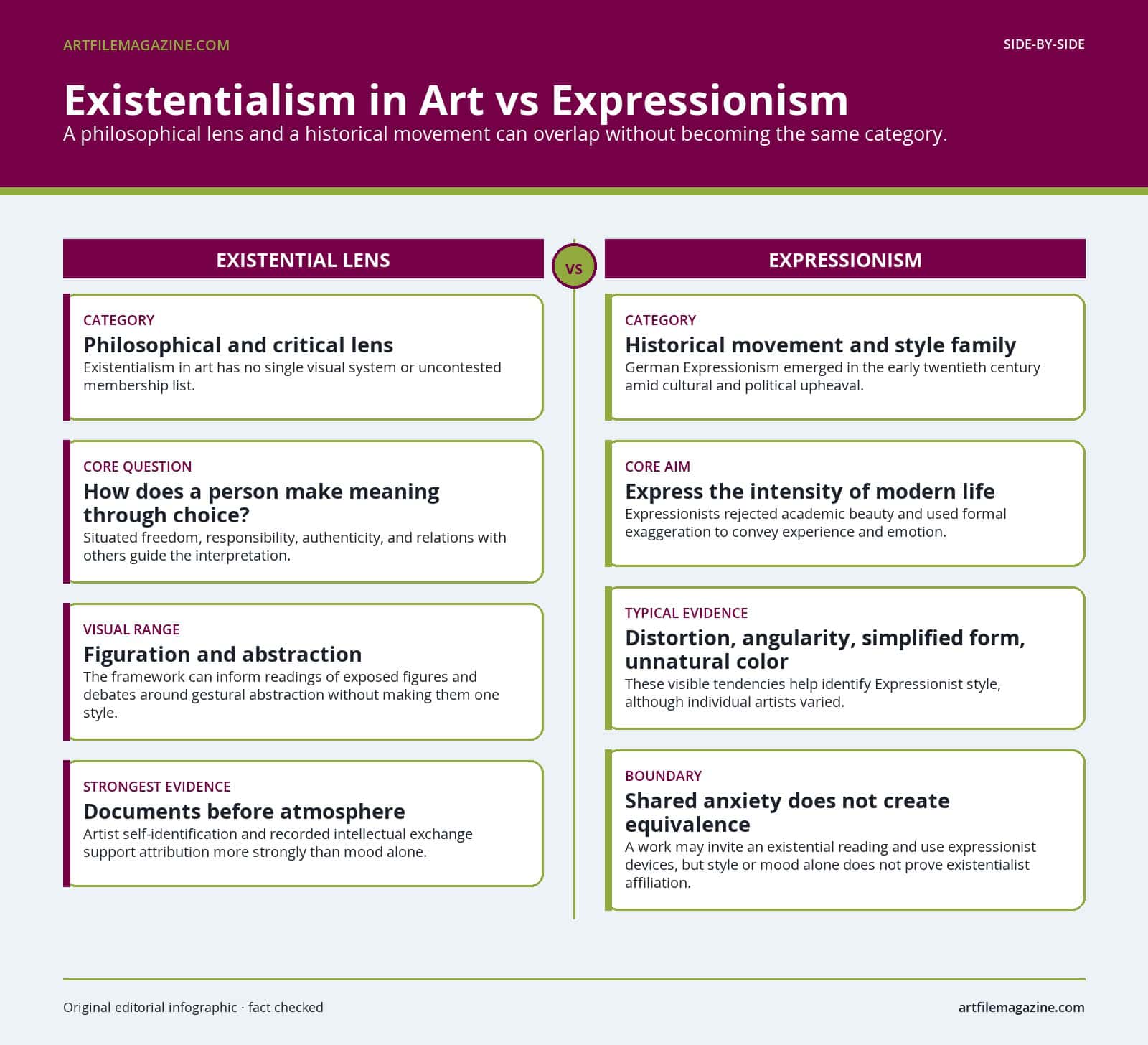
| Comparison | Existentialism in art | Expressionism |
|---|---|---|
| Category | A philosophical and critical lens without a single visual system or settled membership list | An early twentieth-century historical movement and style family |
| Strongest evidence | Artist self-identification, documented intellectual exchange, and contemporary framing | Historical context alongside common formal tendencies |
| Recognition | No visual feature proves the connection by itself | Bold distortion, angular simplified forms, and unnatural color are common clues |
| Boundary | Figurative and abstract works can both receive existential readings | Shared anxiety or distortion does not make Expressionism and existentialism equivalent |
Movement, style, and interpretive lens
German Expressionism emerged in the early twentieth century amid cultural and political upheaval. Artists rejected academic standards of beauty and commonly used bold distortion, simplified angular forms, and unnatural color. These visible tendencies help identify German Expressionism, even though its artists did not all work alike.
Existentialism prescribes no comparable set of formal devices. Its central questions concern situated freedom, responsibility, authenticity, perception, meaning, and relations with others. An existential reading might address an Expressionist portrait, a postwar sculpture, an architectural print, or a nonfigurative painting without claiming that they belong to one style.
Where the categories overlap
Both categories can address anxiety, disrupted identity, modern upheaval, and bodies under pressure. Distortion may help an artist reject ideal beauty while also presenting a person whose identity appears unstable. The overlap occurs in what a work can make perceptible, not in an automatic equivalence between the terms.
Abstract Expressionism creates a second source of confusion. It was a distinct American movement of the 1940s and 1950s, not the abstract branch of an existentialist movement. Existential ideas formed part of its critical environment, especially around freedom and artistic action, but its painters held varied positions and developed markedly different styles.
Why The Scream is a boundary example
Edvard Munch’s The Scream dates to 1893, decades before existentialism’s mid-twentieth-century French cultural moment. Its distorted figure, unstable space, and apparent crisis can support questions about isolation, perception, and the insecure self. Those questions make an existential interpretation possible.
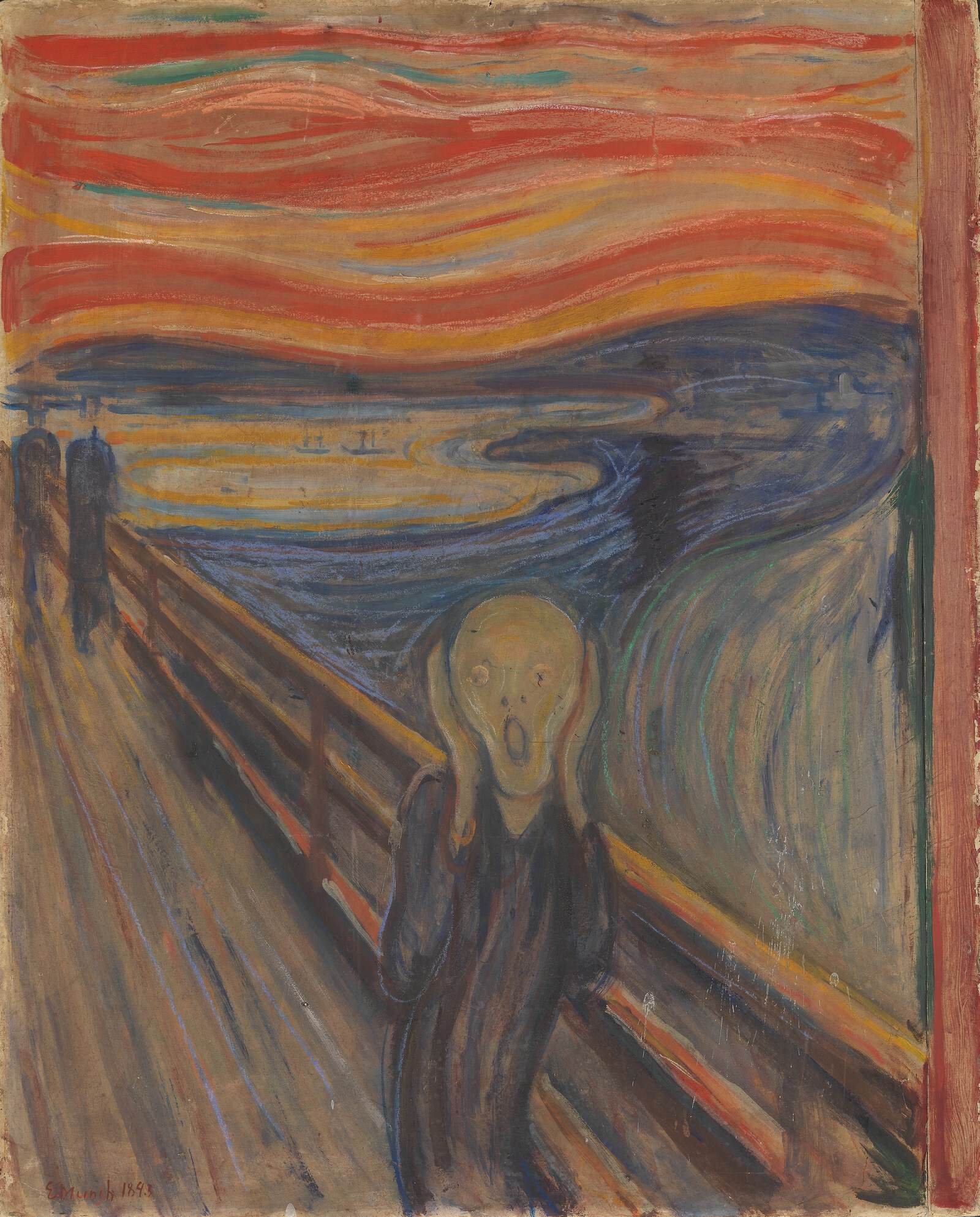 Edvard Munch’s The Scream (1893), made in oil, tempera, and pastel on cardboard. Image by Edvard Munch via Wikimedia Commons, licensed under Public domain.
The date prevents the painting from proving membership in a postwar existentialist art movement. It is better understood as a boundary or prehistory example: a work can illuminate concerns later associated with existentialism without belonging to a group that did not exist when it was made. The same distinction applies whenever thematic resemblance outruns historical evidence.
Legacy and Common Misreadings
Existentialist aesthetics outlived its postwar prominence because it offers more than an atmosphere of despair. It supplies ways to examine embodiment, perspective, material creation, responsibility, and the meeting between a work and its viewer. These questions can remain relevant even when an artist avoids the label.
A framework that outlived its postwar moment
The strongest later uses preserve the distinction between history and interpretation. A contemporary work may construct a world in which viewers confront limited choices or become aware of their own physical position. That makes an existential reading reasonable, but it does not justify calling its maker an existentialist without testimony, documented context, or careful critical qualification.
This restraint improves close looking. Instead of searching for a gloomy mood, ask what kind of world the work builds, where it places the viewer, and what actions it permits or blocks. The answers reveal how form carries an idea.
Three shortcuts to avoid
- Existentialism means despair: Anxiety and mortality matter, but so do freedom, responsibility, authenticity, perception, and the creation of meaning.
- Dark or distorted art is existentialist: Mood and style can begin an interpretation, but they cannot establish historical affiliation.
- Existentialism is another name for Expressionism: One is mainly a philosophical lens; the other is a historical movement and style family.
A productive final question is concrete: what does this work make a person do, choose, perceive, or become within the world it creates? That question keeps attention on the artwork while leaving room for evidence, uncertainty, and interpretation.
Frequently Asked Questions
Questions about these labels often come down to evidence. The answers below distinguish documented affiliation from later interpretation and keep existentialism separate from neighboring art movements.
Is existentialist art an art movement?
Not in the usual art-historical sense. The term covers philosophical influence, contemporary critical framing, artist self-identification, and later interpretation rather than one organized group with a uniform style.
Which artist called herself an existentialist?
Louise Bourgeois explicitly preferred the existentialist label to a Surrealist classification. Her reading of Sartre, Beauvoir, and Camus, along with her reference to No Exit, makes her association unusually well documented.
Is The Scream existentialist art?
It can receive an existential interpretation, particularly around isolation and unstable experience. Its 1893 date, however, makes it a precursor or boundary example rather than evidence of membership in a postwar existentialist movement.
How is existentialism in art different from Abstract Expressionism?
Existentialism is a philosophical and critical framework. Abstract Expressionism was an American art movement of the 1940s and 1950s. Existential ideas influenced part of its critical atmosphere, but the two terms are not interchangeable.

Jordan Anthony is a Cape Town-based film photographer, curator, and arts writer. She holds a Bachelor of Art in Fine Arts from the University of the Witwatersrand, Johannesburg, where she explored themes like healing, identity, dreams, and intuitive creation in her Contemporary art practice. Jordan has collaborated with various local art institutions, including the KZNSA Gallery in Durban, the Turbine Art Fair, and the Wits Art Museum. Her photography focuses on abstract color manipulations, portraiture, candid shots, and urban landscapes. She’s intrigued by philosophy, memory, and esotericism, drawing inspiration from Surrealism, Fluxus, and ancient civilizations, as well as childhood influences and found objects. Jordan is working for artfilemagazine since 2022 and writes blog posts about art history and photography.
Learn more about Jordan Anthony and about us.
Cite this Article
Jordan, Anthony, “Existentialism Art: Meaning, History, and Key Works.” artfilemagazine – Your Online Art Source. September 10, 2026. URL: https://artfilemagazine.com/existentialism-art/
Anthony, J. (2026, 10 September). Existentialism Art: Meaning, History, and Key Works. artfilemagazine – Your Online Art Source. https://artfilemagazine.com/existentialism-art/
Anthony, Jordan. “Existentialism Art: Meaning, History, and Key Works.” artfilemagazine – Your Online Art Source, September 10, 2026. https://artfilemagazine.com/existentialism-art/.