

Soir Bleu by Edward Hopper: Meaning, Facts and Context
A white-clad clown called Pierrot sits at the center of Edward Hopper’s Soir Bleu, impossible to miss yet strangely cut off from everyone nearby. The crowded café only grows less sociable the longer one looks. Following its colors, barriers, and broken lines of sight reveals how Hopper turned memories of Paris into an early study of urban disconnection.
| Artist: | Edward Hopper |
| Title: | Soir Bleu |
| Date: | 1914 |
| Medium: | Oil on canvas |
| Dimensions: | Overall 36 1/8 × 71 15/16 in. (91.8 × 182.7 cm); frame 42 7/16 × 78 1/4 × 3 in. (107.8 × 198.8 × 7.6 cm) |
| Accession number: | 70.1208 |
| Collection: | Whitney Museum of American Art, New York |
| Credit line: | Josephine N. Hopper Bequest |
| Object identity: | Finished oil painting, distinct from Un Maquereau (Study for Soir Bleu), accession 70.318 |
| Display status: | Not on view according to the Whitney record checked September 6, 2026 |
Why Hopper Painted a Paris Memory in New York
Soir Bleu looks like a report from a Parisian café terrace, but it was not painted there. Hopper completed the canvas in New York in 1914, four years after his final trip to Paris. Its setting is better understood as a construction from accumulated observation and memory than as a snapshot of one documented evening.
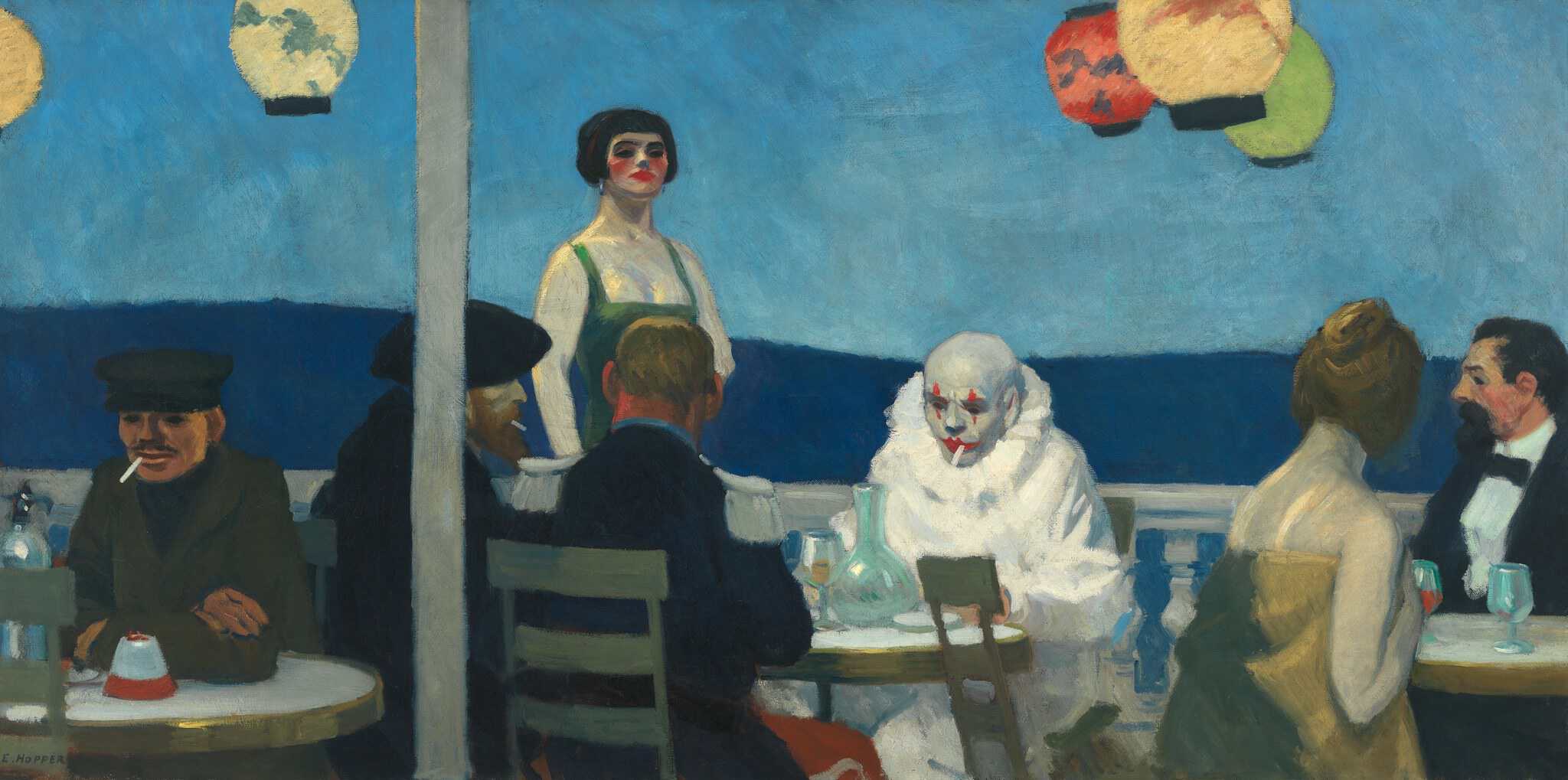 Edward Hopper’s Soir Bleu (1914), a wide Paris café scene centered on a white-clad Pierrot. Image by Edward Hopper via Wikimedia Commons, licensed under Public domain.
From Paris Notebooks to a New York Canvas
Hopper traveled to Paris three times between 1906 and 1910. His first stay lasted about ten months, giving him time to watch the city rather than merely pass through it. Letters and surviving sketchbooks record his attention to cafés, clothing, occupations, social class, and the ways people occupied public spaces.
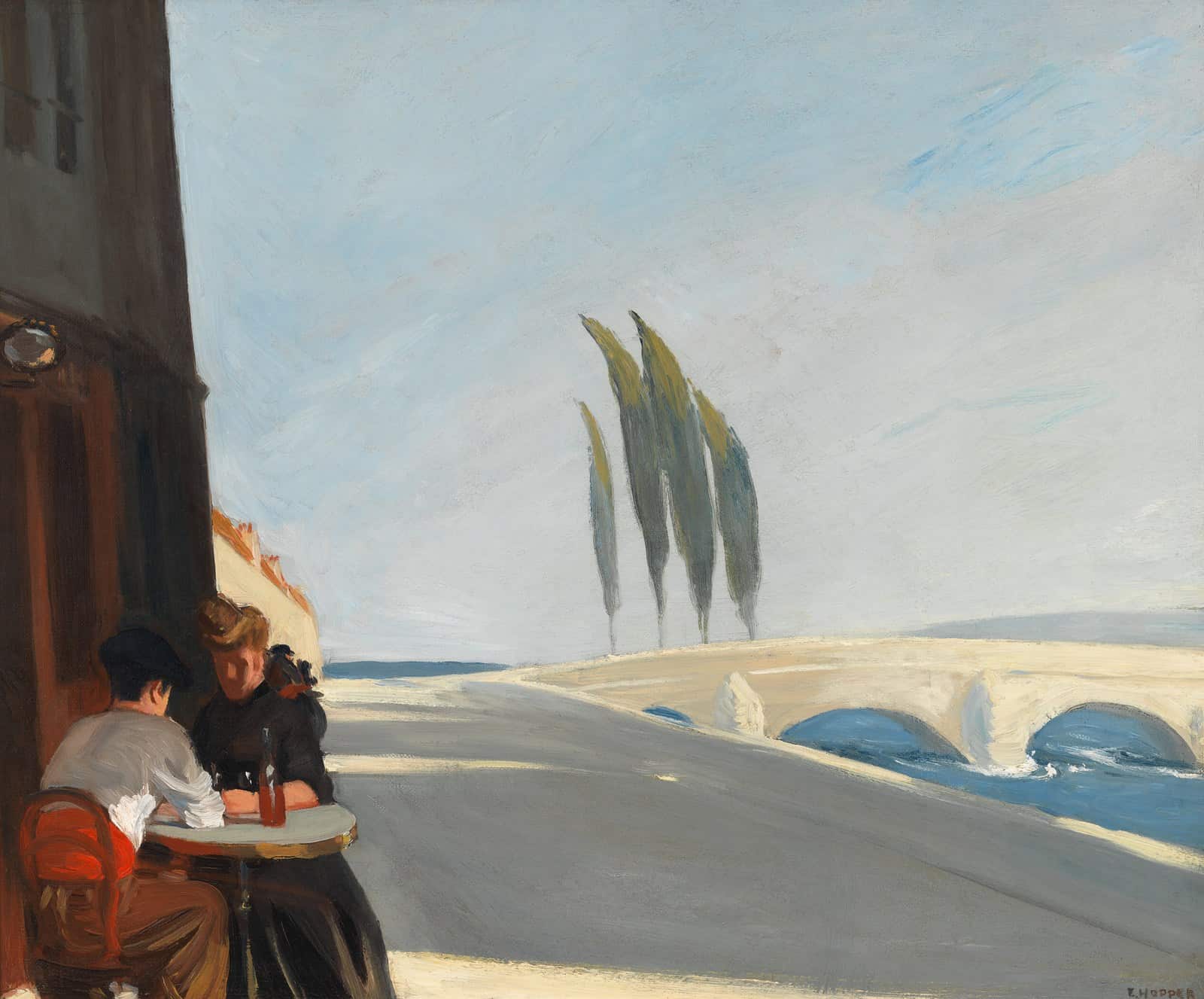 Edward Hopper’s Le Bistro or The Wine Shop (1909), painted during his Paris years. Image by Edward Hopper via Wikimedia Commons, licensed under Public domain.
Those notebooks supplied raw material for later work. Scholarship connected with the Whitney traces figures in Soir Bleu to types Hopper had drawn in Paris during 1906 and 1907. He did not simply enlarge one sketch. He selected, altered, and arranged remembered characters to create a seven-person group whose members share a terrace without forming a unified gathering.
This process also explains why the figures can feel both observed and staged. Individual details suggest people noticed in daily life, while the carefully spaced cast resembles a theatrical lineup. The scene belongs to Paris in subject but to Hopper’s New York studio in execution.
Why the Title Remains French
Soir Bleu literally means “blue evening.” It can also suggest the blue light of twilight, which suits a terrace illuminated by hanging globes while the background remains saturated with cool color. The canonical title is French, and translating it as Blue Evening is helpful for understanding the words but does not replace the museum title.
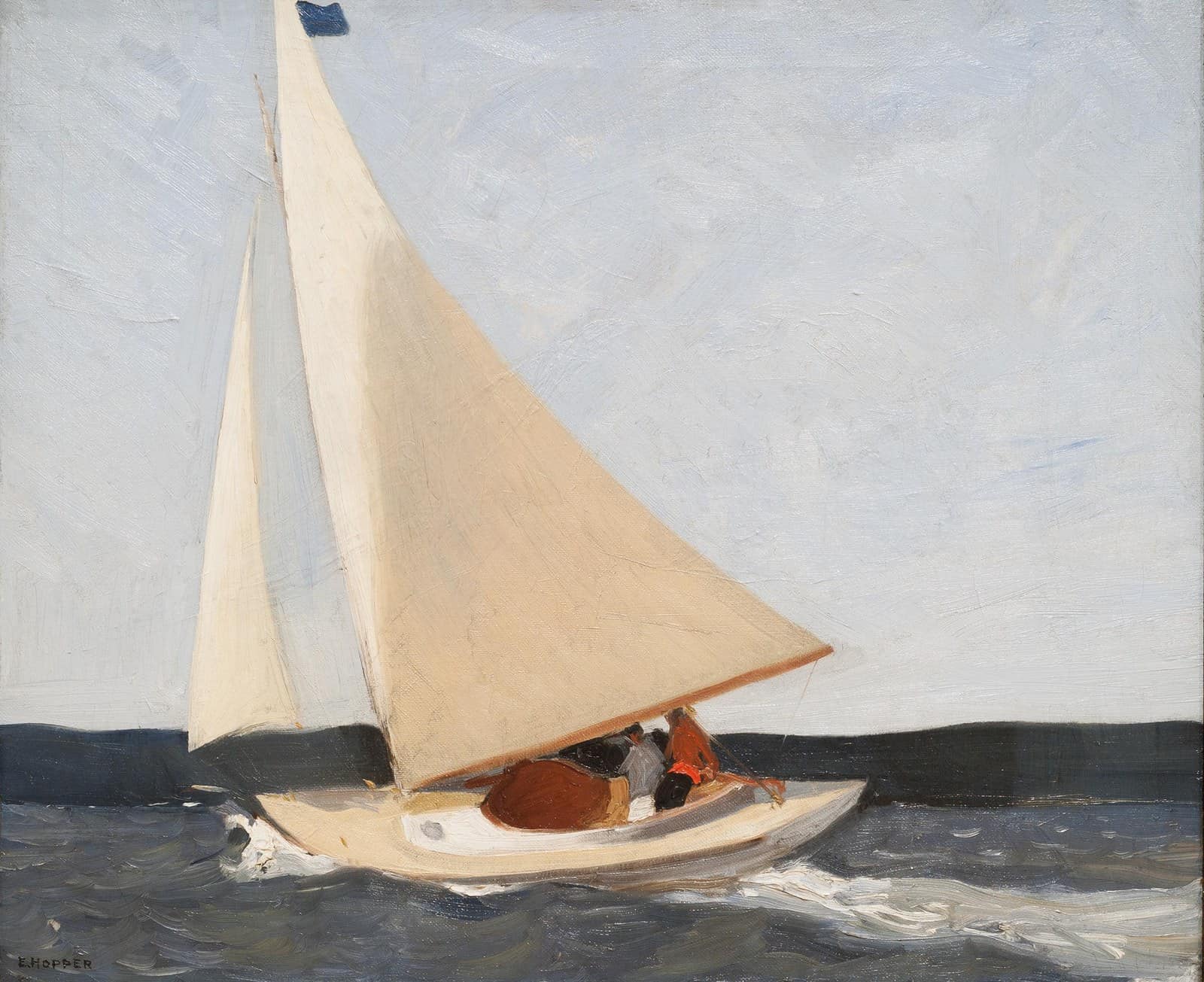 Edward Hopper’s Sailing (1911), sold at the 1913 Armory Show before he painted Soir Bleu. Image by Edward Hopper via Wikimedia Commons, licensed under Public domain.
The phrase has also been associated with Arthur Rimbaud’s poem Sensation. That literary connection offers a mood of evening, wandering, and longing, but the poem does not supply a documented one-to-one key for the seven figures.
The French title therefore does several jobs without settling the painting’s meaning. It preserves the remembered location, strengthens the twilight atmosphere, and keeps the scene slightly removed from Hopper’s New York surroundings. It is not evidence that he painted the canvas in France.
The timing matters. Hopper sold Sailing, a 1911 painting, at the 1913 Armory Show. The following year he completed the nearly six-foot-wide, seven-figure composition of Soir Bleu.
How to Look at Soir Bleu
The painting rewards a simple discipline: record what the composition does before deciding what its characters feel. Scale, divisions, repeated shapes, color, posture, and gaze all create the tension. Psychological terms such as loneliness become more persuasive after those visible choices have been identified.
Start With the Unusually Wide Canvas
The painted surface is almost twice as wide as it is tall. That proportion prevents the eye from taking in the group as a compact portrait. Looking becomes a lateral action, moving from the partly screened bearded profile at the left, through the pale Pierrot near the center, and toward the figures at the right.
Seven people occupy this long field. Six sit while one woman stands, and three table areas divide them into smaller clusters. The arrangement has the rhythm of a frieze, meaning a row of figures extended across a shallow horizontal band. Hopper disrupts that rhythm with gaps, overlapping bodies, and the standing figure’s change in height.
The viewpoint places the spectator across from the terrace rather than inside a conversational circle. We can inspect faces, costumes, and spacing, but no seat is offered to us. The width also means that one person can be physically near another while remaining compositionally tied to a different part of the canvas.
Follow the Post, Railing, Lanterns, and Tables
A vertical post near the left third is the first major interruption. It cuts through the terrace, partly screens the leftmost figure, and separates an edge group from the larger assembly. The balustrade then runs across the background as a firm horizontal boundary. Together, post and railing turn an open-air café into a divided visual structure.
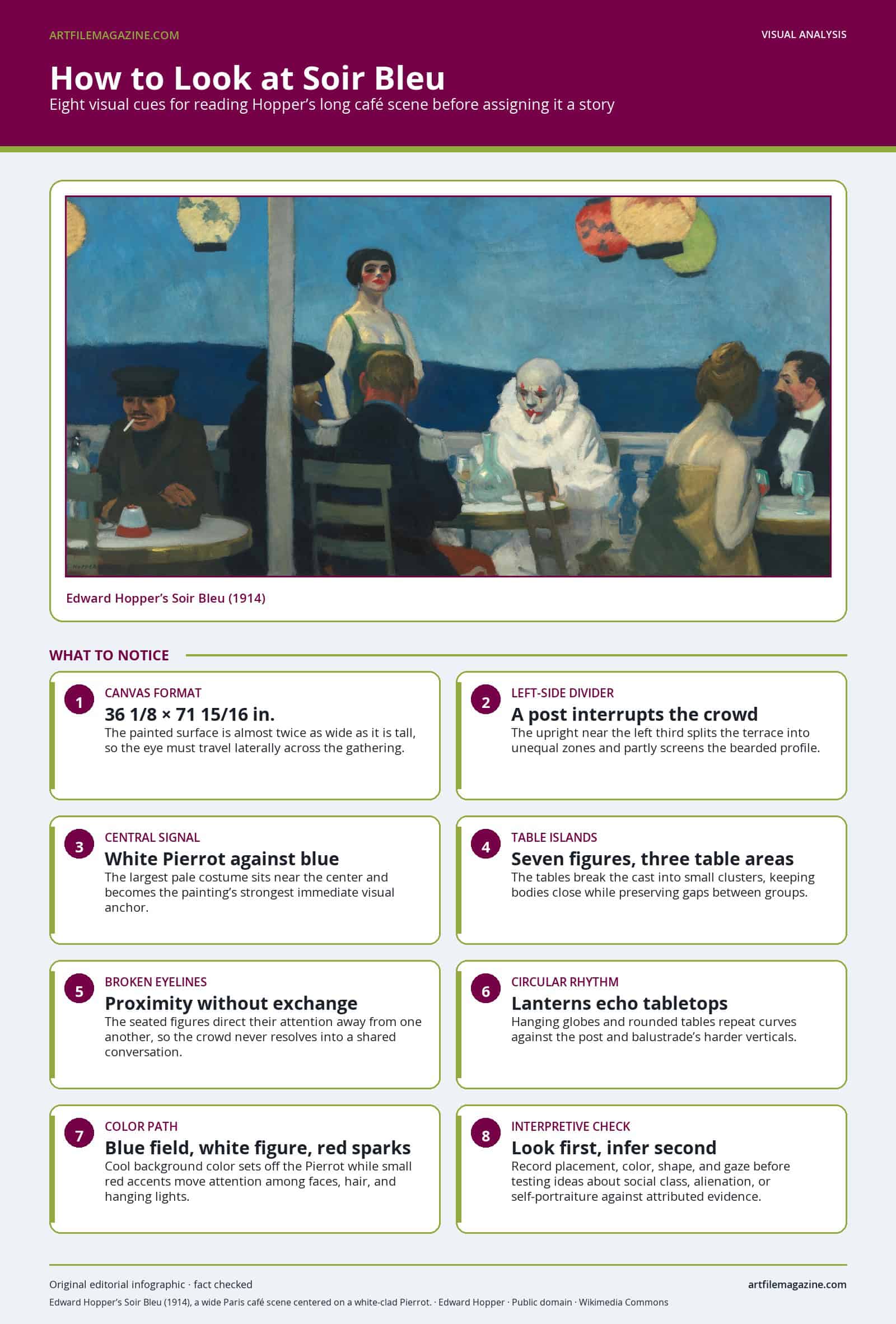
A four-step scan brings that structure into focus:
- Begin with the post and notice how it splits the crowd into unequal zones.
- Trace the balustrade behind the figures and watch how its straight line holds the scene together.
- Compare the rounded tables with the hanging globes above them. Their repeated circles create a rhythm across the wide canvas.
- Return to the people and note where table edges, gaps, and overlapping bodies separate one cluster from the next.
This framework makes the social effect easier to see. The tables provide places for company, but they also behave like islands. The lanterns provide public illumination, yet their separated globes reinforce the sequence of distinct zones. Objects associated with sociability help organize the lack of connection.
The oil paint contributes through broad masses of color. The Pierrot’s costume reads as a firm pale shape rather than a cloud of flickering light, while the blue background remains expansive enough to bind the whole terrace. Material, format, and composition work together: opaque white fixes the central figure, and the long blue field forces every other accent to compete across distance.
Watch the Color and Broken Eyelines
The Pierrot becomes the immediate visual anchor because his white clothing produces the strongest light-dark contrast near the center. He is not necessarily the narrative hero, but the composition makes him the hardest figure to ignore. His large pale form pushes forward against the cooler blues behind him.
Small red accents prevent the eye from stopping there. Warm notes appear around faces, hair, and the hanging lights, sending attention from one part of the terrace to another. The result is a color path rather than a single spotlight: blue establishes the field, white arrests the gaze, and red restarts its movement.
For a wider view of blue as a compositional force, readers can consult this guide to famous blue paintings. In Soir Bleu, however, the effect depends specifically on the relationship among the cool field, the central white costume, and the smaller red notes.
Posture and lines of sight complete the pattern. The seated figures do not exchange direct eye contact. Their heads point in different directions, and closeness never becomes a clearly shared conversation. The standing woman adds another body to the crowd without repairing those broken lines.
Only after observing that pattern does “alienation” become useful. It describes the effect produced by turned heads, table divisions, spatial barriers, and unequal color emphasis. It is an interpretation grounded in visible features, not a confirmed diagnosis of seven fictional people.
What the Scene May Mean
Soir Bleu has inspired several explanations, but they do not carry equal certainty. The café setting, seven-figure count, and compositional divisions are observable. Claims about social symbolism, self-portraiture, or private heartbreak depend on attributed readings and should remain open to challenge.
Social Types Without Social Contact
Art historian Rick Brettell described Soir Bleu as an unusually ambitious large-scale figure painting. He read its cast as an assortment of social types participating in urban entertainment while remaining alienated from one another. In this account, the café is a place where classes and occupations can occupy the same public setting without creating intimacy.
Brettell’s interpretation gains force from the structure. Hopper does not isolate one person in an empty room. He makes disconnection occur within a crowd, using posts, tables, gaps, and diverted attention to break a gathering into units. Entertainment is available, but collective pleasure is not visibly shared.
This distinction matters when placing the work within American Realism. The scene remains recognizable and socially specific, yet realism here does not mean a neutral record. Hopper edits observed types into an arrangement that makes modern public life feel organized and emotionally uncertain at once.
The Pierrot and the Limits of Autobiography
The central figure is Pierrot, a familiar French theatrical clown. His pale face and costume set him apart from the patrons in darker dress. That mismatch is visible; what it means remains open.
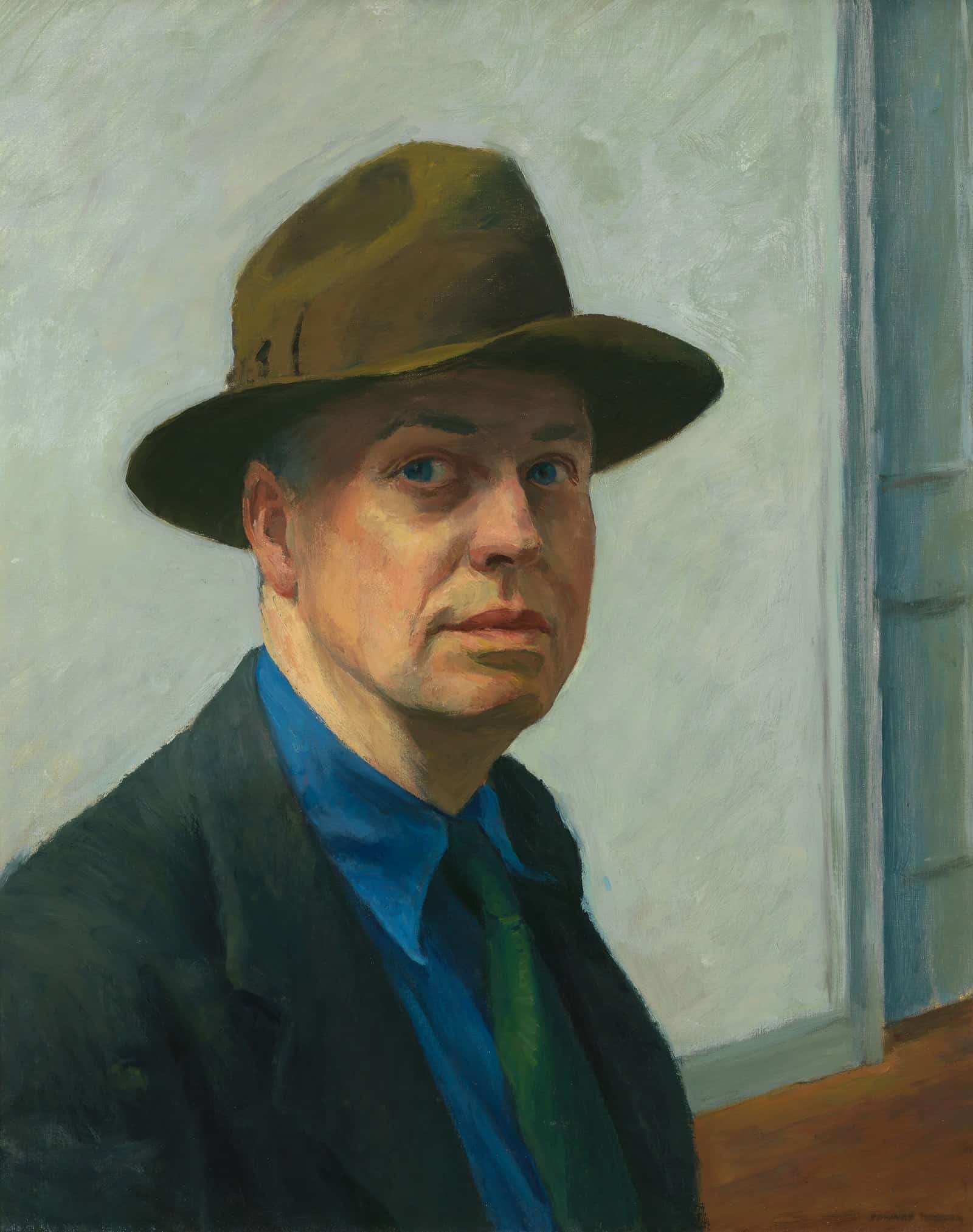 Edward Hopper’s Self-Portrait, painted around 1925 to 1930. Image by Edward Hopper via Wikimedia Commons, licensed under Public domain.
An exhibition text from the Thyssen and Grand Palais identifies this Pierrot as a self-portrait of Hopper. The reading is plausible enough to consider: the figure occupies a central position, looks conspicuously separate, and invites comparison with the artist. The identification remains an attributed museum interpretation, not an artist-confirmed fact. Resemblance and placement can support a reading, but they cannot prove intention.
Elizabeth Thompson Colleary proposed another biographical line. Her reading connects the painting’s emotional severity with Hopper learning that Alta Hilsdale had married while he was working on the canvas in 1914. That context may help explain why the scene has been understood in personal terms, but it remains a scholar’s interpretation rather than a verified cause of every compositional choice.
The Rimbaud association supplies a third path centered on twilight, movement, and longing. These readings can coexist because they address different levels of the painting. One considers public social types, another tests autobiography, and another examines literary atmosphere. None requires a secret code in which every person or object has one fixed meaning.
A cautious interpretation therefore begins with what can be seen. The Pierrot is central, pale, and visually detached. It is reasonable to ask whether he acts as Hopper’s surrogate, but more accurate to leave the answer attributed and unresolved.
From Rejection to the Whitney
The painting’s early exhibition history helps explain its unusual position in Hopper’s career. Its present museum identity also prevents two common errors: confusing ownership with gallery display and treating related material as another version of the finished canvas.
The 1915 Reviews and the Painting’s Long Silence
Hopper exhibited Soir Bleu at the MacDowell Club of New York in February 1915 alongside New York Corner. This was not the 1913 Armory Show. The work connected with that earlier event was Sailing, which Hopper sold there.
Contemporary reviewers preferred the American subject of New York Corner and responded poorly to the French café scene. An institutional chronology links that reception with Hopper’s subsequent retreat from French subjects in oil painting. The response mattered because it discouraged the direction represented by his large Paris-memory canvas.
A College Art Association review describes Soir Bleu as having been exhibited only once during Hopper’s lifetime. That supports the conclusion that the painting had a remarkably limited public life while he was alive. It does not establish exactly where the work was stored, whether it was rolled at a particular moment, or who later returned it to public attention.
The silence is especially striking because Brettell describes Soir Bleu as an unusually ambitious large-scale figure painting. Its size, seven-person cast, and controlled arrangement explain that characterization. The poor reviews did not make the canvas insignificant, but they sharply limited its documented exhibition history during Hopper’s lifetime.
The Whitney Record and Why the Outlier Matters
The Josephine N. Hopper Bequest placed the finished painting in the Whitney Museum of American Art, where it is controlled as accession 70.1208. That number identifies the exact 1914 oil on canvas discussed here. It should follow the title whenever confusion with studies or similarly named material is possible.
Taken together, the object and exhibition records explain why this specific work matters. Soir Bleu connects individual Paris observations to an ambitious seven-figure composition made in New York, then shows how an unfavorable 1915 response restricted its public life during Hopper’s lifetime.
Its scale, crowded cast, remembered Paris setting, and divided social space make it an outlier in Hopper’s development. At the same time, its controlled viewpoint and disconnected figures anticipate concerns that would become central to his later work.
The painting also offers a precise case of structure carrying social meaning. The post, railing, tables, lanterns, color contrasts, and diverted gazes divide a crowded public setting before any biographical explanation is applied. Its importance rests on that union of visible design, open interpretation, and consequential object history, not on a single hidden identity for the Pierrot.
Frequently Asked Questions
These three questions clarify the painting’s style, its unidentified cast, and Hopper’s earlier interest in café subjects.
Is Soir Bleu an Impressionist Painting?
It does not fit neatly under that label. Its cool color and Hopper’s encounters with French art make Degas and Impressionist painting relevant contexts, but its solid figures, clear contours, and staged social tension remain closely tied to realism.
Are the Seven Figures Portraits of Known People?
The cast is not securely documented as a group of seven named sitters. Brettell interprets the figures as varied social types, while other scholars have proposed personal meanings for particular figures. Those attributed readings do not establish a biography for every person shown.
Did Hopper Paint Café Subjects Before Soir Bleu?
Yes. Hopper’s 1909 painting Le Bistro or The Wine Shop predates Soir Bleu, so the café subject was already present in his work. The 1914 canvas is distinct in scale and construction, expanding the setting into a wide, seven-figure arrangement.

Jaycene-Fay Ravenscroft is a writer, poet, and creative based in South Africa, boasting over 6 years of experience working in a contemporary art gallery. She earned her Bachelor of Arts degree with majors in Art History and Ancient History from the University of South Africa, supplementing her studies with courses in Archaeology and Anthropology. Driven by a passion for learning, Jaycene-Fay finds inspiration in symbology and the interconnectedness of the world. Trained to analyze and critique art, she is enthusiastic about delving into the meanings behind each artwork, exploring its ties to the artist’s cultural, historical, and social context. Writing serves as Jaycene-Fay’s means of researching, sharing knowledge, and creatively expressing herself. For artfilemagazine, Jaycene-Fay writes articles on art history with a focus on historical paintings.
Learn more about Jaycene-Fay Ravenscroft and about us.
Cite this Article
Jaycene Fay, Ravenscroft, “Soir Bleu by Edward Hopper: Meaning, Facts and Context.” artfilemagazine – Your Online Art Source. September 18, 2026. URL: https://artfilemagazine.com/soir-bleu-by-edward-hopper/
Ravenscroft, J. (2026, 18 September). Soir Bleu by Edward Hopper: Meaning, Facts and Context. artfilemagazine – Your Online Art Source. https://artfilemagazine.com/soir-bleu-by-edward-hopper/
Ravenscroft, Jaycene Fay. “Soir Bleu by Edward Hopper: Meaning, Facts and Context.” artfilemagazine – Your Online Art Source, September 18, 2026. https://artfilemagazine.com/soir-bleu-by-edward-hopper/.