

The Stone Breakers by Courbet: Meaning, Scale, and Loss
A hammer rises over a roadside pile while a basket weighs against the back of a second worker whose face remains hidden. Gustave Courbet’s The Stone Breakers made this anonymous labor monumental, yet the original canvas is gone and survives only through records and reproductions. A close look reveals why its scale, cramped space, and rough paint mattered, while its wartime history clarifies what was destroyed and what still exists.
Key Facts
| Artist: | Gustave Courbet |
| Title: | The Stone Breakers; variants include The Stonebreakers, Les Casseurs de pierres, and Die Steinklopfer |
| Salon title: | Les casseurs de pierre (Doubs) |
| Date: | 1849 |
| Medium/support: | Oil on canvas |
| Dimensions: | 159 × 259 cm |
| Former collection: | Galerie Neue Meister, Staatliche Kunstsammlungen Dresden |
| Inventory number: | 2522 |
| Status: | Destroyed by fire in February 1945 during a wartime evacuation attempt |
| Separate work: | Not the surviving 56 × 65 cm painting in the Oskar Reinhart Collection, accession 1923.15 |
How Courbet Found the Subject
Courbet created The Stone Breakers during the period when he was bringing contemporary rural life into large public paintings. That choice became central to the Realism art movement, which rejected academic idealization in favor of subjects and physical details drawn from the artist’s own time.
The Roadside Encounter Near Maizières
In a letter assigned the date November 26, 1849, Courbet described meeting two men breaking stones on the road near Maizières. He saw the encounter as an image of poverty and asked the workers to pose in his studio the following morning. The account is unusually valuable because it connects an ordinary roadside observation directly to the painting’s creation.
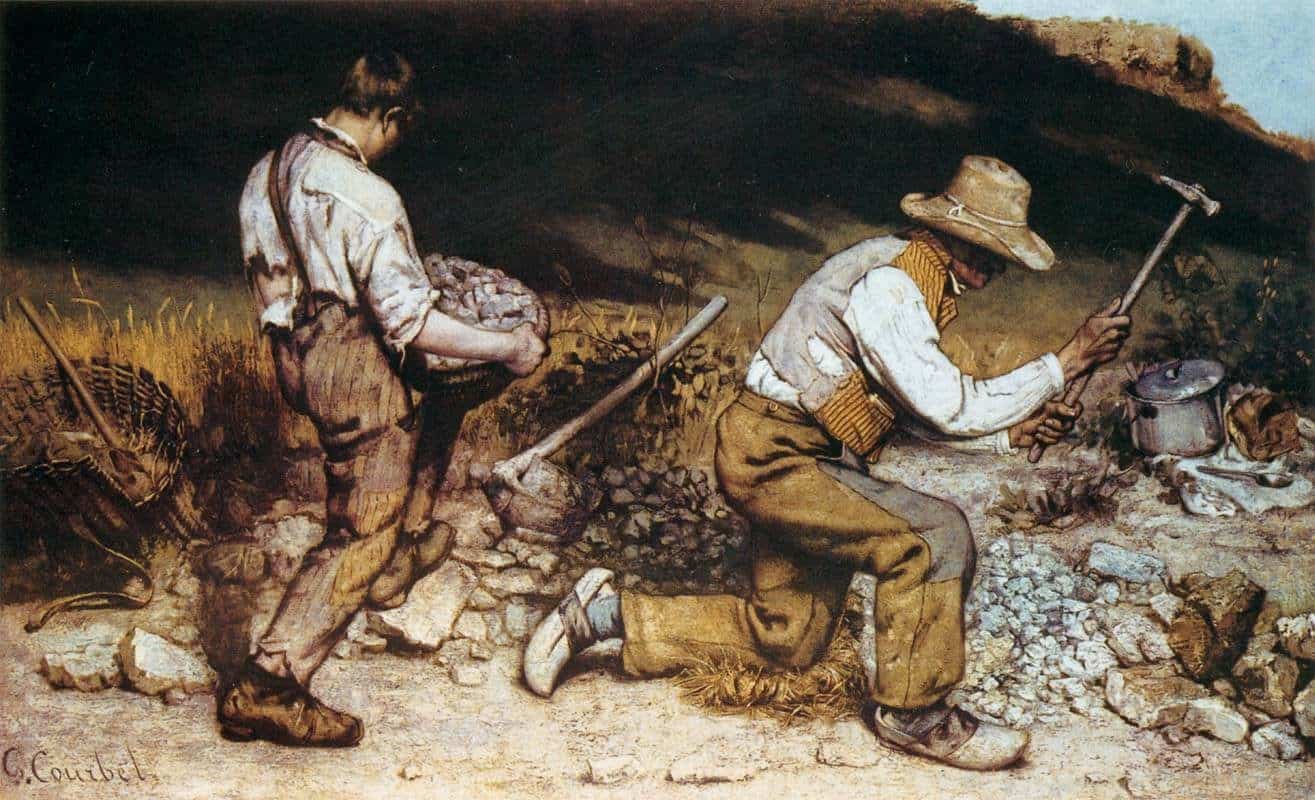 Gustave Courbet’s The Stone Breakers shows an older kneeling road worker and a younger standing worker carrying stone beside a steep roadside bank. Image by Gustave Courbet via Wikimedia Commons, licensed under Public domain.
Courbet described an older man, about 70, kneeling at his task and a younger worker standing with a load of stone. He noticed patched clothes, damaged footwear, the glare of bright sunlight, and equipment that included a hand barrow, hoe, carrying basket, and cooking pot.
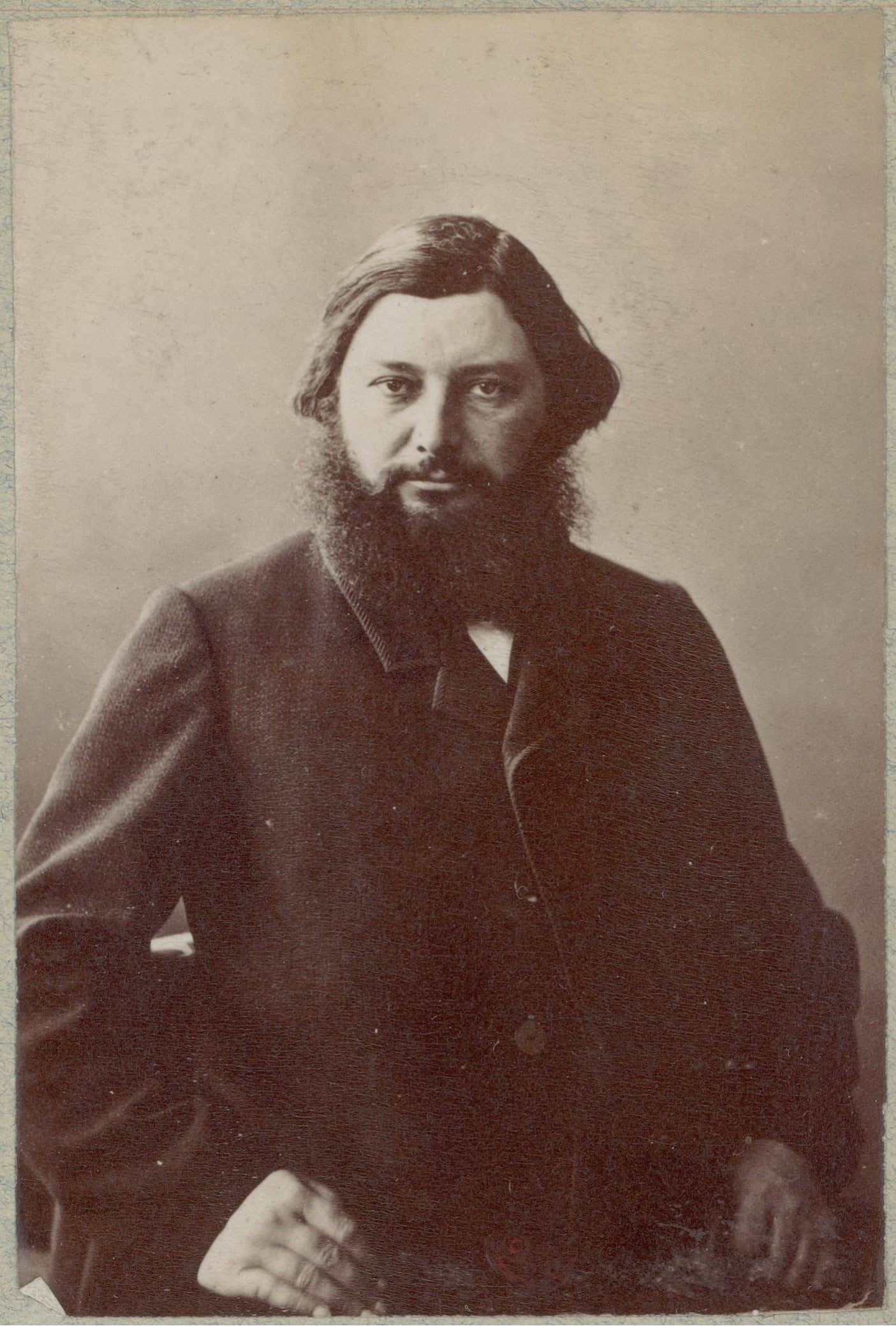 Gustave Courbet photographed in Nadar’s studio during the 1860s. Image by Nadar via Wikimedia Commons, licensed under Public domain.
The letter is still an artist’s account, not an objective transcript of the encounter. Its language tells us how Courbet chose to present the episode and how he wanted the two workers understood. It does not prove that every formal decision in the finished canvas followed a fixed political program.
From the 1849 Medal to the 1850 Salon
Courbet gained public recognition with After Dinner at Ornans, which received a medal at the Salon in 1849. Around his Salon breakthrough, he developed ambitious rural paintings that also included A Burial at Ornans and Peasants from Flagey Returning from the Fair.
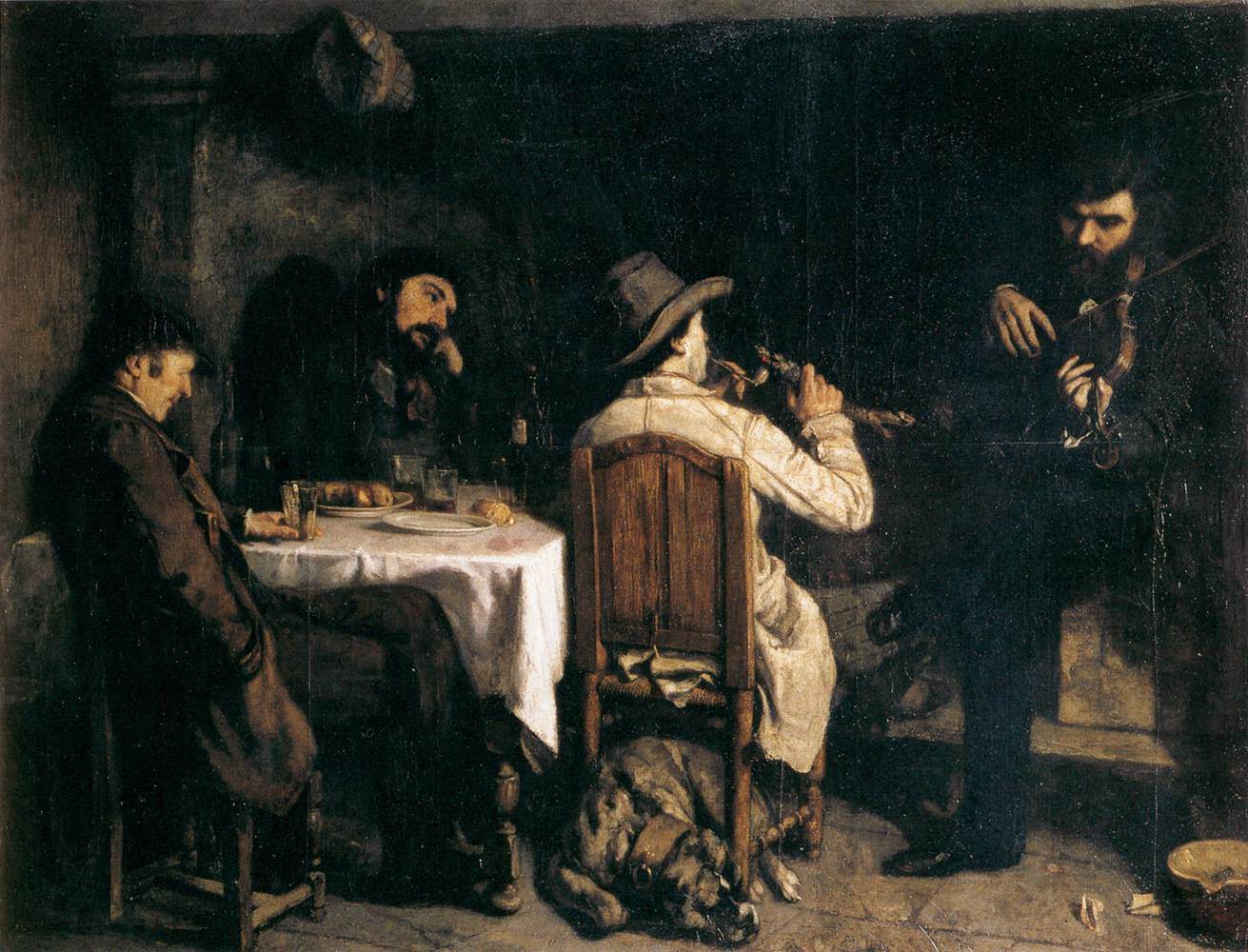 After Dinner at Ornans won a Salon medal in 1849, bringing Courbet public recognition shortly before he painted The Stone Breakers. Image by Gustave Courbet via Wikimedia Commons, licensed under Public domain.
The Stone Breakers appeared at the Paris Salon under the title Les casseurs de pierre (Doubs). It was painting number 663 in the catalogue for the exhibition that opened on December 30, 1850. The parenthetical “Doubs” formed part of the recorded Salon title.
By exhibiting the painting publicly at the Salon, Courbet presented contemporary road labor on a monumental scale alongside rural works that challenged conventional hierarchies of subject matter.
How to Look at The Stone Breakers
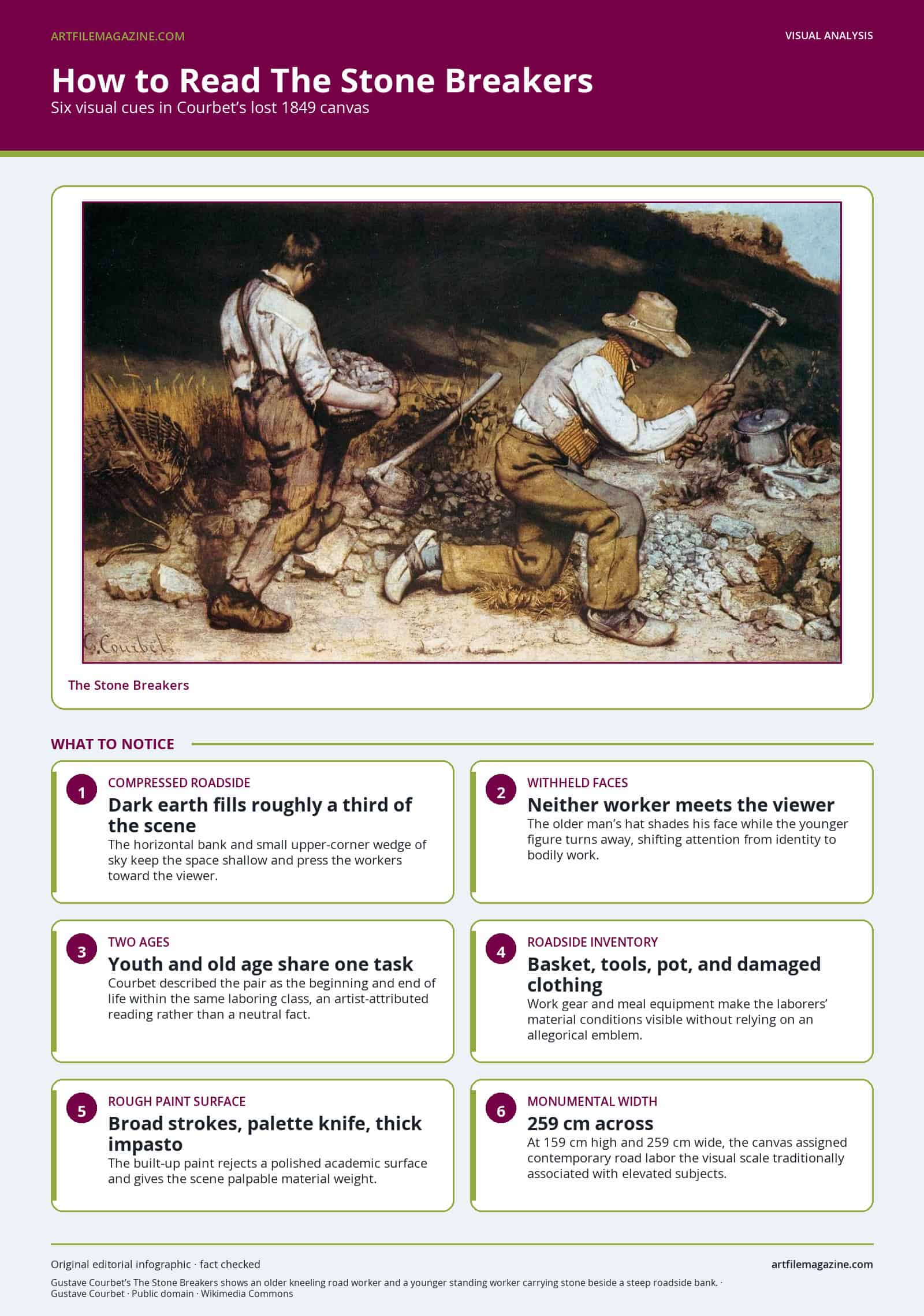
The familiar reproduction can initially seem straightforward: one man breaks rock while another carries it away. Courbet complicates that simple action through compressed space, inaccessible faces, scattered equipment, and a surface that refuses to make hard labor look smooth.
A Shallow Space With Nowhere to Escape
A dark roadside bank stretches across much of the composition and occupies roughly a third of the scene. Only a small wedge of sky opens above it. Rather than allowing the eye to travel into a distant landscape, the bank presses the figures, stones, tools, and viewer into the same shallow zone.
This arrangement makes the workers feel physically close, but it does not invite social intimacy. There is no broad view that would turn the labor into a picturesque country scene. The painting keeps returning the eye to a confined strip of road where the task is already underway and appears likely to continue beyond the depicted moment.
Bodies Shown Through Labor, Not Likeness
The older worker kneels with his hammer while the younger figure turns away under a load of stone. A hat shades the kneeling man’s face, and the standing worker presents his back. Neither offers the direct gaze or clearly modeled features through which a conventional portrait establishes personality.
That withholding redirects attention toward bent limbs, weight, balance, and repetition. The men become legible through what their bodies are doing. It is reasonable to read this anonymity as emphasizing a wider condition of labor, but the hidden faces alone cannot prove that Courbet intended to erase the workers’ individuality.
Tools, Food, and Patched Clothing
The roadside is crowded with practical objects: a basket or hod for carrying stone, a hand barrow, a hoe, a discarded pick, and a pot associated with the workers’ meal. A satchel and damaged clothing extend the subject beyond the single swing of a hammer. Work, food, movement, and rest all appear governed by the same exposed setting.
Clothing makes economic conditions visible without requiring an allegorical symbol. Patches, worn shoes, corduroy, and soiled linen describe use rather than costume. An 1851 reviewer who disliked the absence of faces and conventional beauty nevertheless praised the truthful rendering of these materials. Even hostile criticism therefore recognized Courbet’s attention to the workers’ physical circumstances.
When Paint Itself Feels Rough
Courbet used broad strokes, palette-knife handling, and impasto, meaning paint applied thickly enough to create a raised surface. Such handling resisted the polished finish expected in academic exhibition painting. Scholars have linked this rough surface to the material character of the stone, earth, fabric, and labor represented in the scene.
The original no longer survives, so present-day viewers must be cautious about claims involving exact color, texture, or condition. Historical reproductions preserve the composition and substantial visual information, but they cannot fully convey the scale or physical presence of nearly three meters of painted canvas.
Why the Painting Unsettled the Salon
The Stone Breakers challenged convention through several choices acting together. The subject was contemporary manual labor, the format was monumental, the figures lacked idealized beauty, the space felt constricted, and the paint surface remained visibly worked.
The Scale of History Painting Without a Hero
At 259 centimeters across, the canvas assigned road workers a visual scale associated with historical, religious, and mythological subjects. Courbet did not transform the men into named heroes or place them at a dramatic climax. They perform repetitive work whose significance comes from its ordinary material reality.
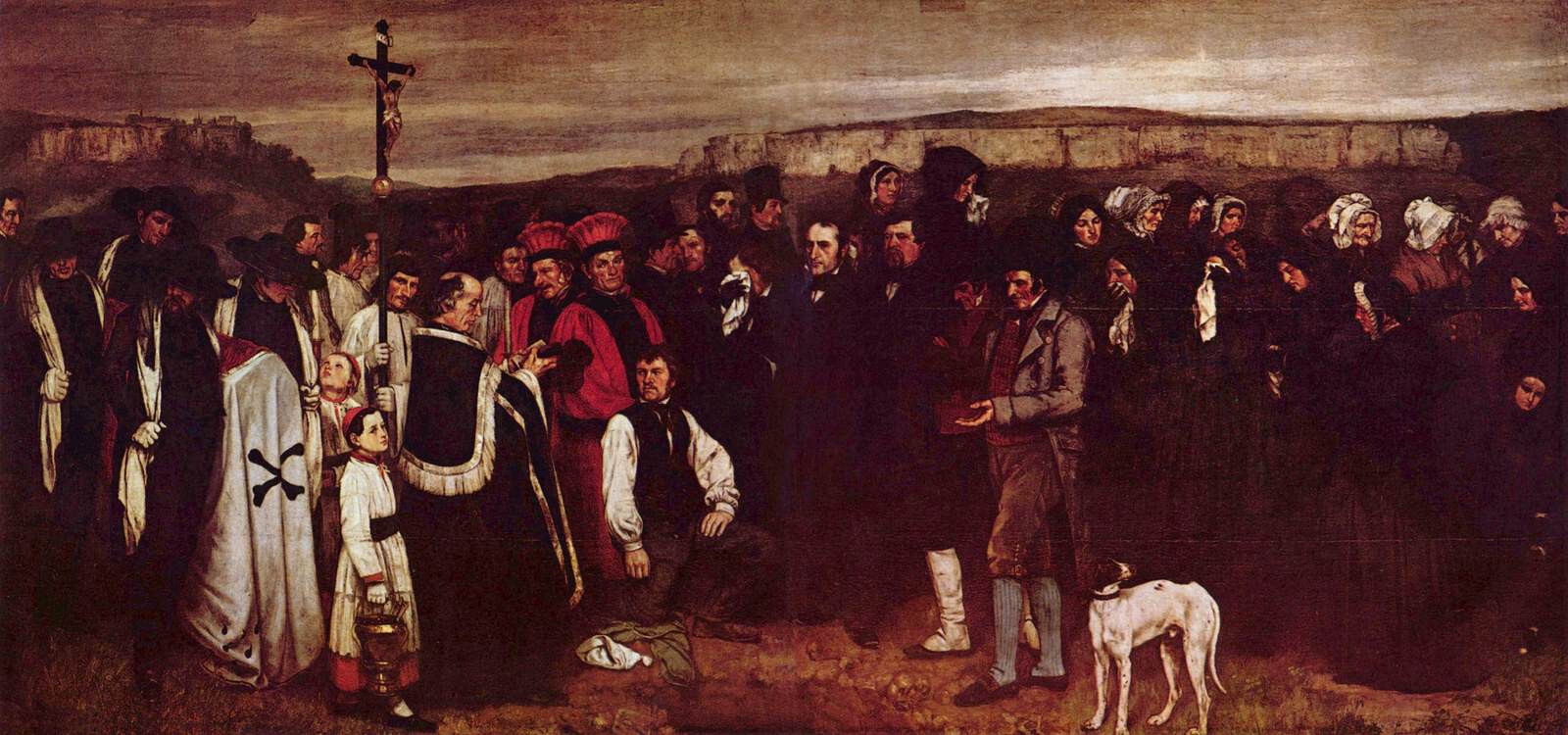 Gustave Courbet 003. A Burial at Ornans Alternative title(s): Painting of Human Figures, the History of a Burial at Ornans Un enterrement à Ornans, dit aussi Tableau de figures humaines, historique d’un enterrement à Orn. Image by Toulouse via Wikimedia Commons, licensed under Public domain.
This was also the larger strategy behind Courbet’s rural Salon group. A Burial at Ornans gave a provincial funeral panoramic breadth, while Peasants from Flagey Returning from the Fair spread contemporary country figures across another large canvas. Among famous Realism paintings, these works remain useful examples of how scale could disrupt the inherited ranking of subjects.
The disturbance therefore did not come from poverty as a theme alone. Small scenes of ordinary people already existed. Courbet’s sharper challenge was to make such people occupy the kind of wall space and public attention normally reserved for elevated narratives.
What a Hostile Review Reveals
Frances de Peyronnet’s 1851 response exposes the expectations Courbet violated. The reviewer admired the accuracy of the corduroys, wooden shoes, and dirty linen but objected that the workers’ faces could not be seen and that the scene offered no conventional beauty. Truthful detail was acceptable up to the point where it displaced idealization.
The criticism also shows why calling the controversy a simple battle between realism and beauty is inadequate. Face, pose, finish, scale, and subject worked together. Courbet denied viewers an expressive hero, a reassuring landscape, and a polished surface, yet demanded that they confront the workers on a monumental canvas.
What Does The Stone Breakers Mean?
Three levels should remain distinct. The first is what the painting visibly shows. The second is the meaning Courbet supplied in his letter. The third consists of later political interpretations, including the influential reading offered by Pierre-Joseph Proudhon.
Courbet’s Poverty and Life-Cycle Framing
The observable facts are two workers of different ages performing related stages of the same road labor under materially poor conditions. The older man breaks stone; the younger one carries it. Their clothes and equipment register wear, while the composition provides no narrative rescue or visible reward.
Courbet went further in his 1849 letter. He presented the two ages as the beginning and end of life within the same impoverished social class. On his own account, youth does not signal advancement and old age does not bring release. The pairing turns one roadside task into a compressed life cycle.
Because this interpretation comes from Courbet, it carries more evidentiary weight than a later guess about his private intentions. Even so, the letter addressed a particular recipient and occasion. It can guide interpretation without serving as a complete key to every feature in the painting.
Proudhon’s Later Social Critique
In 1865, Proudhon interpreted The Stone Breakers as an indictment of an industrial civilization that had failed to free people from brutal manual labor. His reading sharpened the picture into a broad social argument. It remains historically important, but it was published about 16 years after Courbet painted the work.
The distinction in dates prevents a common shortcut. Proudhon’s analysis demonstrates how the painting could be understood within a socialist critique; it does not document Courbet’s exact thoughts in 1849. The artist’s own letter emphasizes poverty and a life spent within the same class, while Proudhon converts those observations into a more explicit theory of society.
Where Interpretation Must Remain Conditional
The concealed faces can suggest anonymity, repetition, or dehumanization. The shallow space can feel trapping, and the pairing of ages can imply that the labor offers no route forward. These readings are grounded in visible features, but words such as “trapping” and “dehumanization” describe effects perceived by viewers, not measurable properties of the canvas.
It is similarly too simple to label the work socialist propaganda. Courbet’s political associations and artistic motives were complex, and the painting contains no slogan or prescribed solution. Its force comes partly from that openness: it makes poor labor impossible to overlook while leaving the viewer to confront how observation, sympathy, and political judgment relate.
How the Original Painting Was Lost
The phrase “destroyed in Dresden” is accurate only in a broad sense. The canvas did not simply burn while hanging in a museum. Its loss occurred during a failed attempt to move threatened works near the end of the Second World War.
The Failed Evacuation Through Dresden
On February 13, 1945, The Stone Breakers was among 154 paintings scheduled for transfer from Schloss Milkel to Schloss Schieritz. Blocked roads prevented the intended route, forcing the convoy through Dresden. The trailer carrying the paintings remained at Terrassenufer.
The trailer and its contents burned during the air raids that night. This sequence identifies the canvas as a wartime transport loss rather than a work destroyed inside its normal gallery setting. The former Dresden inventory number, 2522, now identifies a lost museum object rather than a painting that can be visited.
What Survives Is a Record, Not the Canvas
Photographs, reproductions, catalogues, and collection records preserve knowledge of the monumental composition. They allow viewers to identify the figures, tools, and spatial arrangement. They do not restore the physical object or supply a current gallery location.
This difference matters most when discussing color and surface. A reproduction can shift tones, flatten impasto, and drastically reduce scale. Close reading remains possible, but seeing a digital image is not equivalent to standing before the original oil painting.
The Smaller Stone Breakers Is a Different Work
The Oskar Reinhart Collection holds a separate painting by Courbet also associated with the stone-breaker subject. Dated around 1849, it is an oil on canvas measuring 56 × 65 cm and carries accession number 1923.15. Those dimensions alone distinguish it decisively from the lost Dresden canvas, which measured 159 × 259 cm.
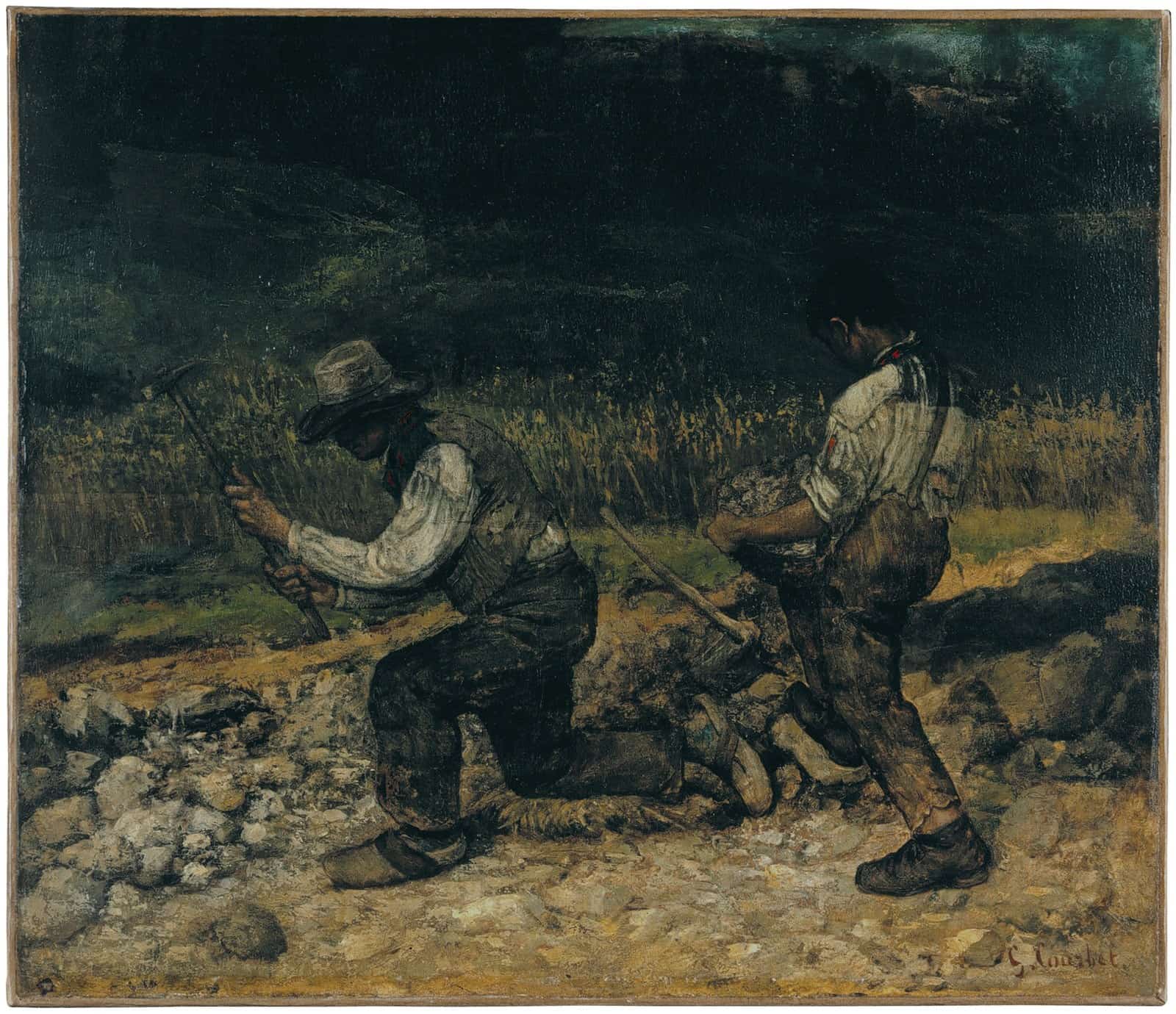 Courbet’s smaller 1849 Stone Breakers in the Oskar Reinhart Collection is a separate surviving painting, not the lost Dresden canvas. Image by Gustave Courbet via Wikimedia Commons, licensed under Public domain.
The smaller work is not the monumental original recovered after the war. Nor should a reproduction of it be captioned as Dresden’s inventory 2522. The two paintings have related titles and subject matter, but their collection records and physical measurements establish separate object identities.
A quick recognition check prevents the error: look for the collection name and measurements in a caption. “Oskar Reinhart,” “56 × 65 cm,” or “1923.15” identifies the smaller surviving painting. “Dresden,” “159 × 259 cm,” or “2522” identifies the original destroyed in 1945.
Why the Work Still Matters
Courbet made labor monumental without converting the laborers into celebrities, saints, or heroes. Their bodies dominate the format, but their faces remain unavailable. Their possessions and damaged clothes receive close attention, but no sentimental anecdote explains how the viewer should feel about them.
That balance is the painting’s lasting formal achievement. Scale demands attention, compressed space blocks picturesque escape, and rough paint keeps the image materially present. Within the wider development of changing art styles, Courbet’s intervention shows that subject matter and technique can challenge convention at the same time.
The painting’s destruction adds another responsibility. Understanding it now requires careful object identification as well as interpretation. Title variants, disputed measurements, historical reproductions, and a separate smaller painting can easily blur together. Keeping those records straight does more than correct a caption; it preserves the particular artistic decision Courbet made when he placed two road workers across a canvas 259 centimeters wide.
Frequently Asked Questions
These short answers resolve the most common points of confusion surrounding Courbet’s lost painting.
Where Is The Stone Breakers Today?
The original has no current physical location. It was destroyed when a trailer carrying evacuated museum paintings burned at Terrassenufer in Dresden during the air raids of February 13, 1945. Museums and publications show historical reproductions rather than the canvas itself.
Why Can’t Viewers See the Workers’ Faces?
The older man’s hat obscures his face, while the younger worker turns away. This directs attention toward their actions, bodies, clothing, and shared labor. Anonymity and dehumanization are plausible interpretations of that choice, but Courbet’s precise motive cannot be proven from the hidden faces alone.
Was The Stone Breakers a Socialist Painting?
Courbet described the two workers as the beginning and end of life within the same poor class. Proudhon later gave the painting an explicit socialist interpretation in 1865. That later reading is influential, but it should not be mistaken for complete evidence of Courbet’s intentions in 1849.
How Large Was the Original Painting?
Dresden inventory 2522 was recorded at 159 × 259 cm, though other measurements circulate. The canvas was therefore nearly 2.6 meters wide.
Is the Oskar Reinhart Painting the Same Work?
No. The Oskar Reinhart painting is a separate oil on canvas measuring 56 × 65 cm and dated around 1849. It survives, whereas Dresden’s much larger canvas, inventory number 2522, was destroyed in 1945.

Jordan Anthony is a Cape Town-based film photographer, curator, and arts writer. She holds a Bachelor of Art in Fine Arts from the University of the Witwatersrand, Johannesburg, where she explored themes like healing, identity, dreams, and intuitive creation in her Contemporary art practice. Jordan has collaborated with various local art institutions, including the KZNSA Gallery in Durban, the Turbine Art Fair, and the Wits Art Museum. Her photography focuses on abstract color manipulations, portraiture, candid shots, and urban landscapes. She’s intrigued by philosophy, memory, and esotericism, drawing inspiration from Surrealism, Fluxus, and ancient civilizations, as well as childhood influences and found objects. Jordan is working for artfilemagazine since 2022 and writes blog posts about art history and photography.
Learn more about Jordan Anthony and about us.
Cite this Article
Jordan, Anthony, “The Stone Breakers by Courbet: Meaning, Scale, and Loss.” artfilemagazine – Your Online Art Source. September 9, 2026. URL: https://artfilemagazine.com/the-stone-breakers-gustave-courbet/
Anthony, J. (2026, 9 September). The Stone Breakers by Courbet: Meaning, Scale, and Loss. artfilemagazine – Your Online Art Source. https://artfilemagazine.com/the-stone-breakers-gustave-courbet/
Anthony, Jordan. “The Stone Breakers by Courbet: Meaning, Scale, and Loss.” artfilemagazine – Your Online Art Source, September 9, 2026. https://artfilemagazine.com/the-stone-breakers-gustave-courbet/.