

Water Serpents II by Gustav Klimt: Meaning and History
Four women drift through Water Serpents II, yet their bodies are only the beginning of what the painting asks us to see. Hair, fish, flowers, circles, and curling gold details turn the wide canvas into a current that seems to carry figures and ornament together. Following that current reveals a work Klimt repeatedly revised, an intimate scene whose meaning remains open, and a difficult ownership history that still affects where it can be seen.
| Artist: | Gustav Klimt |
| Title: | Water Serpents II |
| Title variants: | Water Snakes II; Wasserschlangen II; Wasserschlangen II (Freundinnen) |
| Date: | Begun in 1904; substantially reworked in 1906-07 and adjusted before its 1908 exhibition |
| Medium/support: | Oil on canvas |
| Dimensions: | 80 × 145 cm |
| Collection: | Private collection; courtesy of HomeArt for the 2023 Belvedere loan |
| Accession number: | No public museum accession number documented |
| Object identity: | The reworked horizontal oil painting, not Water Serpents I, a preparatory study, copy, or reproduction |
How the Painting Changed Between 1904 and 1908
A single date cannot adequately describe the making of Water Serpents II. Klimt showed an unfinished state in 1904, developed a second version through drawings made around 1905-06, and substantially revised the canvas before presenting it at the Kunstschau Wien in 1908. Museum records therefore use dates such as 1904, 1904/1906-07, or 1907, depending on which stage they emphasize.
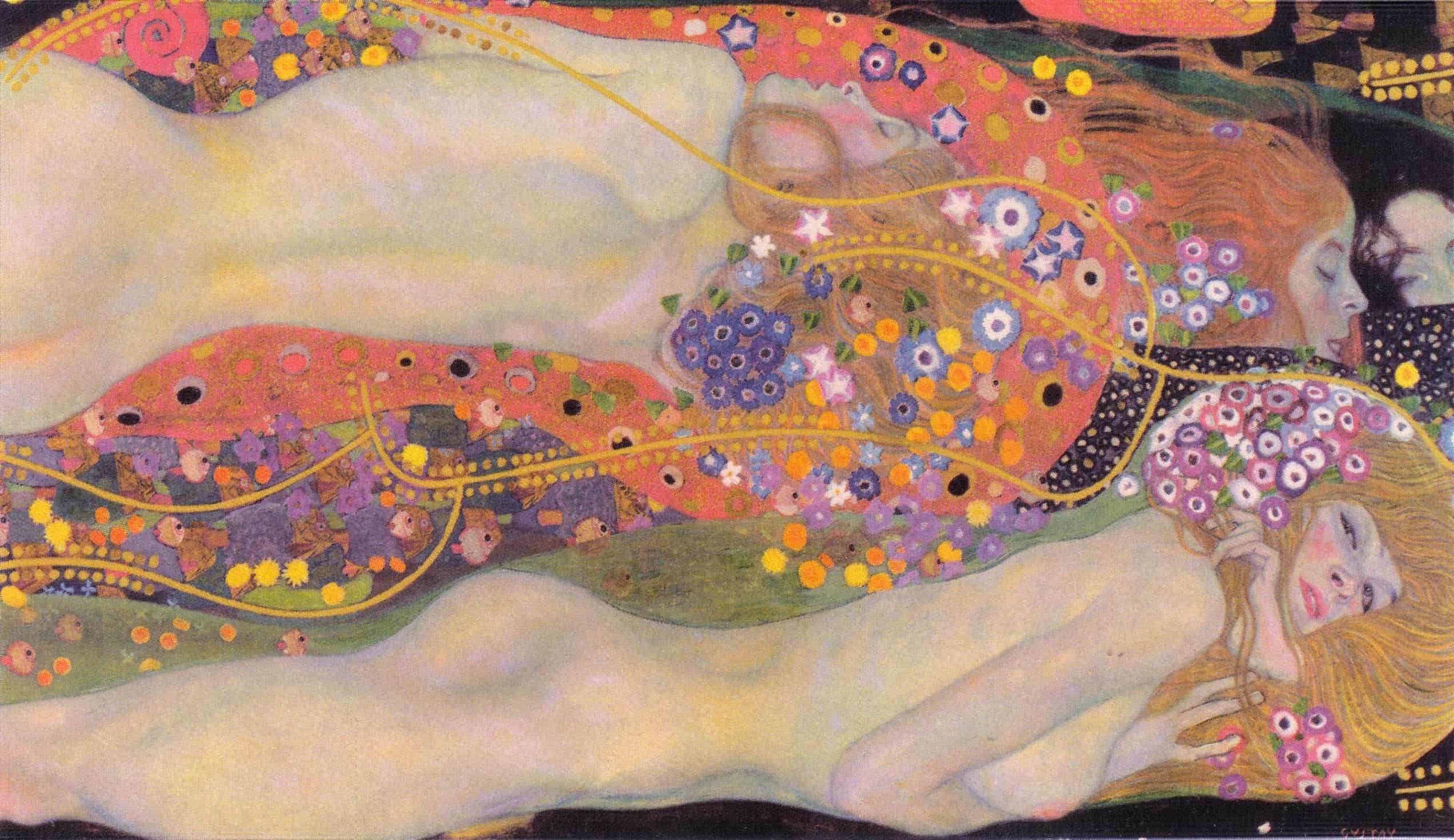 Gustav Klimt’s Water Serpents II, with four female figures drifting through a horizontal field of hair, flowers, fish, and curling ornament. Image by Gustav Klimt via Wikimedia Commons, licensed under Public domain.
That long process matters because the image did not simply move from sketch to finished canvas in one straight line. Klimt kept reconsidering the arrangement after the painting had entered public view. The work belongs to Viennese Modernism and the wider world of Art Nouveau, but its tightly interwoven surface also records the artist’s own habit of returning to an image until its parts worked together.
The Unfinished 1904 Exhibition State
Water Serpents II first appeared at the 20th Vienna Secession exhibition in 1904. Klimt delivered it four days after the exhibition opened, and it was still unfinished. That late arrival challenges the tempting idea that an exhibition date always marks a work’s final state.
An installation photograph by Moriz Nähr preserves evidence of this early appearance. The photograph is valuable because it lets researchers distinguish the displayed 1904 version from the later surface. Rather than treating every recorded date as a contradiction, the image shows why several dates belong to the same canvas.
Preparatory Drawings for the Second Version
Drawings from 1905-06 show Klimt working through a second arrangement. He placed reclining female bodies roughly parallel to the paper’s edges, then superimposed one figure on another. These studies isolate poses and contours that the painted ornament partly conceals.
The drawings also reveal how deliberately he constructed the horizontal rhythm. A body could become a long directional line, while an overlapping shoulder, hip, or head interrupted that line just enough to keep the group from becoming static. The painted figures may seem to float effortlessly, but the preparatory sheets show repeated decisions about their placement.
Reworking the Canvas for the 1908 Kunstschau
Klimt revised the same canvas for the Kunstschau Wien in 1908. The changes were substantial enough that records sometimes identify a 1906-07 phase or call the later arrangement a second version. He made further adjustments before the exhibition rather than preserving the 1904 state as a finished endpoint.
The most useful dating formula therefore describes a sequence: begun in 1904, substantially reworked in 1906-07, and adjusted before 1908. It recognizes the first public appearance without pretending that the surface seen today had already reached its final form.
How to Look at Water Serpents II
Begin with the format. At 145 centimeters wide but only 80 centimeters high, the canvas encourages the eye to travel sideways. Klimt reinforces that movement with extended bodies, streaming hair, and curling ornament instead of opening a deep space behind the figures.
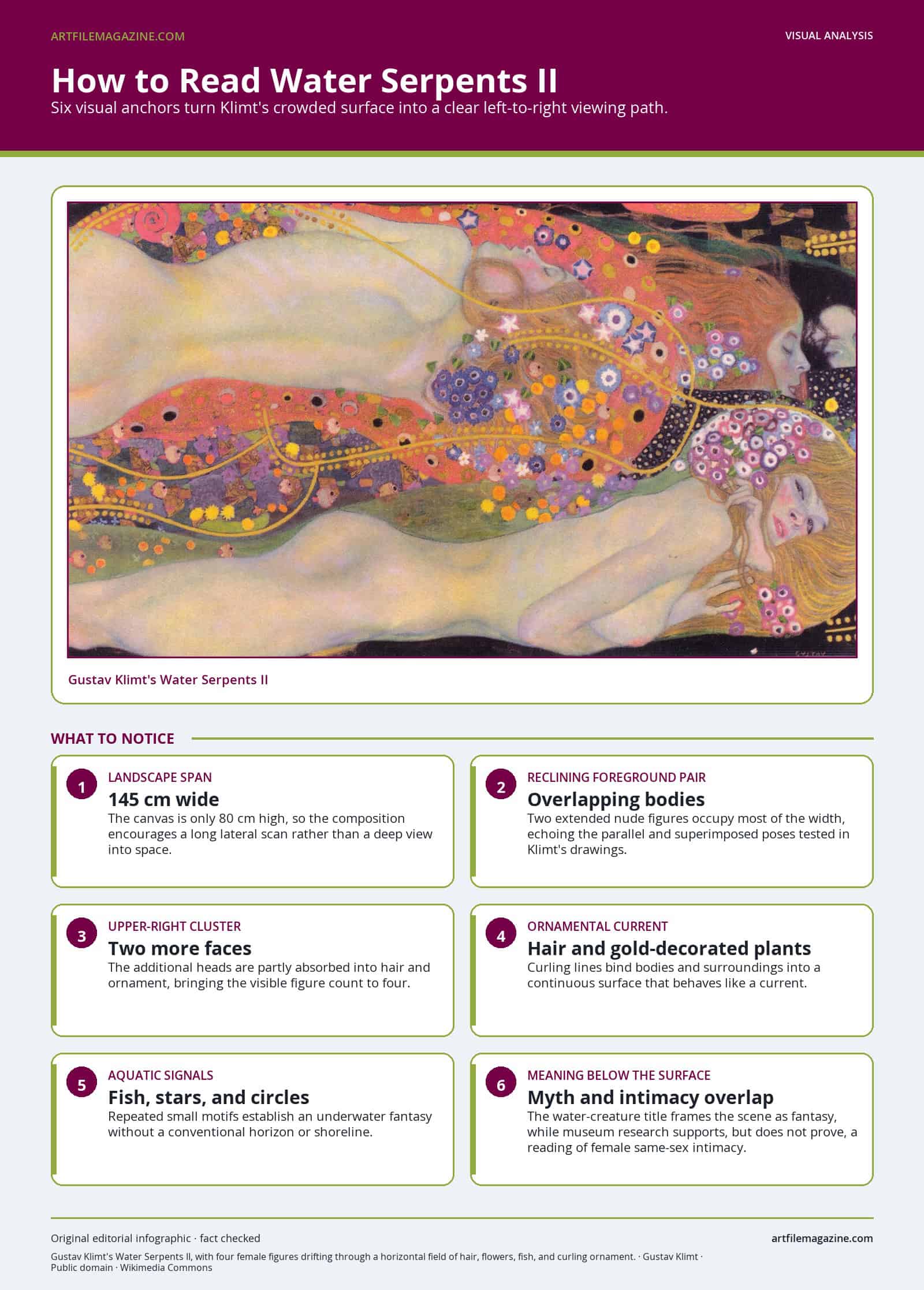
A useful viewing method is to make three passes. First trace the large bodies across the width. Next locate all four women, including the partly embedded faces at the upper right. Finally follow the smaller aquatic motifs and ask where a strand of hair ends and the surrounding pattern begins.
Reclining Bodies Create a Lateral Current
Two reclining nude figures occupy most of the composition. Their overlapping forms run along the canvas rather than receding toward a distant horizon. This alignment turns the human body into the painting’s main current, pulling attention from one end to the other.
The result is both restful and unstable. The figures appear suspended, but their outlines keep moving. Klimt does not rely on a shoreline, floor, or conventional horizon to orient them. Their horizontal poses establish direction while the surrounding patterns weaken any secure sense of gravity.
Four Figures Emerge at Different Speeds
The painting contains four female figures, although they do not announce themselves equally. The two extended nudes are relatively easy to recognize. Two more heads occupy the upper-right cluster, where hair and ornament partly absorb them into the surrounding field.
This uneven visibility controls the pace of looking. A viewer may register the foreground pair immediately and discover the remaining faces only after scanning the darker, denser area above. Klimt makes counting an act of close observation, not a fact delivered at a glance.
Hair, Plants, Fish, and Pattern Compress the Space
Gold-decorated water plants wind around the figures, while fish, stars, circles, and floral forms break up the surface. These details signal an aquatic fantasy without constructing a naturalistic underwater landscape. They function as both objects and pattern.
Hair plays a similar double role. It belongs to individual bodies, yet its curling lines also connect those bodies to the larger ornamental flow. The shallow pictorial depth allows skin, plants, hair, serpentine forms, and small motifs to occupy what feels like one continuous layer.
This is why the decoration is not merely an attractive covering. It directs attention, joins separated areas, and makes the border between figure and environment difficult to fix. For another view of Klimt binding bodies to ornament, readers can compare The Kiss by Gustav Klimt while keeping the two paintings’ distinct subjects and histories in mind.
What the Underwater Scene May Mean
Close looking can establish that four women share an ornamental aquatic space. It cannot, by itself, prove who the figures are or prescribe one narrative. Interpretation begins where those visible relationships meet the suggestive title, the intimate poses, and evidence from the preparatory drawings.
 The Coronation of King Gustav III of Sweden. Uncompleted (Carl Gustav Pilo) – Nationalmuseum – 18007. Image by Carl Gustaf Pilo via Wikimedia Commons, licensed under Public domain.
Mythological Cover and Erotic Intimacy
The title Water Serpents II frames the women as beings associated with an underwater or mythological realm. Yet Klimt does not give them the fixed attributes of named characters in a familiar myth. The title creates imaginative distance while the intertwined bodies and close faces create an erotic charge.
That combination permits more than one response. The figures can appear like water creatures carried by a current, women enclosed in a private fantasy, or bodies whose intimacy is partly revealed and partly hidden by pattern. These are readings of the composition, not a documented plot supplied by Klimt.
What the Drawings Support
Albertina interpretation connects the studies for Water Serpents II with Klimt’s early sustained treatment of lesbian love and autoeroticism, meaning erotic attention directed toward oneself. The drawings matter because they expose bodily relationships that the painted decoration makes less explicit.
They show that the superimposed poses were developed through deliberate study. That evidence strengthens a reading of female same-sex intimacy. It does not prove the figures’ identities, define their relationship, or turn the image into a single confirmed narrative.
Why the Interpretation Remains Open
Klimt left little explanation of the precise symbolic meaning of works such as this one. Any confident claim that the water setting represents one specific story therefore goes beyond the surviving evidence. The responsible distinction is simple: four women and their physical proximity are visible facts; what that intimacy ultimately signifies remains interpretive.
This openness is part of the painting’s construction. Ornament offers cover without erasing the bodies, while the bodies give the pattern emotional and erotic force. Concealment and revelation occur at the same time.
The Undulating Lines of Jan Toorop
The Van Gogh Museum identifies Jan Toorop’s undulating lines, especially those in his 1893 work The Three Brides, as an influence on Water Serpents II. The connection concerns the behavior of line: curves link figures, symbolic forms, and decorative detail across the surface.
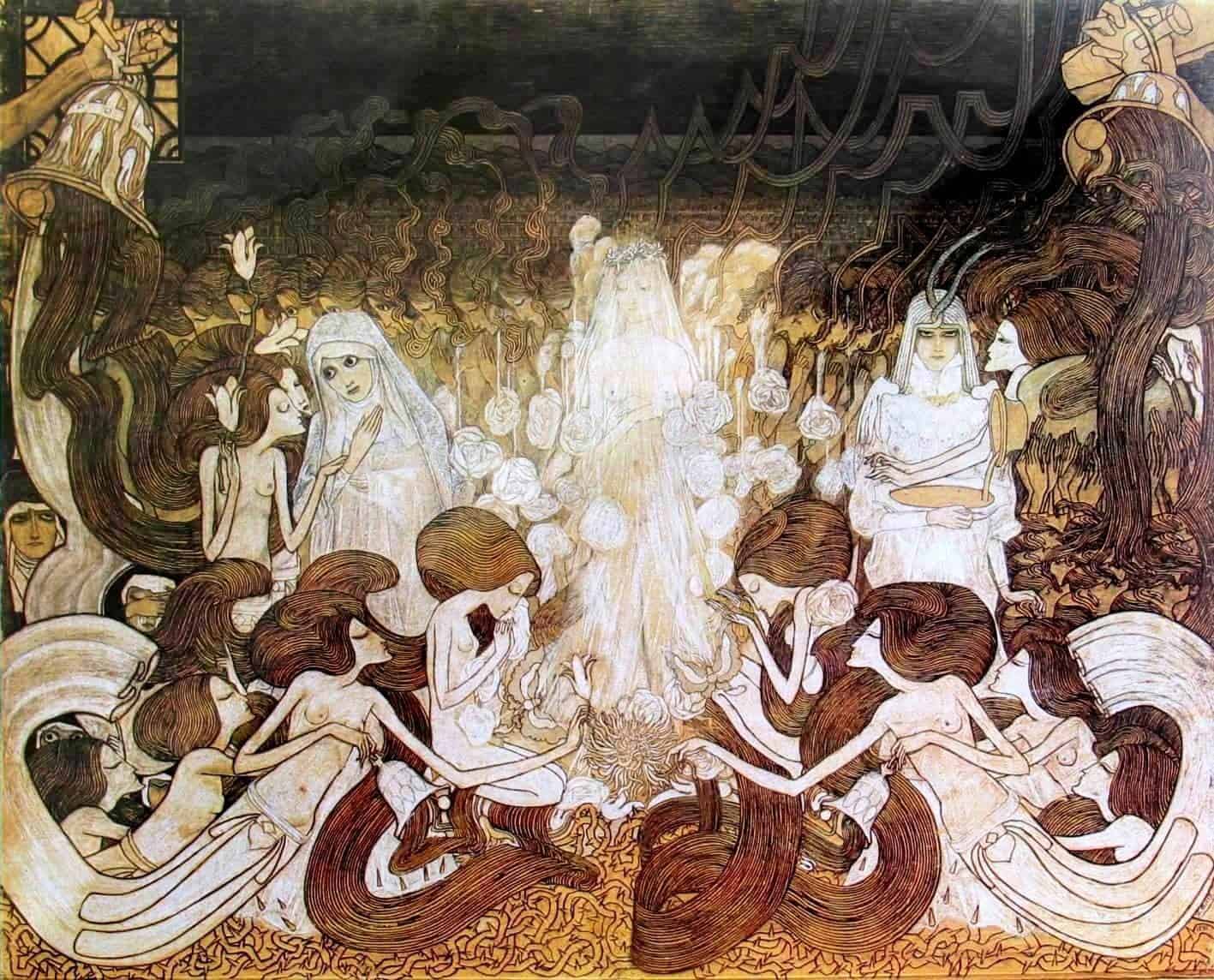 Jan Toorop’s The Three Brides from 1893, whose undulating lines have been connected to Water Serpents II. Image by Jan Toorop via Wikimedia Commons, licensed under Public domain.
Influence does not mean that Klimt copied Toorop’s subject. It offers a more precise way to understand how international Symbolist and Art Nouveau experiments could inform his visual language. For broader context on patterned surfaces and stylized nature, see this guide to Art Nouveau paintings.
Water Serpents I Is a Different Work
The Roman numerals identify two separate objects, not consecutive states of one painting. Confusing them produces errors in medium, dimensions, orientation, collection, and accession number. The horizontal canvas discussed here is Water Serpents II.
A Vertical Parchment Work Versus a Horizontal Canvas
Water Serpents I is a vertical mixed-media work on parchment measuring 50 × 20 centimeters. It belongs to the Belvedere and carries accession number 5077. Water Serpents II, by contrast, is an 80 × 145 centimeter horizontal oil painting in a private collection.
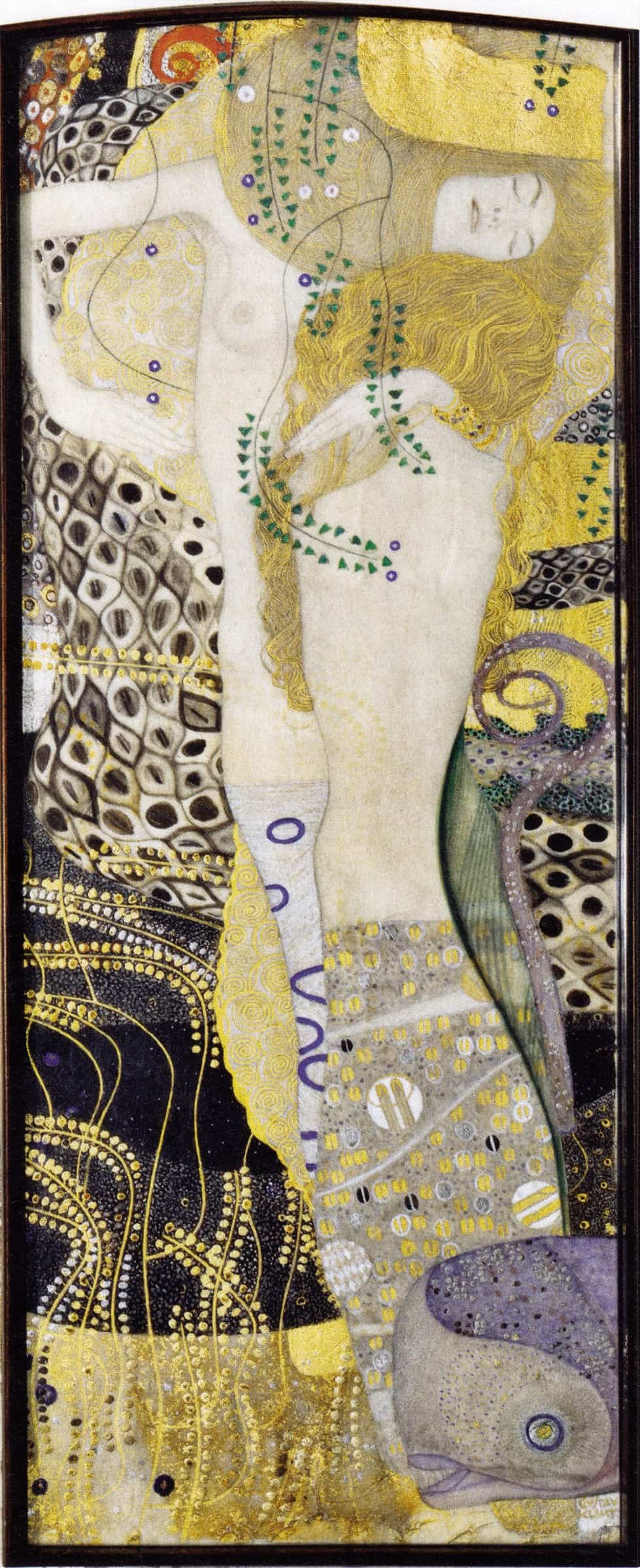 Water Serpents I, Klimt’s smaller vertical mixed-media companion on parchment. Image by Gustav Klimt via Wikimedia Commons, licensed under Public domain.
The difference in format changes the viewing experience. The narrow first work concentrates the aquatic figures vertically. The second stretches its bodies and ornament across a broad field, giving the motif room to become more crowded and spatially ambiguous. Accession number 5077 belongs only to Water Serpents I; no public museum accession number is documented for Water Serpents II.
Klimt’s Recurring Water Creatures
The related titles make more sense within Klimt’s continuing interest in aquatic figures. His water-creature subjects include Moving Water, Water Nymphs, Goldfish, Will-o’-the-Wisp, Daphne, and Water Serpents I.
These connections establish a recurring theme, not a single evolving object. Water Serpents II has its own canvas, revision history, ownership chain, and exhibition record. The alternative English title Water Snakes II refers to this same horizontal canvas.
From the Steiner Collection to the 2013 Settlement
The painting’s history cannot be reduced to a vague tale of a lost masterpiece. Its documented path involves a Klimt patron and her daughter, Nazi-era seizure, subsequent possession by a film director associated with the Nazi regime, and a private agreement reached decades later.
Jenny Steiner, Klara Mertens, and Prewar Ownership
Jenny Steiner was a Klimt patron, collector, and supporter of the Vienna Secession. The provenance record states that she had given Water Serpents II to her daughter Klara, later Klara Mertens, by 1923. This establishes Klara within the painting’s documented prewar ownership history.
That family connection matters when describing the later settlement. Referring only to a famous collector and a later sale would obscure the individual whose legal successors ultimately participated in the agreement.
Nazi Seizure and Gustav Ucicky
On October 14, 1938, the Property Transfer Office seized the household furnishings and artworks of Jenny Steiner and Klara. The seizure formed part of the Nazi persecution that stripped Jewish owners of property after Austria’s annexation.
Water Serpents II subsequently entered the possession of Gustav Ucicky, a film director who worked for the Nazi regime, following political intervention. After his death, the painting remained with his widow, Ursula Ucicky. This documented chain is more accurate than calling the work merely missing or mysteriously rediscovered.
What the 2013 Agreement Did
In 2013, Ursula Ucicky reached a voluntary private settlement connected with the Steiner successors. The proceeds from the painting’s sale were divided with the legal successors of Klara Mertens.
This was a private settlement, not an Austrian state-museum restitution order under federal restitution law. That distinction acknowledges the Nazi-era loss and the successors’ participation while accurately describing the agreement’s legal form.
Where the Painting Is Now and What Conservation Revealed
The private status of Water Serpents II limits both public access and certainty about its permanent location. Its temporary Belvedere loan in 2023 nevertheless allowed audiences to see it and gave conservators an unusual opportunity to examine physical evidence beneath its familiar surface.
A Private Work, Not a Permanent Belvedere Display
The painting remains in a private collection. Its permanent location and current owner’s identity have not been publicly disclosed, and it has no documented public museum accession number.
The Belvedere listed the 2023 loan as courtesy of HomeArt. The museum recorded the work as a private-collection loan, not as part of its own collection, and the courtesy credit does not establish HomeArt as its legal owner.
The 2023 Belvedere Display
The painting was displayed at the Belvedere in Vienna from February 3 through May 29, 2023, as part of an exhibition devoted to Klimt and his artistic influences.
The appearance was a temporary loan rather than a change in permanent museum ownership. Anyone hoping to see the work should check current exhibition listings instead of assuming that it remains on view in Vienna.
Underdrawing, Revisions, and Oxidized Silver
Belvedere X-radiography revealed initial drawing beneath the visible paint and changes to the nymphs, serpents, and gold vines. X-radiography uses penetrating radiation to record structural differences below the surface, making covered lines and alterations easier to detect.
Microscopic examination added a change that ordinary reproductions cannot explain. Fish that now look brown were originally silver-colored, and oxidation altered their appearance over time. The finding turns color into historical evidence: viewers today do not see every detail exactly as Klimt’s first audiences did.
Together, the imaging and microscopy confirm that revision continued within the material object. The painting’s chronology is not merely an argument based on dates and catalogues. It survives in concealed drawing, altered forms, and surfaces changed by chemical processes.
Why Water Serpents II Matters
The painting demonstrates that Klimt’s ornament is structural. Pattern directs the viewing route, joins bodies that might otherwise appear separate, and destabilizes the division between a figure and her environment. The wide format makes that system especially clear because every curve contributes to a sustained lateral movement.
Pattern as Structure, Concealment, and Revelation
The drawings and X-rays also replace the myth of an effortless decorative vision with evidence of repeated choices. Klimt adjusted poses, serpentine forms, and vines over several years. What looks seamless is the result of reconsideration.
Its erotic interpretation works in a similar way. The studies give institutional support to a reading of female same-sex intimacy, yet the absence of a definitive explanation prevents that reading from becoming a closed story. Bodies and pattern disclose enough to invite interpretation while withholding certainty.
Finally, the work matters as an owned and displaced object. Its modern identity includes Jenny Steiner, Klara Mertens, the Nazi seizure, Ucicky’s possession, and the terms of the 2013 private settlement. Looking responsibly means attending to both surfaces: the painted one Klimt revised and the historical one shaped by the people who possessed, lost, recovered value from, and temporarily displayed it.
Frequently Asked Questions
These short answers clarify the painting’s identity, availability, and materials without relying on ownership or market rumors.
Is Water Serpents II on Permanent Public Display?
No permanent public display is documented. The work remains in a private collection, and its 2023 Belvedere appearance was a temporary loan.
How Many Women Are in Water Serpents II?
Four women are visible. Two extended nude figures dominate the horizontal field, while two additional heads emerge from the dense upper-right cluster.
Are Water Serpents II and Water Snakes II the Same Painting?
Yes. Water Snakes II is an alternative English rendering of the German title Wasserschlangen II. It should not be confused with the separate work Water Serpents I.
Was the Painting Formally Restituted?
The 2013 outcome was a voluntary private settlement involving Ursula Ucicky and the Steiner successors. Sale proceeds were divided with Klara Mertens’s legal successors; it was not a state-museum restitution order.
Did Klimt Use Real Gold and Silver?
The painting’s formal medium is oil on canvas. Technical examination describes gold vines and fish that were originally silver-colored, but it does not establish that Klimt used specific gold-leaf or silver-leaf materials in this work.

Jordan Anthony is a Cape Town-based film photographer, curator, and arts writer. She holds a Bachelor of Art in Fine Arts from the University of the Witwatersrand, Johannesburg, where she explored themes like healing, identity, dreams, and intuitive creation in her Contemporary art practice. Jordan has collaborated with various local art institutions, including the KZNSA Gallery in Durban, the Turbine Art Fair, and the Wits Art Museum. Her photography focuses on abstract color manipulations, portraiture, candid shots, and urban landscapes. She’s intrigued by philosophy, memory, and esotericism, drawing inspiration from Surrealism, Fluxus, and ancient civilizations, as well as childhood influences and found objects. Jordan is working for artfilemagazine since 2022 and writes blog posts about art history and photography.
Learn more about Jordan Anthony and about us.
Cite this Article
Jordan, Anthony, “Water Serpents II by Gustav Klimt: Meaning and History.” artfilemagazine – Your Online Art Source. September 15, 2026. URL: https://artfilemagazine.com/water-serpents-ii-by-gustav-klimt/
Anthony, J. (2026, 15 September). Water Serpents II by Gustav Klimt: Meaning and History. artfilemagazine – Your Online Art Source. https://artfilemagazine.com/water-serpents-ii-by-gustav-klimt/
Anthony, Jordan. “Water Serpents II by Gustav Klimt: Meaning and History.” artfilemagazine – Your Online Art Source, September 15, 2026. https://artfilemagazine.com/water-serpents-ii-by-gustav-klimt/.