

What Is 2D Art? A Practical Guide to Surface and Space
A printed wave can tower over tiny boats, and a portrait can open onto miles of landscape, even though both works remain physically shallow. The puzzle is not how real the scene looks, but where the artwork organizes its space. That distinction turns 2D art from a vague label into a practical way to read paintings, prints, photographs, collages, and digital images.
What Is 2D Art?
Two-dimensional art is organized primarily across length and width on a surface. Its traditional core includes drawing, painting, and printmaking. Some contemporary teaching programs use a broader scope. Illinois Wesleyan University, for example, includes film photography, digital photography, and unconventional two-dimensional projects in its curriculum.
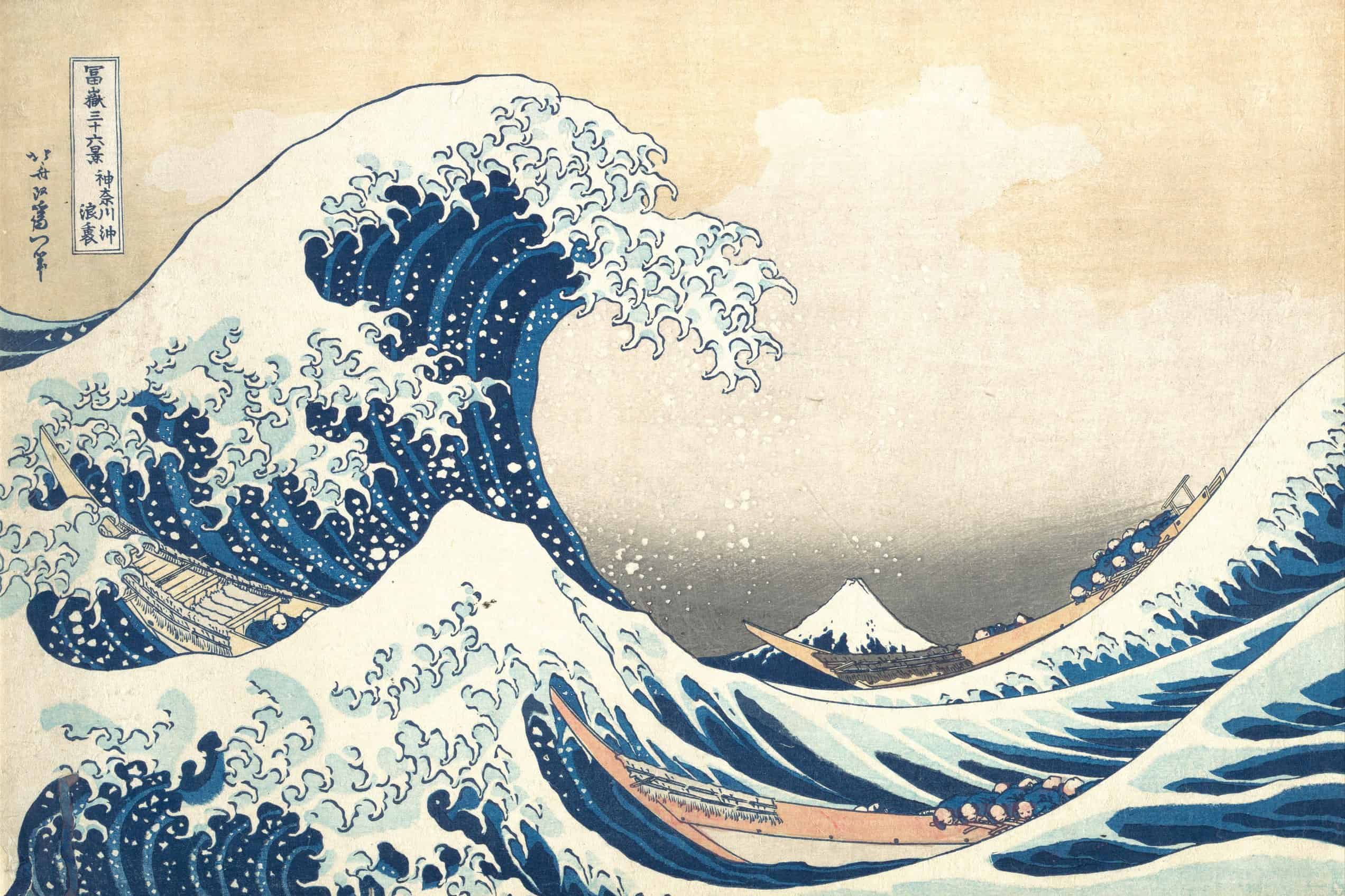 Katsushika Hokusai’s Under the Wave off Kanagawa, also known as The Great Wave, from about 1830 to 1832. Image by Katsushika Hokusai via Wikimedia Commons, licensed under Public domain, cropped.
The term describes the artwork’s dominant spatial field. It does not mean that the material itself has no thickness. Paper has an edge, a wooden panel has depth, and paint may rise above a canvas. These objects remain two-dimensional when their images are chiefly arranged and viewed across a surface rather than as volumes projecting into the viewer’s space.
This is why realism does not determine dimensionality. A carefully shaded face can appear solid, and a landscape can seem to recede toward a distant horizon, but neither illusion gives the depicted forms measurable volume outside the support.
The Surface Matters More Than the Illusion
The picture plane is the flat field across which an image is organized. It may be a sheet, a wall, a rigid panel, or the visible area of a screen. Marks, colors, and shapes occupy positions on that plane even when they appear to describe objects far behind or in front of it.
It helps to ask two separate questions. What space does the physical object occupy, and what space does the image ask the eye to imagine? A painted hallway has pictorial depth, while a projecting shelf has real depth. Confusing these two kinds of space can make a realistic painting seem more three-dimensional in classification than it is.
Shape Versus Form
In formal analysis, a shape has two dimensions, while a form has three. A circle is a shape; a sphere is a form. An artist can turn a painted circle into the illusion of a sphere by shifting its values from light to dark, but the mark on the surface remains a two-dimensional shape.
The word form can also refer more broadly to an artwork’s organization, so context matters. When dimensionality is the subject, form means something with actual or represented length, width, and depth.
How 2D Art Developed Across Places and Media
Two-dimensional art is a spatial category, not a movement with a founder or a single birthplace. A useful chronology therefore follows documented changes in how surface-based images created depth, multiplied, recorded light, and incorporated physical materials. These turning points belong to distinct regional histories rather than one universal line of progress.
Early 1400s: Pictorial Space Becomes Systematic
Artists had more than one way to make a flat picture appear deep. In early 15th-century Florence, Filippo Brunelleschi developed the single-point system of linear perspective, and Leon Battista Alberti later codified it in De Pictura. Receding parallel lines could now be organized toward a vanishing point through a teachable mathematical structure.
Netherlandish painters of the same period created convincing spatial illusions more empirically, without relying on the Florentine system. The historical change was therefore not a universal switch from flatness to depth. It was the development of different regional methods for controlling pictorial space, including a codified Italian system that artists could apply across architecture, painting, and relief.
Early 1400s to 1830s: Prints Multiply the Image
Printmaking changed the relationship between an image and its support. In Europe, woodblocks were used on textiles before artists and printers adopted them for images on paper in the early 15th century. An inked block, plate, or screen could transfer closely related images to multiple sheets. By the 16th century, Albrecht Dürer was using woodcut for sustained narrative and expressive work.
Japanese color woodblock printing followed its own technical history. Color prints became popular after their development in the 1760s, and the use of multiple blocks for different colors was perfected by 1765. In Edo-period Japan, woodblock printing became both a popular art form and an advanced color-reproduction process.
Hokusai’s Under the Wave off Kanagawa, made about 1830 to 1832, belongs to this mature print culture. The Met’s JP1847 impression was produced with ink and color on paper, including layered blue printing that adds contrast and visual depth. Its identity as one impression also matters: a repeatable design does not erase the physical differences among individual printed sheets.
1839: Photography Introduces New Kinds of Surface Image
Photography emerged publicly in 1839 through different processes in France and Britain. Louis Daguerre produced one-of-a-kind images on silvered copper, while William Henry Fox Talbot developed a paper negative from which multiple positive prints could be made. This distinction brought both unique photographic objects and reproducible photographic images into the history of surface-based art.
Dorothea Lange’s 1936 photograph commonly known as Migrant Mother shows a later stage of that history in the United States. Its figures, light, and shadow can be studied across a bounded photographic field, but its medium also carries a production history different from a drawing, painting, or woodblock print.
1912 to the Present: The Surface Becomes a Boundary
The invention of collage by Georges Braque and Pablo Picasso in 1912 marked a major shift in Western art. Pasted paper brought actual materials and textures into the composition while directing attention to the flat picture surface. Collage could therefore operate as both an image and a physical construction.
Kurt Schwitters pushed that question further in 1921 with Merz Picture 32 A. The Cherry Picture. Its combination of paper, cloth, wood, metal, cork, paint, pencil, and ink includes objects that project from the board. The work does not simply represent depth; it makes actual projection part of the viewing experience.
Contemporary classifications have expanded in another direction. Some American university programs now place film photography, digital photography, and unconventional projects within 2D study. At the same time, video, projection, and other works that depend on duration are often treated as time-based practices. The history of 2D art is therefore also a history of changing boundaries around surface, material, reproduction, and time.
The Main Types of 2D Art
Categories vary among museums, textbooks, and art programs. Drawing, painting, and printmaking provide a traditional foundation, while particular curricula may also include photography and other surface-based practices. These media occupy one large branch among the many forms of visual art.
Drawing
Drawing organizes lines, tones, and shapes directly across a support. Lines may describe edges, record movement, divide areas, or remain visible as independent marks rather than representing objects.
 Leonardo da Vinci’s Vitruvian Man, a drawing dating to about 1492. Image by Futturnauta via Wikimedia Commons, licensed under CC BY-SA 4.0.
Leonardo da Vinci’s Vitruvian Man provides a clear example. The figure appears in superimposed positions within a circle and square. Those geometric boundaries and repeated contours organize the body’s proportions on one field. Viewers recognize a human body, but the drawing itself does not acquire bodily volume.
Painting
Painting adds color, shifts of value, meaning relative lightness and darkness, and a material surface to the same basic spatial problem. Paint can be thin and smooth or visibly built up, yet the arrangement may still function chiefly across the support.
Leonardo’s Mona Lisa is painted on a poplar panel and displayed in the Louvre’s Salle des États. Its sfumato, a method of making contours and tonal transitions appear subtle rather than sharply bounded, helps the sitter’s face look rounded. The distant landscape also appears to open behind her. These effects create pictorial space on a wooden surface; they do not turn the depicted sitter or landscape into sculpture.
Printmaking
Printmaking is one of the traditional core categories of two-dimensional art. A print is still a distinct physical object, so different impressions of one design should not be treated as the same sheet.
The Metropolitan Museum of Art’s JP1847 impression of Katsushika Hokusai’s Under the Wave off Kanagawa, also called The Great Wave, dates to about 1830 to 1832. It is a woodblock print in ink and color on paper measuring 25.7 by 37.9 centimeters. Overlapping forms and differences of scale make the scene appear far deeper than the paper itself.
Photography and Digital Images
Photography can fall within the scope of 2D art, although programs and institutions do not all organize their categories in the same way. A fixed photograph is readily analyzed as an arrangement of shapes, values, textures, and spaces across a bounded surface.
 Dorothea Lange’s 1936 photograph commonly known as Migrant Mother. Image by Dorothea Lange via Wikimedia Commons, licensed under Public domain.
Dorothea Lange’s 1936 photograph commonly known as Migrant Mother provides an example. It is identified by Library of Congress call number LC-USF34-009058-C. Its figures, light, and shadows are organized within a bounded image, whether a viewer encounters it as a photographic print or a static reproduction.
Digital presentation requires the same care. A fixed digital image can be analyzed as a field of length and width, but that observation does not settle the category of every digital artwork. If duration is essential to the complete work, a time-based classification may be more informative.
How 2D Art Creates Space and Depth
A flat support can suggest a space that appears much deeper than the object itself. Looking closely at the picture plane and the visual cues arranged across it reveals how artists build that illusion without creating physical volume.
The Picture Plane and Pictorial Space
The picture plane stays flat, but pictorial space can appear deep. Artists construct that impression by arranging the elements of art, including line, shape, color, value, texture, and space. Positive space generally refers to the areas occupied by primary forms, while negative space describes the surrounding or intervening areas.
Actual texture belongs to the material surface, such as raised paint, coarse paper, or attached fabric. Implied texture is visual. A smooth sheet can depict rough bark, soft hair, or polished metal through changes in line, color, and value.
Six Common Depth Cues
Artists often combine several devices to make a flat field feel spacious:
- Overlap: One shape partly covers another, suggesting that it sits closer to the viewer.
- Diminishing scale: Similar objects appear smaller as their imagined distance increases.
- Atmospheric perspective: Distant areas lose contrast, clarity, or color intensity. A closer look at atmospheric perspective explains how air can be suggested without being physically present.
- Vertical placement: In many images, forms positioned higher in the field appear farther away.
- Linear perspective: Receding parallel lines appear to converge toward one or more vanishing points.
- Modeling: Gradations from light to dark make a flat shape appear rounded or solid.
Hokusai’s Great Wave uses overlapping forms and dramatic differences of scale to place boats, water, and distant land within an implied space. In the Mona Lisa, modeling gives the sitter volume while softened contours help the distant landscape recede. Both examples make depth perceptible without moving beyond a picture plane.
When an Artist Emphasizes Flatness
Convincing depth is not a universal measure of quality. An artist may suppress modeling, reject a single viewpoint, keep colors evenly intense, or arrange shapes like a pattern. These choices direct attention toward the surface and the relationships among marks rather than toward an imagined window onto the world.
A useful description therefore asks what the work does with space, not whether it looks realistic. Deep illusion and deliberate flatness are different strategies available within the same two-dimensional field.
Where 2D Stops and 3D Begins
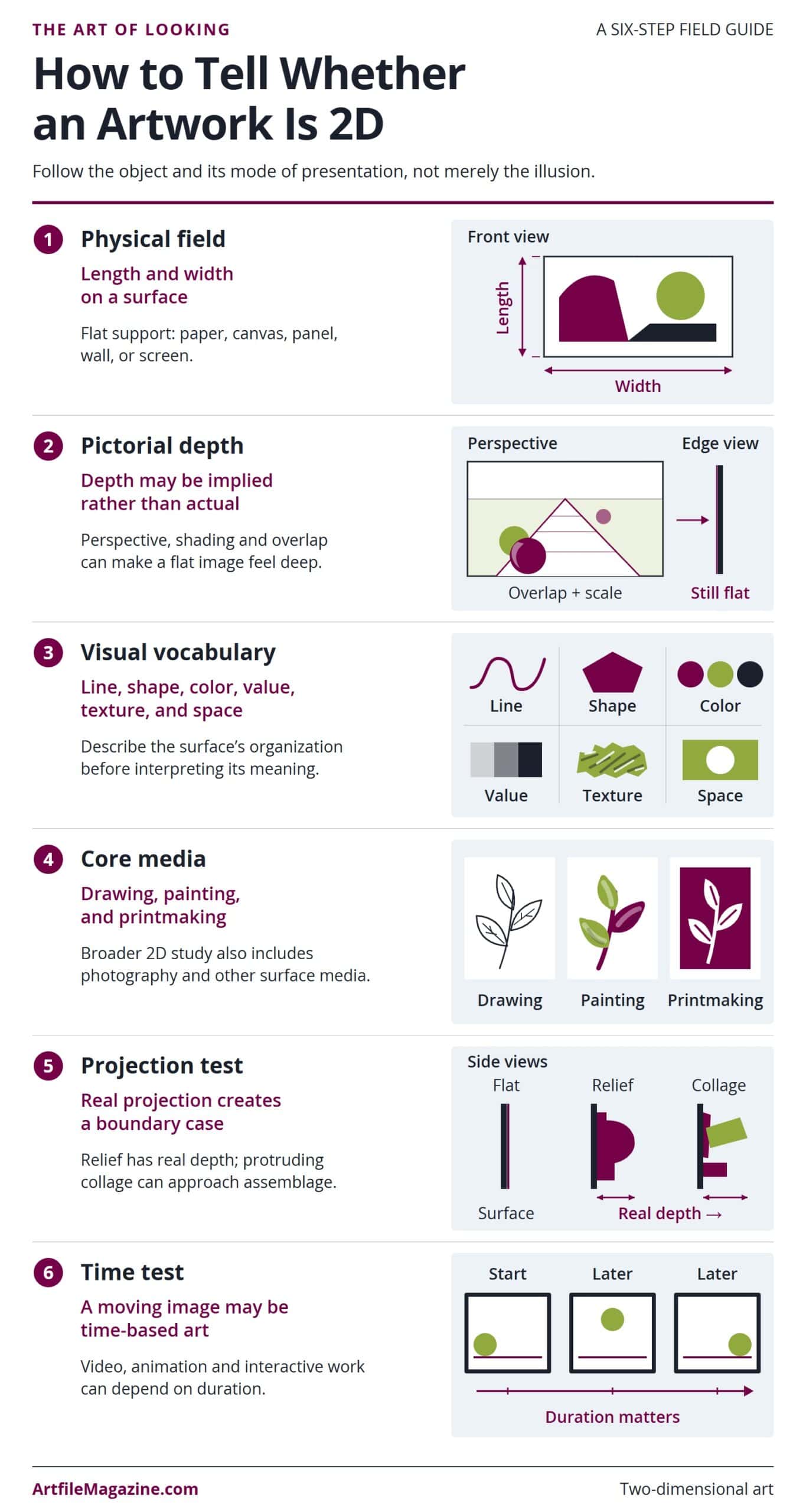
No simple thickness test settles every boundary case. As a practical viewing guide, ask whether the composition is read primarily across a surface or whether projected materials make actual depth central. For works involving changing images, also ask whether duration is necessary to experience the complete work. These questions are aids rather than universal rules, and boundary works may reasonably receive different classifications.
2D Art and 3D Art Compared
In a two-dimensional work, relationships across a surface carry the main composition, while volume is usually depicted rather than physically occupied. In three-dimensional art, actual depth and volume are central to the work’s structure. Both categories can include real texture, and both can depict recognizable or abstract subjects.
The distinction therefore rests less on realism or literal material thickness than on how the work uses space. Raised brushstrokes may remain secondary to a painting’s surface organization. Projecting sculptural forms, by contrast, make real depth an active part of what the viewer encounters.
Collage, Assemblage, and Relief
Collage art complicates a strict binary because pasted materials possess real thickness. A mostly flat collage can still function as a two-dimensional composition when its pieces operate like shapes across a support. Relief sculpture differs because its forms project from a background, making real depth part of the work.
Kurt Schwitters’s 1921 Merz Picture 32 A. The Cherry Picture is a revealing boundary example. It combines pasted paper, cloth, wood, metal, cork, oil, pencil, and ink on board, and some objects protrude from the surface. That projection deliberately unsettles the division between a flat picture and a spatial object.
As projection becomes more important to a work’s construction, categories such as relief or assemblage art may become more useful. The boundary remains contextual rather than a universal measurement rule.
Digital Images, Video, and Time
A fixed illustration or photograph displayed on a monitor can be analyzed as a two-dimensional field because its image is organized across the visible surface. That describes its spatial arrangement, not necessarily its complete institutional category.
Video and projection mapping depend on duration as well as visible imagery. Performance and new-media practices can also be classified as time-based or four-dimensional art. A single frame may be flat, but classifying the complete work requires attention to how it changes over time.
How to Look at a 2D Artwork
A useful close reading moves from the physical support to the arrangement of marks, colors, textures, and spaces. Describing those visible features first gives later interpretation a clear foundation.
A Five-Step Viewing Checklist
- Identify the support and format. Look for paper, canvas, panel, wall, photographic material, or a screen. Notice whether the format is vertical, horizontal, square, or irregular.
- Trace line and shape. Follow strong contours, directional marks, repeated angles, and the boundaries between areas. Ask which shapes dominate and where the eye moves.
- Examine color, value, and texture. Compare lighter and darker passages, then separate physical texture from texture created through marks or tonal changes.
- Map the space. Locate positive and negative areas, then look for overlap, scale changes, perspective, placement, atmosphere, and modeling. Decide whether the image invites the eye inward or keeps attention on the surface.
- Describe before interpreting. First record what is visible and how it is arranged. Only then suggest what the arrangement might express. This keeps observation from being mistaken for established meaning.
A Worked Comparison Across Four Media
- Drawing: In Vitruvian Man, repeated outlines, a circle, and a square provide the most immediate evidence. An interpretation about order or proportion should follow that description.
- Painting: In the Mona Lisa, begin with the poplar support, softened tonal transitions, modeled face, and distant landscape. The viewer may then consider how the contrast between near figure and remote setting shapes the portrait’s effect.
- Printmaking: In the Met’s JP1847 Great Wave, distinguish the paper impression from the scene it represents. Overlap and scale make the water appear forceful and deep even though ink and color remain on the sheet.
- Photography: In Migrant Mother, start with the bounded photographic image and the arrangement of faces, hands, clothing, light, and shadow. Any reading of worry, protection, or attention is an interpretation built from those visible relationships.
The same method works with abstraction. Replace questions about depicted bodies or landscapes with questions about edges, intervals, color fields, texture, and visual weight. A recognizable subject is not required for close looking.
Why Two Dimensions Still Matter
The two-dimensional field is a constraint with unusually broad possibilities. It can preserve a direct drawn mark, hold layers of paint, receive a transferred print, record light photographically, or display pixels. Each process changes how an image is made, repeated, handled, and seen while retaining the productive tension between surface and illusion.
Recognizing that tension improves both viewing and making. It helps a museum visitor separate an object’s materials from the world it depicts, a student explain depth without calling a drawing three-dimensional, and an artist choose whether to open an imagined space or insist on the surface itself.
Frequently Asked Questions
Boundary cases become clearer when physical depth, pictorial illusion, presentation, and duration are considered separately.
Is Photography Considered 2D Art?
It can be, particularly when a photograph is presented as a fixed image on paper or a screen. Art programs and institutions may use different taxonomies, so the work’s presentation and the purpose of the classification both matter.
Can 2D Art Have Real Texture?
Yes. Paper fibers, brushstrokes, and attached materials can create physical texture without automatically changing the work’s primary classification. When projection makes real depth central, the categories of relief or assemblage may become more useful.
Is All Digital Art Two-Dimensional?
No. A static digital image can be analyzed as a two-dimensional field, while video, projection mapping, performance, and some new-media practices are classified as time-based or four-dimensional. A flat display alone does not settle the category.
What Is the Difference Between Shape and Form?
A shape has two dimensions, such as a circle drawn on paper. A form has three, such as a physical sphere. Shading can make the circle look spherical, but that represented form remains an illusion within a two-dimensional image.

Jordan Anthony is a Cape Town-based film photographer, curator, and arts writer. She holds a Bachelor of Art in Fine Arts from the University of the Witwatersrand, Johannesburg, where she explored themes like healing, identity, dreams, and intuitive creation in her Contemporary art practice. Jordan has collaborated with various local art institutions, including the KZNSA Gallery in Durban, the Turbine Art Fair, and the Wits Art Museum. Her photography focuses on abstract color manipulations, portraiture, candid shots, and urban landscapes. She’s intrigued by philosophy, memory, and esotericism, drawing inspiration from Surrealism, Fluxus, and ancient civilizations, as well as childhood influences and found objects. Jordan is working for artfilemagazine since 2022 and writes blog posts about art history and photography.
Learn more about Jordan Anthony and about us.
Cite this Article
Jordan, Anthony, “What Is 2D Art? A Practical Guide to Surface and Space.” artfilemagazine – Your Online Art Source. September 11, 2026. URL: https://artfilemagazine.com/what-is-2d-art/
Anthony, J. (2026, 11 September). What Is 2D Art? A Practical Guide to Surface and Space. artfilemagazine – Your Online Art Source. https://artfilemagazine.com/what-is-2d-art/
Anthony, Jordan. “What Is 2D Art? A Practical Guide to Surface and Space.” artfilemagazine – Your Online Art Source, September 11, 2026. https://artfilemagazine.com/what-is-2d-art/.