

15 Guatemalan Artists: Works, Media, and Visual Clues
A public mural built into city architecture, a miniature oil made portable during wartime, and a silver-covered skateboard all belong to the story of Guatemalan art. These 15 profiles form a representative cross-section that reaches from Kaqchikel community painting and modern abstraction to photography, performance, textiles, and installation. Each profile pairs an anchor work or strategy with a practical recognition cue, making very different practices easier to tell apart.
From Comalapa Painting to Civic Modernism
This representative chronological cross-section begins with locally rooted painting in San Juan Comalapa, follows artistic exchange between Guatemala and Mexico, and reaches the integration of murals and sculpture into Guatemala City’s public architecture.
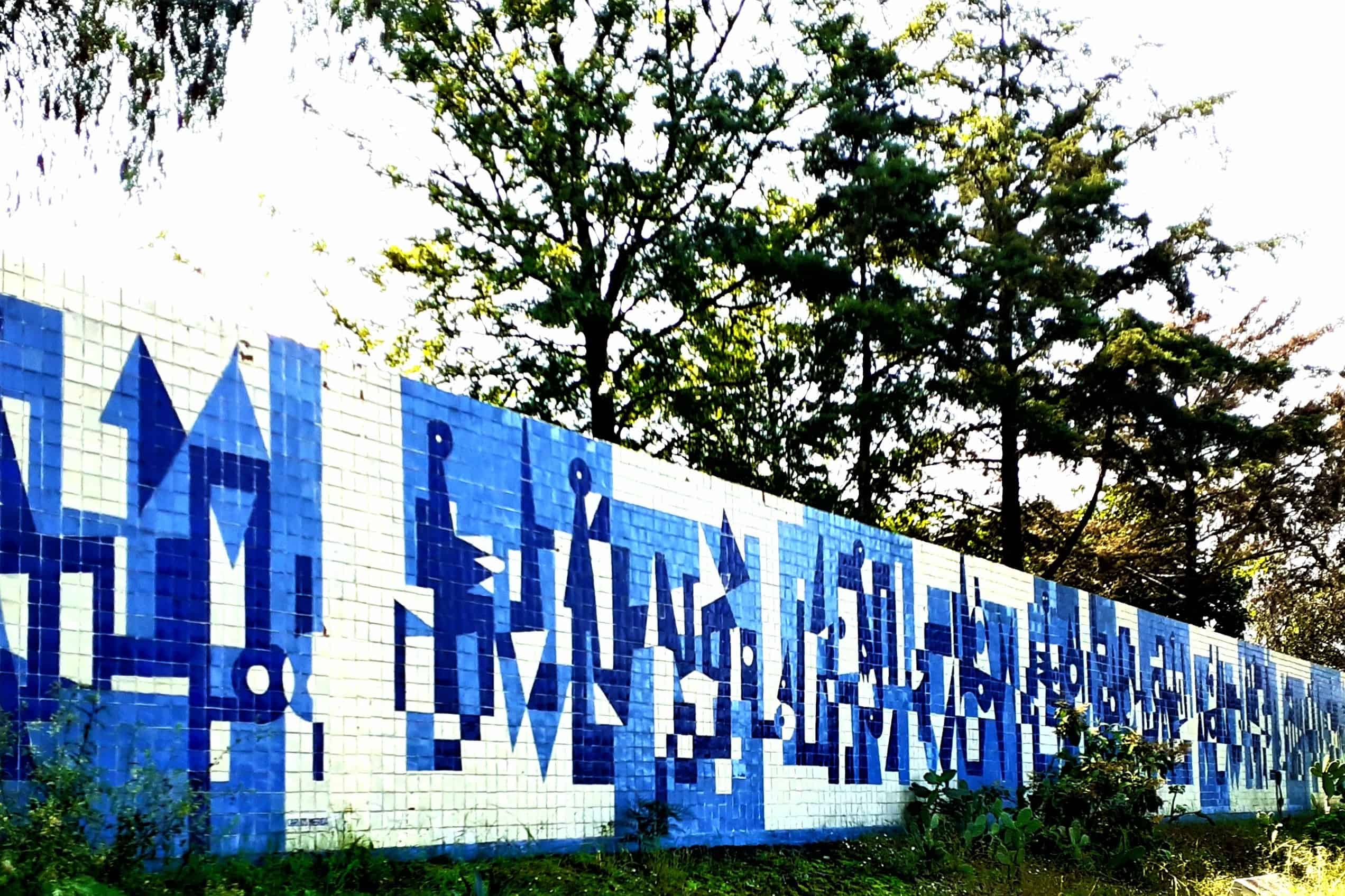 Carlos Mérida’s 1967 tile mural Integrated Abstraction in Mexico City. Image by Eduardo Ruiz Mondragón via Wikimedia Commons, licensed under CC BY-SA 4.0, cropped.
That architectural turn is especially visible in the Civic Center, which includes the National Theater, Bank of Guatemala, Municipal Building, and Guatemalan Social Security Institute. Carlos Mérida, Roberto González Goyri, Efraín Recinos, and other artists produced murals for the complex, placing modern art directly within civic space.
Andrés Curruchich (1891-1969)
| Dates: | 1891-1969 |
| Guatemala connection: | Kaqchikel painter from San Juan Comalapa |
| Principal media: | Oil painting |
| Anchor work or strategy: | Oil scenes recording daily life, traditions, and rites |
| Recognition cue: | Scenes of Kaqchikel community life in San Juan Comalapa |
Andrés Curruchich pioneered the documented tradition of Kaqchikel popular painting associated with San Juan Comalapa. His oils record people working, gathering, observing rites, and maintaining local traditions. The activities and relationships within a scene are central to its meaning.
To recognize his practice, begin by identifying the shared event rather than searching for a single recurring symbol. Labor, ceremony, and community custom provide the strongest clues. His sustained attention to these subjects helped make local experience a significant part of Guatemala’s twentieth-century visual record.
Carlos Mérida (1891-1984)
| Dates: | 1891-1984 |
| Guatemala connection: | Guatemalan modernist and Civic Center muralist |
| Principal media: | Painting, printmaking, and murals |
| Anchor work or strategy: | Mayor of Almolonga, 1916-1919 |
| Recognition cue: | An early contemporary Indigenous subject or later geometry shaped by Mesoamerican references |
Mayor of Almolonga depicts a contemporary Indigenous official rather than an imagined figure from an ancient past. It offers a useful starting point for Mérida’s early engagement with Indigenism, which brought Indigenous people and culture into debates about modern national art.
Mérida later developed abstract art that continued to engage Maya and other Mesoamerican references through geometric relationships. He also worked at mural scale and contributed to Guatemala City’s Civic Center. The contrast between the recognizable official in Mayor of Almolonga and his later geometric work reveals the breadth of his modernism.
Rina Lazo (1923-2019)
| Dates: | 1923-2019 |
| Guatemala connection: | Born in Guatemala City and trained in Mexico |
| Principal media: | Fresco, murals, and prints |
| Anchor work or strategy: | Replicas of the Bonampak murals and her broader fresco practice |
| Recognition cue: | A fresco, mural, print, or Bonampak replica within her documented practice |
A scholarship took Rina Lazo to La Esmeralda, the influential art school in Mexico. She assisted Diego Rivera, learned fresco, and became an important Guatemala-born participant in Mexican muralism. Her practice also included prints and replicas of the Maya murals at Bonampak.
Lazo’s career makes the artistic exchange between Guatemala and Mexico especially clear. Rivera’s workshop connected her to a major public mural tradition, while the Bonampak replicas demonstrate a sustained engagement with Maya wall painting. Medium and subject together provide more reliable recognition clues than a single recurring visual motif.
Roberto González Goyri (1924-2007)
| Dates: | 1924-2007 |
| Guatemala connection: | Guatemalan artist associated with the Civic Center |
| Principal media: | Sculpture and architectural murals |
| Anchor work or strategy: | Wolf’s Head, 1950, and the Civic Center murals |
| Recognition cue: | A sculpture such as Wolf’s Head or a mural made for Civic Center architecture |
Roberto González Goyri worked in both freestanding sculpture and art commissioned for buildings. The Museum of Modern Art records his 1950 sculpture Wolf’s Head, while accounts of Guatemala City’s Civic Center identify him among the artists who produced murals for the complex.
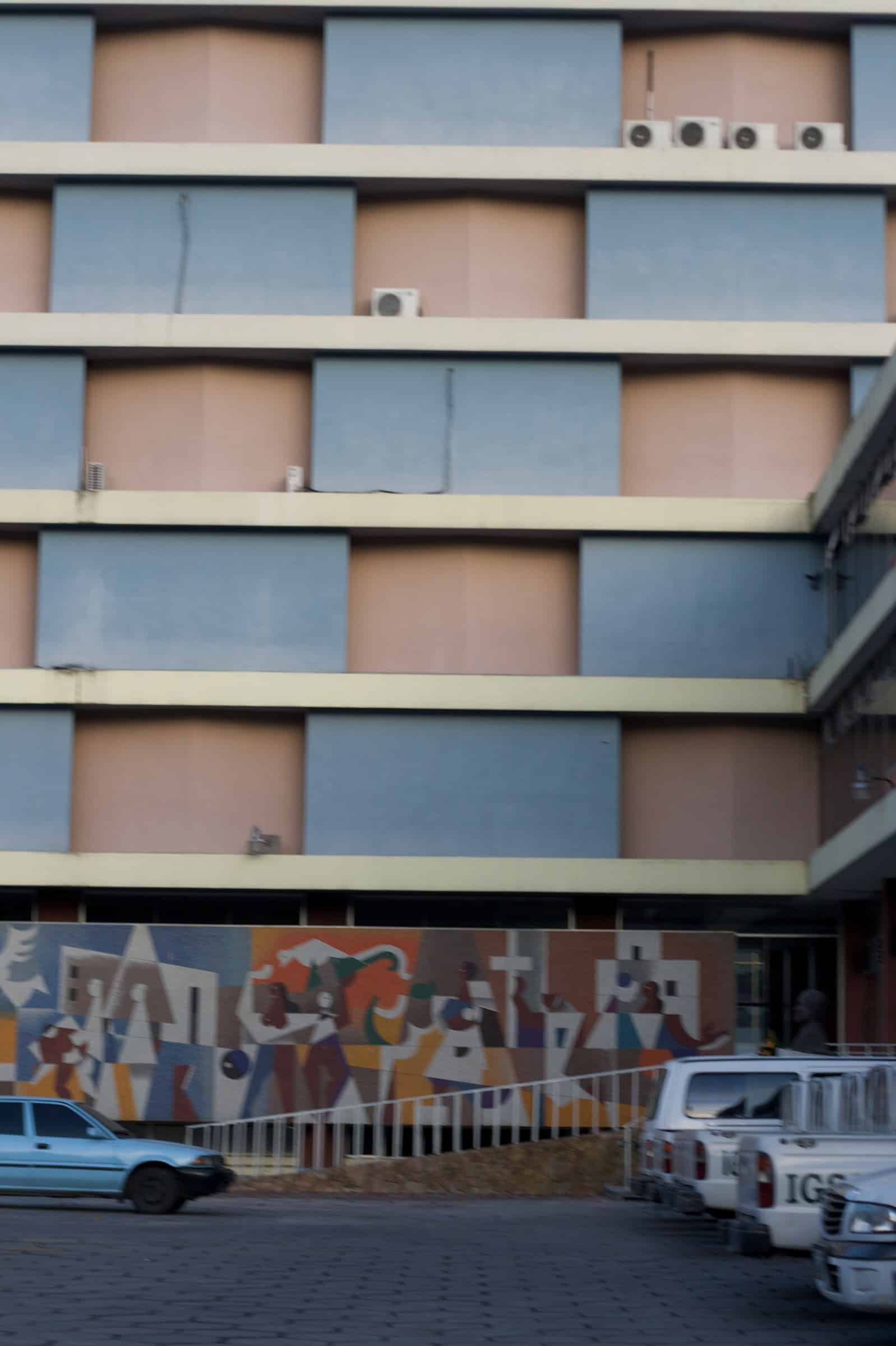 The main entrance of the Guatemalan Social Security Institute in Guatemala City’s Civic Center. Image by Lestrada via Wikimedia Commons, licensed under Public domain.
Those two contexts provide a practical route into his work. A museum sculpture should be distinguished from the murals encountered as part of civic architecture, yet both belong to the same career. Medium, location, and the connection to the Civic Center are the most dependable identifying fields supported across the available records.
Efraín Recinos (1928-2011)
| Dates: | 1928-2011 |
| Guatemala connection: | Guatemalan designer of major civic and cultural projects |
| Principal media: | Architecture, engineering, sculpture, painting, murals, and design |
| Anchor work or strategy: | Centro Cultural Miguel Ángel Asturias |
| Recognition cue: | A public project joining his work as an artist, engineer, architect, and designer |
Efraín Recinos worked across painting, sculpture, murals, engineering, architecture, design, and urbanism. His defining public project is the Centro Cultural Miguel Ángel Asturias, inaugurated in Guatemala City in 1978. He also contributed murals to the wider Civic Center.
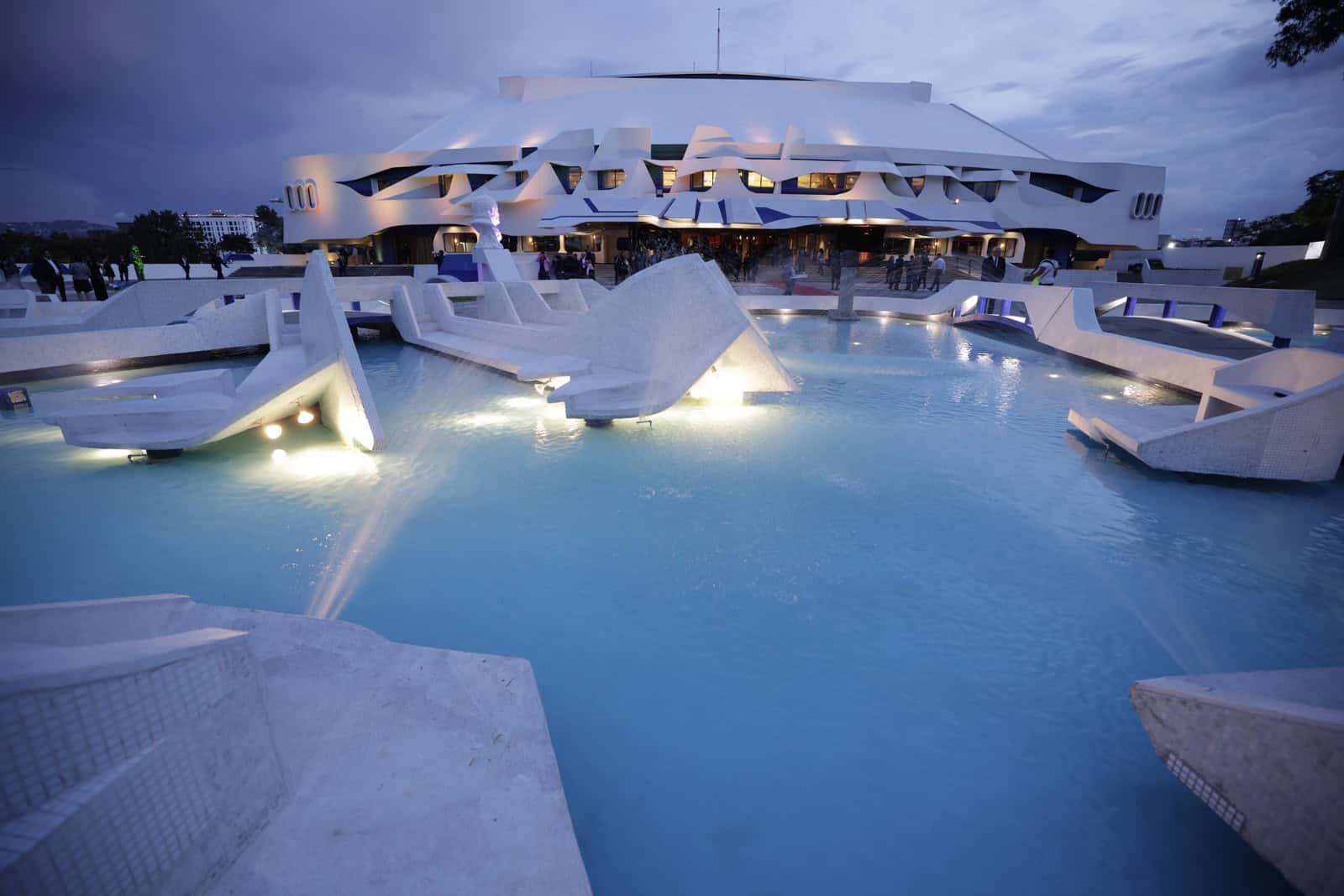 The Centro Cultural Miguel Ángel Asturias in Guatemala City, designed by Efraín Recinos. Image by Gobierno de Guatemala via Wikimedia Commons, licensed under Public domain.
Recinos demonstrates how a Guatemalan visual artist could shape an entire cultural building rather than contribute only an object placed inside one. The cultural center is therefore the best starting point for recognizing the scale of his practice. It brings together several professional roles that are often separated in accounts of art and architecture.
Abstraction, Experiment, and the Human Gaze
Margarita Azurdia, Rodolfo Abularach, and Luis González Palma each moved beyond straightforward narrative through a different organizing device. Textile-related geometry led Azurdia across changing media, Abularach repeatedly isolated the eye, and González Palma used the direct gaze within mixed-media photography.
Margarita Azurdia (1931-1998)
| Dates: | 1931-1998 |
| Guatemala connection: | Guatemalan experimental artist |
| Principal media: | Painting, sculpture, participatory installation, dance, and artist books |
| Anchor work or strategy: | The Geométricas series |
| Recognition cue: | Diamond and lozenge geometry followed by shifts into sculpture, participation, dance, or books |
In her Geométricas, Margarita Azurdia joined modern abstraction to diamond and lozenge forms associated with Maya women’s huipils. These textile-linked structures distinguish the series from Carlos Mérida’s separate engagement with geometric abstraction and Mesoamerican references.
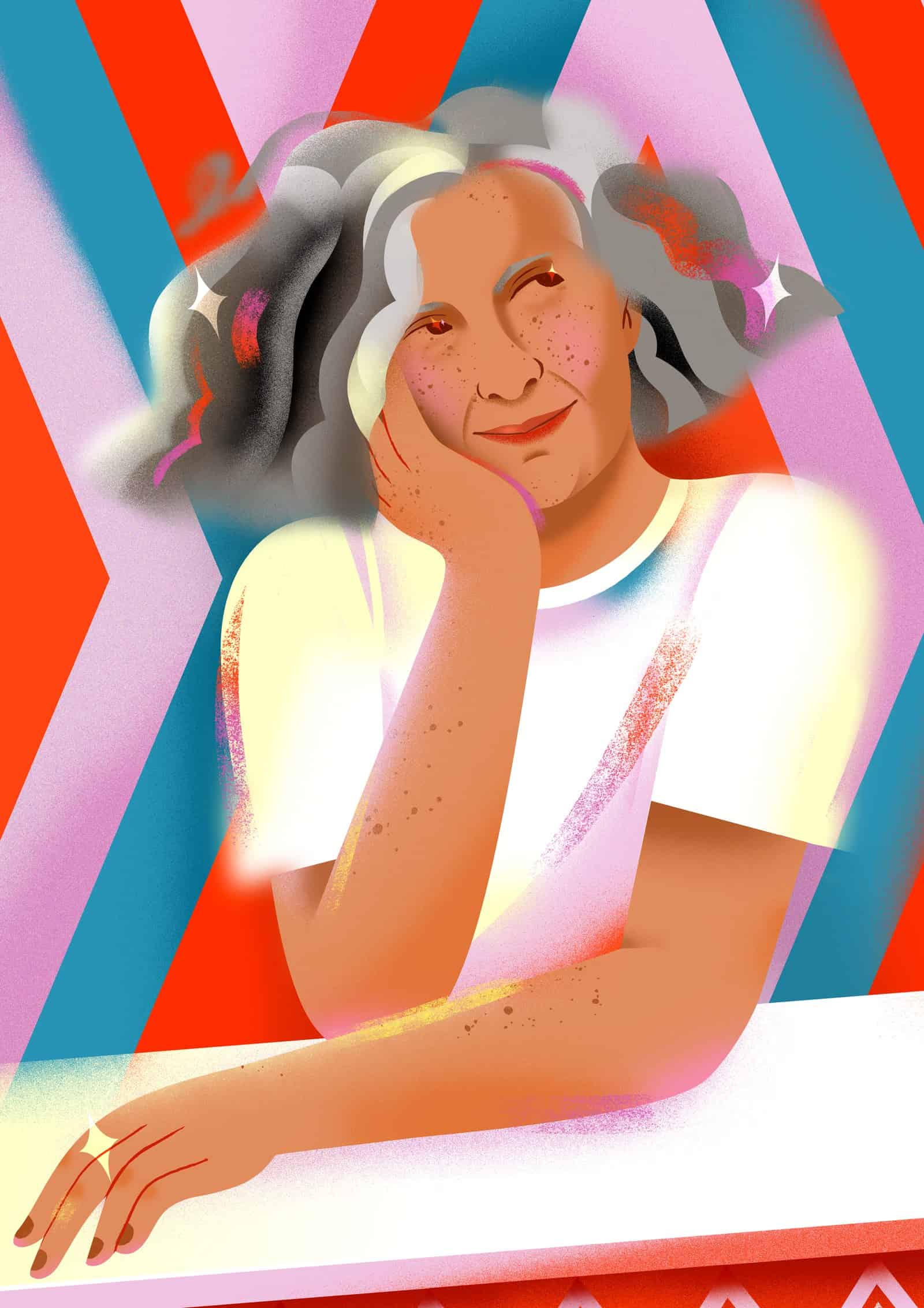 An illustrated portrait of Guatemalan multimedia artist Margarita Azurdia. Image by Elenaresko via Wikimedia Commons, licensed under CC BY-SA 4.0.
Geometry was one phase within a deliberately wide-ranging practice. Azurdia moved into carved sculpture, participatory installations, dance, performance, and artist books. That change of medium is itself useful recognition guidance: her career cannot be identified by geometric paintings alone.
Rodolfo Abularach (1933-2020)
| Dates: | 1933-2020 |
| Guatemala connection: | Guatemalan artist represented in major museum collections |
| Principal media: | Drawing, painting, and printmaking |
| Anchor work or strategy: | The recurring isolated human eye |
| Recognition cue: | A greatly enlarged eye separated from the rest of the face |
Rodolfo Abularach repeatedly enlarged and isolated the human eye across drawings, paintings, and prints. Removed from the rest of the face, the organ becomes both a subject and a structure through which he could revisit the act of looking in different media.
The eye should not be mistaken for a one-work novelty. Its recurrence across his mature practice allowed him to vary technique while retaining a recognizable subject. The strongest clue is the separation of the eye from a complete portrait, making vision itself more prominent than the identity of a sitter.
Luis González Palma (born 1957)
| Dates: | Born 1957 |
| Guatemala connection: | Born in Guatemala |
| Principal media: | Photography and mixed media |
| Anchor work or strategy: | Sepia-toned portraits with selectively untinted eyes |
| Recognition cue: | A direct photographic gaze intensified by sepia toning and comparatively clear eyes |
Luis González Palma’s photographs often combine sepia toning with eyes left comparatively untinted. The contrast directs attention toward the sitter’s gaze. Catholic and Indigenous symbolism enters works concerned with memory, identity, dignity, and the unequal terms under which people are represented.
His practice belongs to mixed-media art because photography is combined with additional materials and processes. Compare his portraits with Abularach’s eye images: Abularach separates the eye from the sitter, while González Palma retains the portrayed person and makes the exchange of looks central.
Art During the Conflict and the Postwar Turn
Guatemalan art made during the civil conflict and after the 1996 peace accords did not adopt one political style. Institutional surveys connect wartime production with a later generation for whom performance, video, and public action became especially forceful ways to address structural violence.
Video did more than confirm that a temporary action had occurred. Within this new media art milieu, recording and later presentation extended ephemeral performances to audiences beyond the original event.
Rosa Elena Curruchich Bal (1958-2005)
| Dates: | 1958-2005 |
| Guatemala connection: | San Juan Comalapa painter and granddaughter of Andrés Curruchich |
| Principal media: | Miniature oil painting |
| Anchor work or strategy: | Portable paintings of traditions, ceremonies, women’s work, and community life |
| Recognition cue: | A miniature oil scene centered on local activity or women’s roles |
Rosa Elena Curruchich Bal continued the Comalapa painting lineage while giving particular attention to women’s lives. Her miniature oils depict work, ceremonies, traditions, and shared community activity. Although she was Andrés Curruchich’s granddaughter, her scale and wartime circumstances distinguish her practice from his.
She painted secretly after receiving threats during the civil war, and the miniature format could be concealed and carried. Size was therefore both an artistic characteristic and a practical response to danger. The portable format helped preserve and transport images of community experience.
Aníbal López, also known as A-1 53167 (1964-2014)
| Dates: | 1964-2014 |
| Guatemala connection: | Guatemalan artist of the postwar generation |
| Principal media: | Performance, public actions, and conceptual art |
| Anchor work or strategy: | Performance and public-space actions presented under A-1 53167 |
| Recognition cue: | A performance or public action credited to Aníbal López or A-1 53167 |
Aníbal López frequently worked under A-1 53167, a pseudonym derived from his identity-card number. It is a chosen artistic identifier rather than the title of one work or a recurring visual motif. Recognizing both names is essential when following his practice across institutional records.
López belonged to a postwar generation that used performance and public space to confront social realities. His work is consequently approached through actions, their settings, and surviving documentation as well as through conventional objects. The relevant performance art context is public and situational.
Darío Escobar (born 1971)
| Dates: | Born 1971 |
| Guatemala connection: | Born in Guatemala City |
| Principal media: | Sculpture and installation |
| Anchor work or strategy: | Untitled, a skateboard covered in handcrafted silver and tin |
| Recognition cue: | A mass-produced or sporting object transformed through craft, metalwork, or ornament |
Darío Escobar begins with objects that already circulate through commerce and leisure. Mass-produced and sporting forms meet skilled craft, precious materials, religious ornament, and references to colonial and consumer culture. The original function remains identifiable even as its status changes.
His silver-and-tin-covered skateboard is an especially clear example. A board associated with use becomes a handcrafted display object. The meeting of commodity, regional craft, and ornament is the practical clue that separates Escobar’s work from an unaltered consumer product.
Regina José Galindo (born 1974)
| Dates: | Born 1974 |
| Guatemala connection: | Born in Guatemala City |
| Principal media: | Performance and video |
| Anchor work or strategy: | Socially and politically engaged performance centered on embodied witnessing |
| Recognition cue: | A performance or video addressing war, state violence, inequality, or discrimination |
Regina José Galindo uses performance and video to address the civil war, state violence, inequality, and racial and gender discrimination. Her embodied actions connect political conditions with the ethics of witnessing rather than presenting violence as an abstract historical subject.
Performance and its recorded form must be considered together. The original action involves a particular place and audience, while video allows later viewers to encounter a framed record. Subject, medium, and Galindo’s use of the performing body provide the clearest recognition cues.
Materials as Memory in Contemporary Practice
Textiles, theatrical methods, soil, plants, and fire do not represent one Guatemalan or Indigenous style. Sandra Monterroso’s Q’eqchi’ ancestry, Edgar Calel’s Kaqchikel family and community relationships, and Naufús Ramírez-Figueroa’s use of theater and historical memory produce distinct practices. Their materials gain meaning through specific languages, histories, and working relationships.
Sandra Monterroso (born 1974)
| Dates: | Born 1974 |
| Guatemala connection: | Guatemalan artist engaging her Q’eqchi’ Maya ancestry |
| Principal media: | Textiles, natural dyes, installation, performance, and video |
| Anchor work or strategy: | Textiles and natural dyes used to address gender, colonial legacies, and healing |
| Recognition cue: | Textile or natural-dye work presented through installation, performance, or video |
Sandra Monterroso works with textiles and natural dyes to address gender, power, colonial legacies, healing, and her Q’eqchi’ Maya ancestry. Her practice also includes installation, performance, and video, so cloth may operate within an action or spatial arrangement rather than as an isolated object.
Textile and dye are more dependable recognition cues than the idea of a general Indigenous appearance. Monterroso’s work is rooted in a specific Q’eqchi’ relationship and set of concerns. It differs from Calel’s Kaqchikel practice in community affiliation, material emphasis, and mode of collaboration.
Naufús Ramírez-Figueroa (born 1978)
| Dates: | Born 1978 |
| Guatemala connection: | Born in Guatemala City |
| Principal media: | Performance, sculpture, installation, video, drawing, costume, and theater |
| Anchor work or strategy: | Lugar de Consuelo, 2015-2020 |
| Recognition cue: | A staged work using performance, theatrical methods, costumes, or props to approach history |
Naufús Ramírez-Figueroa works across performance, sculpture, installation, video, drawing, costumes, and experimental theater. These media allow historical subjects to be approached through staged actions and constructed settings rather than through a single permanent form.
Lugar de Consuelo engages colonial memory, state violence, and civil-war history through a censored Guatemalan play from 1962. Theater is therefore part of the work’s historical method, not merely its appearance. Costumes, props, performance, and the connection to that play provide concrete ways to identify the project.
Edgar Calel (born 1987)
| Dates: | Born 1987 |
| Guatemala connection: | Maya Kaqchikel artist born in Chi Xot, San Juan Comalapa |
| Principal media: | Drawing, painting, sculpture, installation, performance, and embroidery |
| Anchor work or strategy: | Family collaboration and offerings involving soil, stone, fire, plants, language, or cloth |
| Recognition cue: | An installation or action connecting natural materials with family, place, Kaqchikel language, and offerings |
Edgar Calel works through Maya Kaqchikel language, family relationships, community life, and the specific place of Chi Xot. His practice can involve embroidery, painting, drawing, performance, soil, stones, plants, fire, and offerings. Members of his family may participate as collaborators rather than appearing only as subjects.
These elements belong to living relationships involving family, place, language, and sacred knowledge. They should not be reduced to decorative symbols or a fixed Indigenous style. Recognizing Calel’s practice means attending to the connections among the materials, the people involved, and the Kaqchikel context that activates them.
A Field Guide to Recognizing Their Work
Use two passes when comparing these artists. First identify the medium and scale: community oil, architectural mural, sculpture, toned photograph, altered commodity, recorded performance, textile installation, staged theater, or material offering. Then identify the artist’s organizing strategy, such as documenting local life, developing geometry, isolating the eye, transforming a manufactured object, or connecting materials with language and family.
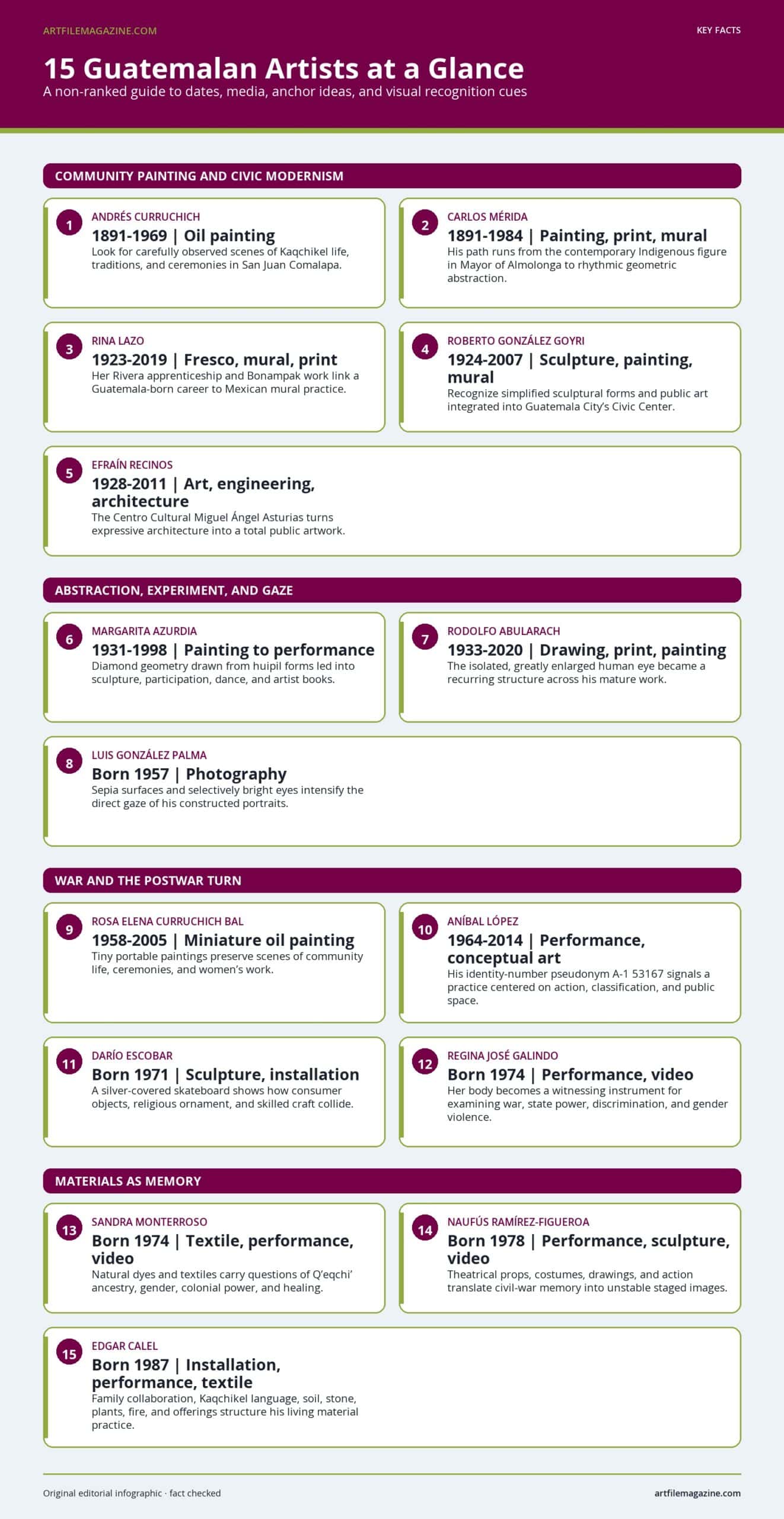
Andrés Curruchich and Rosa Elena Curruchich Bal both painted community life in San Juan Comalapa. Andrés is associated with oil scenes of daily life, traditions, and rites, while Rosa Elena worked in portable miniature oils that often centered ceremonies and women’s work. Their family relationship matters, but format and wartime circumstances distinguish their practices.
For public and architectural art, Carlos Mérida links early Indigenous representation with later geometric abstraction and mural work. Rina Lazo connects fresco and printmaking with Rivera’s workshop and the Bonampak replicas. Roberto González Goyri is documented through both Wolf’s Head and Civic Center murals, while Efraín Recinos joined art, engineering, and design in the Centro Cultural Miguel Ángel Asturias.
The eye separates two otherwise different practices. Rodolfo Abularach repeatedly isolates and enlarges the organ across drawing, painting, and printmaking. Luis González Palma retains the portrayed person, using sepia toning, comparatively untinted eyes, and a direct gaze within mixed-media photography.
Among artists associated with the postwar milieu, Aníbal López can appear under the identity-number pseudonym A-1 53167 and worked through performance and public space. Darío Escobar transforms sporting and consumer objects through craft and ornament. Regina José Galindo uses performance and video to examine violence, inequality, and discrimination through embodied witnessing.
The three youngest practices separate through both material and cultural context. Sandra Monterroso works with textiles, natural dyes, and her Q’eqchi’ ancestry. Naufús Ramírez-Figueroa brings performance, costumes, and experimental theater to historical subjects. Edgar Calel connects Kaqchikel language and family collaboration with soil, stone, fire, plants, embroidery, and offerings. Similar materials should never erase these distinct affiliations and methods.
Frequently Asked Questions
Guatemalan visual art spans community traditions, civic projects, and experimental media. These questions clarify several connections that cut across the individual profiles.
What is Guatemalan visual art known for?
Guatemalan visual art includes several distinct traditions rather than one national style. They range from Kaqchikel community painting, modern abstraction, and Mexican-influenced muralism to civic architecture, mixed-media photography, postwar performance and video, transformed consumer objects, textile practices, and land-based installation. Maya identity enters particular practices through documented languages, communities, places, and family knowledge.
How did the Guatemalan civil conflict affect contemporary art?
The conflict affected what could be represented, how safely artists could work, and how memory could be carried. Rosa Elena Curruchich Bal painted secretly after receiving threats and used a portable miniature format during the war. Around and after the 1996 peace accords, performance and video became especially forceful means of confronting structural violence and extending temporary public actions to later audiences.
Which Guatemalan women artists should I know?
Rina Lazo connects Guatemala with the Mexican fresco tradition. Margarita Azurdia moved from huipil-related geometry into sculpture, participation, dance, and artist books. Rosa Elena Curruchich Bal recorded community life and women’s work in wartime miniatures. Regina José Galindo uses performance and video to examine violence and discrimination, while Sandra Monterroso works with textiles, natural dyes, Q’eqchi’ ancestry, gender, colonial legacies, and healing.
Where can I see works by Guatemalan artists?
Guatemala City’s Civic Center and the Centro Cultural Miguel Ángel Asturias are important public starting points for architecture-integrated art. Museum collection records also document works by Carlos Mérida, Roberto González Goyri, Rodolfo Abularach, Luis González Palma, Rosa Elena Curruchich Bal, Darío Escobar, and Naufús Ramírez-Figueroa. A collection record does not necessarily mean that a work is currently displayed, so consult the venue’s current listings before visiting.
Jaycene-Fay Ravenscroft is a writer, poet, and creative based in South Africa, boasting over 6 years of experience working in a contemporary art gallery. She earned her Bachelor of Arts degree with majors in Art History and Ancient History from the University of South Africa, supplementing her studies with courses in Archaeology and Anthropology. Driven by a passion for learning, Jaycene-Fay finds inspiration in symbology and the interconnectedness of the world. Trained to analyze and critique art, she is enthusiastic about delving into the meanings behind each artwork, exploring its ties to the artist’s cultural, historical, and social context. Writing serves as Jaycene-Fay’s means of researching, sharing knowledge, and creatively expressing herself. For artfilemagazine, Jaycene-Fay writes articles on art history with a focus on historical paintings.
Learn more about Jaycene-Fay Ravenscroft and about us.
Cite this Article
Jaycene Fay, Ravenscroft, “15 Guatemalan Artists: Works, Media, and Visual Clues.” artfilemagazine – Your Online Art Source. September 16, 2026. URL: https://artfilemagazine.com/guatemalan-artists/
Ravenscroft, J. (2026, 16 September). 15 Guatemalan Artists: Works, Media, and Visual Clues. artfilemagazine – Your Online Art Source. https://artfilemagazine.com/guatemalan-artists/
Ravenscroft, Jaycene Fay. “15 Guatemalan Artists: Works, Media, and Visual Clues.” artfilemagazine – Your Online Art Source, September 16, 2026. https://artfilemagazine.com/guatemalan-artists/.