

Honduran Artists: 12 Modern and Contemporary Figures
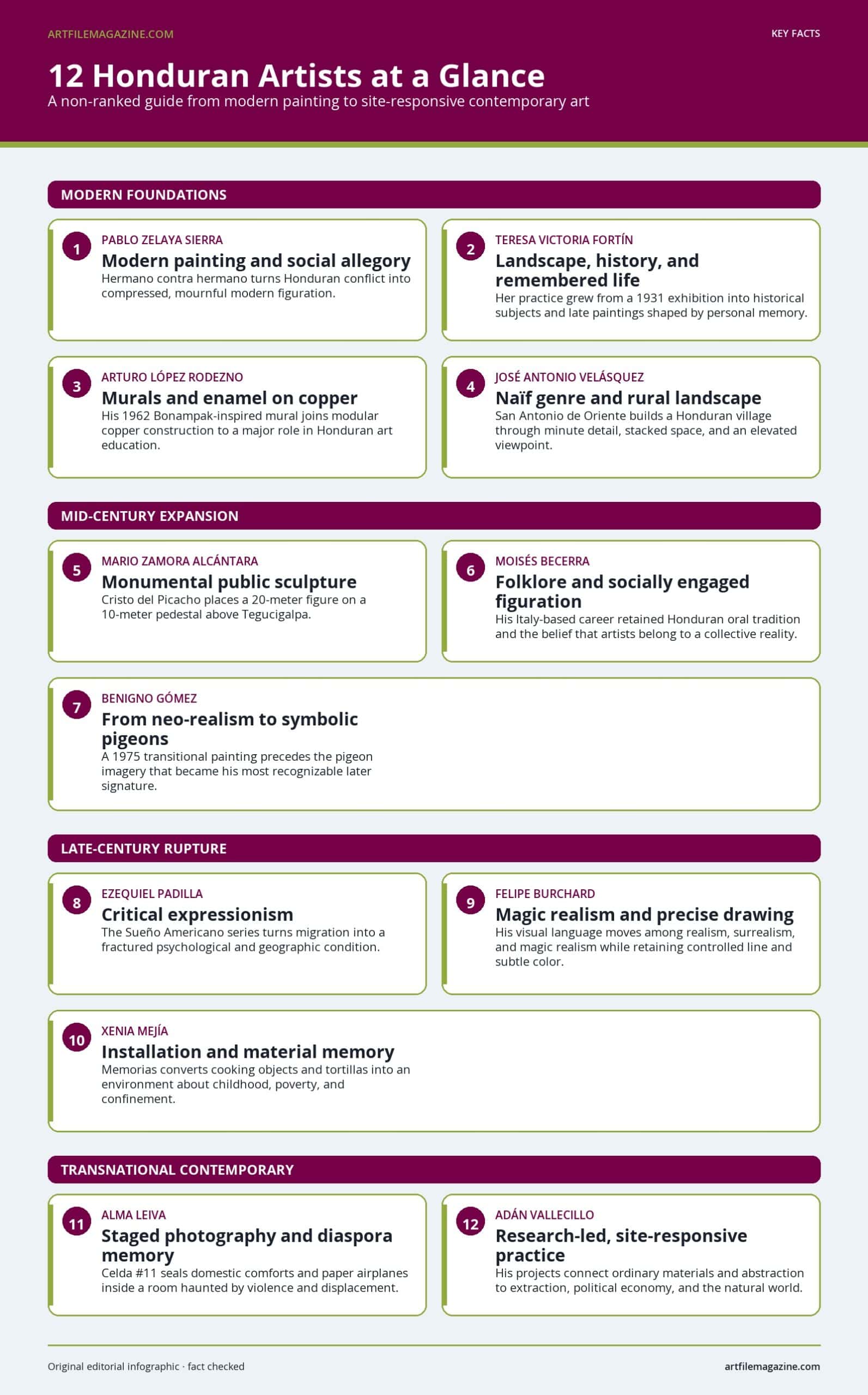
A meticulously inventoried village, a mural assembled from enamel-coated copper plates, and a staged room scattered with paper airplanes open three very different doors into Honduran art. These 12 artists show how painting remained vital even as sculpture, photography, installation, and research-led projects expanded the field. The payoff is a practical guide to why each figure matters, which work to look for, and what makes that practice recognizable.
Honduran art through twelve distinct practices
Honduran visual art did not develop through a tidy sequence in which one style replaced another. Modern painters introduced new ways to simplify figures and confront national conflict, while self-taught artists built densely observed worlds outside academic conventions. Public monuments, collective workshops, installation, photography, and projects shaped by specific sites later enlarged the field without making painting obsolete.
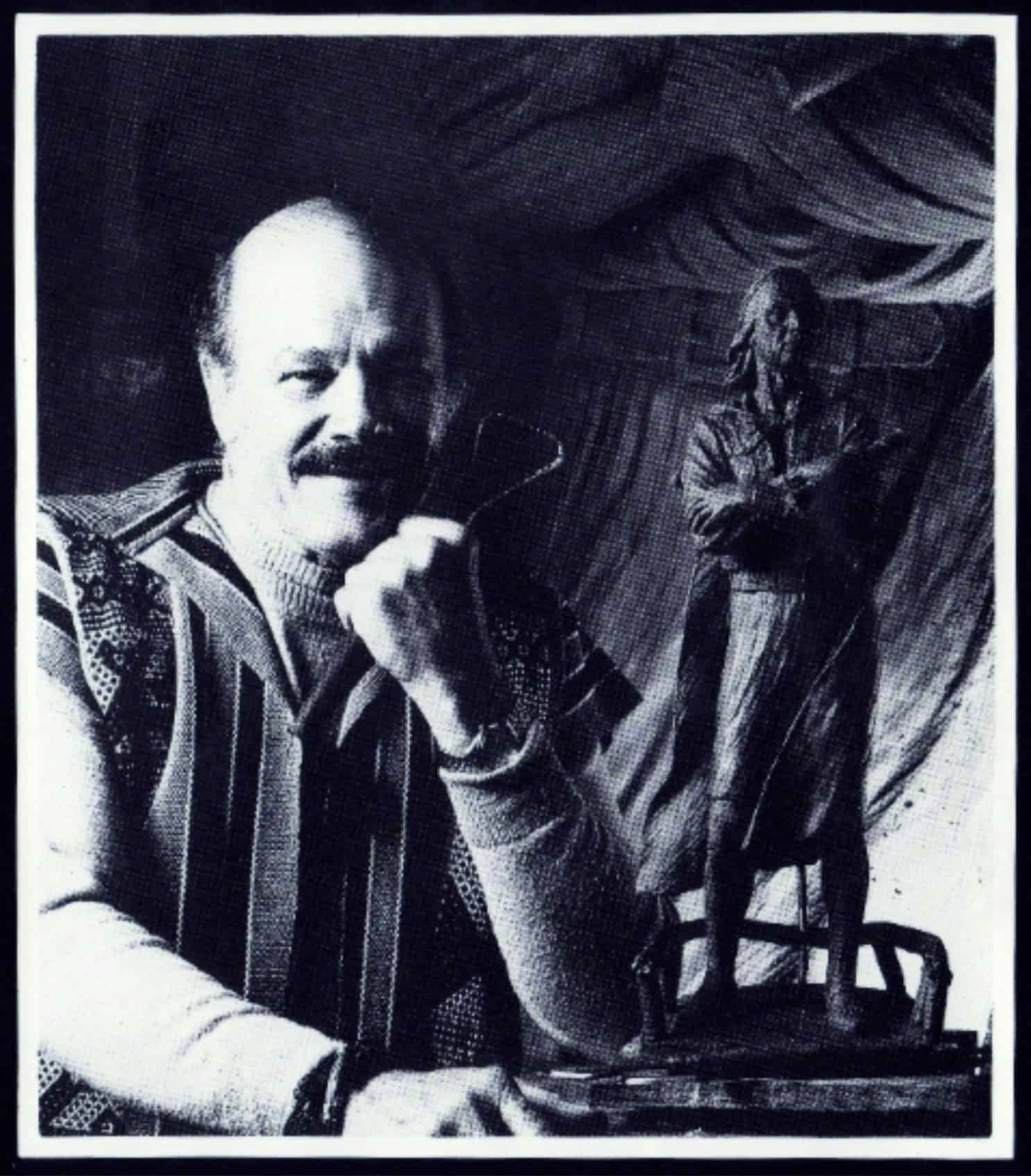 Mario Zamora Alcántara with the model for a Christopher Columbus monument installed in California in 1991. Image by Raulzampe via Wikimedia Commons, licensed under CC BY-SA 4.0.
The National School of Fine Arts, known by its Spanish initials ENBA, provided a lasting center for formal instruction from 1940. The Taller de la Merced became an important collective setting for political and cross-disciplinary experimentation during the 1970s. By the 1990s, installation, digital photography, and video had joined the country’s established types of visual art. Recent practices have carried those experiments into museums and location-specific projects beyond Honduras.
One term needs clarification before the profiles begin. Naïf art describes a visual language developed outside formal academic convention, often through direct observation, unconventional perspective, and concentrated detail. Older records sometimes use “primitivist,” a dated label best understood as part of the historical record rather than a neutral description.
Modern foundations, mid-century public work, later experimentation, and transnational practice overlap across generations. Those overlaps matter. The clearest way to understand these Honduran artists is to follow what they did with space, materials, memory, and public experience.
Modern foundations and public institutions
The first four figures reveal several routes into modern Honduran art. European study mattered for some, formal schooling remained unnecessary for others, and emerging exhibition and educational institutions created new ways for artists to reach a public.
Pablo Zelaya Sierra
| Relationship to Honduras: | Honduran painter treated as a foundational figure in the country’s modern painting |
| Principal medium: | Modern figurative painting about social conflict |
| Formative context: | Artistic study in Madrid before his return to Honduras in 1932 |
| Representative example: | Hermano contra hermano |
| Documented reach: | A central position in institutional and scholarly histories of modern Honduran painting |
| Recognition cue: | Simplified, tightly grouped figures carrying the emotional weight of social conflict |
Pablo Zelaya Sierra brought experience gained in Madrid into a Honduran setting marked by political fracture. Instead of importing a ready-made European formula, he simplified bodies and pressed them into tense arrangements that made local experience newly visible. Gesture and spacing could carry meaning without the descriptive fullness expected from conventional historical painting.
Hermano contra hermano, or “Brother Against Brother,” responds to conflict in Honduras. Its subject is national, but the title reduces political violence to the terrible intimacy of one person facing another. That conversion of history into human confrontation is the key recognition clue. Look for figures tightened into an emotionally concentrated encounter, with incidental detail giving way to posture, gesture, and pressure between bodies.
Teresa Victoria Fortín
| Relationship to Honduras: | An early woman participant in twentieth-century Honduran exhibition culture |
| Principal medium: | Painting in multiple techniques |
| Formative context: | A first exhibition in 1931 developed under the guidance of Pablo Zelaya Sierra and Max Euceda |
| Representative example: | La Boda que nunca fue, 1977 |
| Documented reach: | A long practice represented in Honduran university collections and archival exhibitions |
| Recognition cue: | Vividly combined landscape colors; animated mythological or literary scenes; terra laca on reused cardboard in the 1968 landscape Río Piedras |
Teresa Victoria Fortín entered Honduran exhibition culture in 1931. Her practice cannot be contained by that biographical milestone. She worked across landscapes, historical narratives, literary subjects, and several techniques, giving her career an unusual span between outward observation and inward recollection.
The 1977 painting La Boda que nunca fue, “The Wedding That Never Was,” belongs to her late memory-based work. Across her career, subject and material provide firmer clues than biography alone. Early reviews noted vivid landscape perception, distinctive combinations of color, and animated fantasies drawn from mythology, poetry, and religious history. The 1968 landscape Río Piedras adds a material marker: terra laca applied to reused commercial cardboard. Her later memory paintings returned to oil on canvas.
Arturo López Rodezno
| Relationship to Honduras: | Honduran artist and organizer of the National School of Fine Arts |
| Principal medium: | Monumental murals, including enamel on copper |
| Formative context: | Helped organize the ENBA in 1940 and directed it through 1951 |
| Representative example: | The 1962 Bonampak-inspired enamel-on-copper mural |
| Documented reach: | Long-term influence through art education and monumental public work |
| Recognition cue: | Pre-Hispanic imagery translated into modular metal surfaces and a long horizontal format |
Arturo López Rodezno joined art making to institution building. His role in organizing the ENBA in 1940, followed by more than a decade as its director, helped give formal training a durable place in Honduran cultural life. That educational work makes him essential to the story, but his objects also demonstrate a distinctive meeting of historical reference, architecture, and material experiment.
His 1962 mural draws on imagery from Bonampak and stretches 14 meters long while standing 1.2 meters high. Multiple copper plates form its support, with enamel providing the image-bearing surface. Instead of treating pre-Hispanic imagery as a small archaeological quotation, López Rodezno enlarged it into an architectural encounter. The recognition cues are scale, lateral movement, repeated units, and the visible logic of an image assembled from separate metal sections.
José Antonio Velásquez
| Relationship to Honduras: | Self-taught Honduran artist closely associated with San Antonio de Oriente |
| Principal medium: | Naïf genre painting and rural landscape |
| Formative context: | A visual language developed outside academic art training |
| Representative example: | San Antonio de Oriente, circa 1970 |
| Documented reach: | Recognition in Honduran collections and international museum contexts |
| Recognition cue: | Elevated viewpoints, meticulous detail, and many juxtaposed elements sharing one scene |
José Antonio Velásquez made San Antonio de Oriente a recurring visual subject. His genre paintings, meaning scenes centered on places and ordinary life, do not imitate a single glance. They assemble many observations into one carefully ordered field, allowing buildings, terrain, people, and daily activity to remain individually legible.
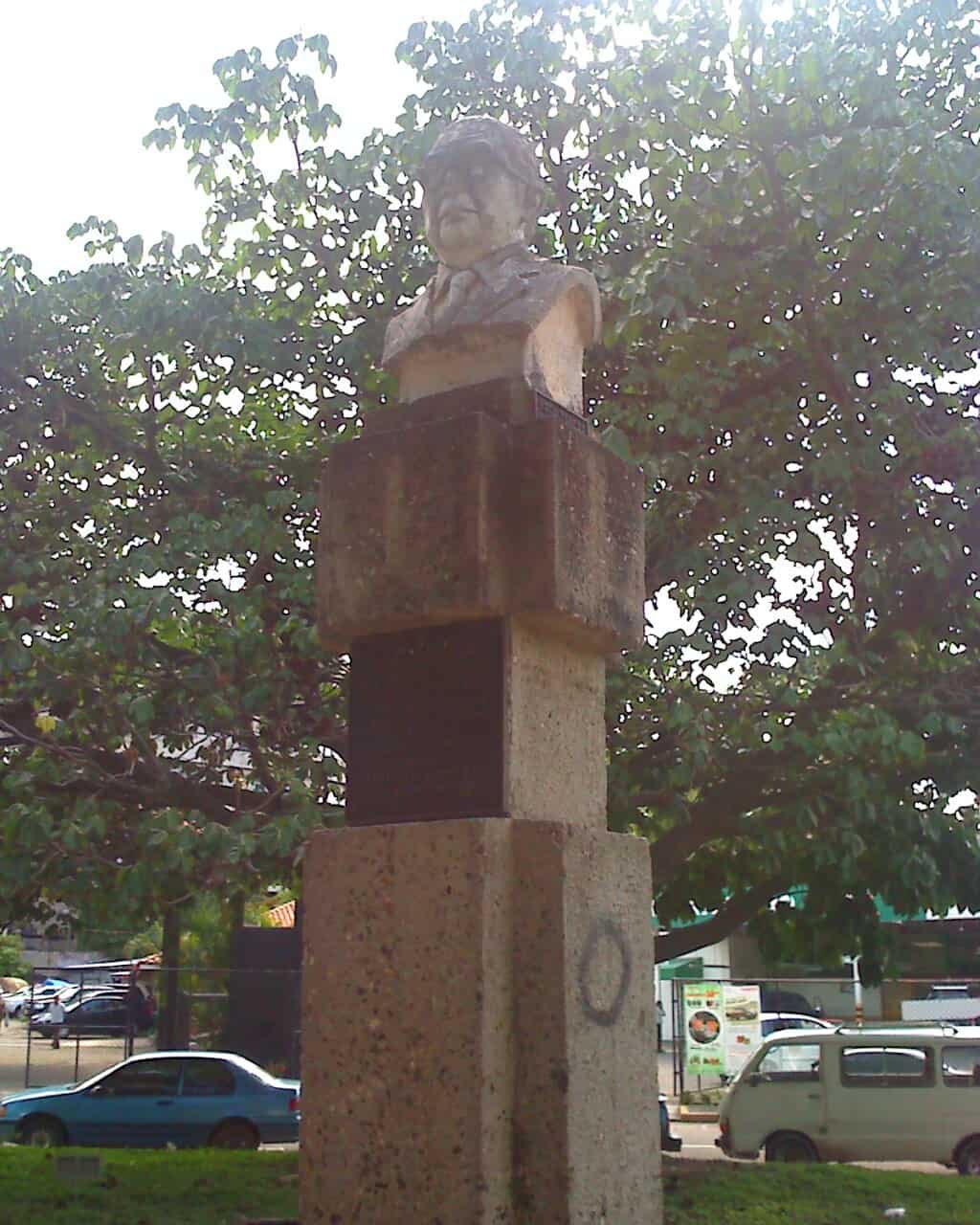 A sculpture of painter José Antonio Velásquez in Tegucigalpa’s Redondel de los Artesanos. Image by Ccet via Wikimedia Commons, licensed under CC BY-SA 3.0.
The circa-1970 San Antonio de Oriente uses an elevated viewpoint and a dense accumulation of detail to construct the village as a whole environment. Conventional depth may matter less than the desire to keep each element available to the eye. That makes Velásquez comparatively easy to recognize: scan for stacked space, crisp separation among forms, and the feeling that the artist has inventoried a community without draining it of movement. His work shows why self-taught does not mean casual or unstructured.
Public sculpture and mid-century exchange
By the middle and later twentieth century, Honduran artists were moving between national schools, overseas study, teaching, and civic commissions. These exchanges enlarged the audience for art. They also expanded its physical scale, from intimate easel paintings to sculpture embedded in the public image of Tegucigalpa.
Mario Zamora Alcántara
| Relationship to Honduras: | Honduran sculptor associated with major national and civic commissions |
| Principal medium: | Marble sculpture and monumental reinforced concrete |
| Formative context: | The expansion of Honduran visual art into civic-scale public work |
| Representative example: | Cristo del Picacho |
| Documented reach: | A marble ensemble for the Legislative Palace and a landmark above Tegucigalpa |
| Recognition cue: | Large, simplified volumes designed to register from a considerable distance |
Mario Zamora Alcántara shifted the encounter with Honduran art from the gallery wall to civic space. His marble sculptural ensemble for the Legislative Palace placed three-dimensional work inside a national political setting. Cristo del Picacho carried that public visibility further by connecting sculpture to landscape and the skyline of the capital.
The reinforced-concrete figure of Christ stands 20 meters high on a 10-meter pedestal and was inaugurated on January 16, 1998. Those measurements are not incidental. Monumental sculpture must communicate across distance, weather, changing light, and a moving audience. Zamora’s recognition cue is therefore volume before surface detail. First read the silhouette, the relationship between figure and pedestal, and the way the surrounding site completes the work. Only then move closer to individual forms.
Moisés Becerra
| Relationship to Honduras: | Honduran artist whose career continued in Italy without abandoning Honduran sources |
| Principal medium: | Figurative painting shaped by folklore, oral tradition, and social concerns |
| Formative context: | An Italy-based practice sustained through continued attention to Honduran experience |
| Representative example: | Luchemos, 1971 |
| Documented reach: | An international career and a documented commitment to the artist’s social role |
| Recognition cue: | Simplified dancers and workers organized through rhythm, with restrained expressions that yield to the movement of the composition |
Moisés Becerra complicates the assumption that residence determines artistic identity. Living and working in Italy widened his geographic field, yet Honduran folklore and oral tradition remained recurring sources. His practice demonstrates how migration can alter an artist’s conditions without erasing the cultural material carried into a new setting.
The title Luchemos, “Let Us Struggle,” gives his 1971 painting a collective imperative. That public address aligns with his documented view that an artist has a social role rather than an isolated decorative function. His broader body of work provides a concrete way to recognize that position: dancers and workers are built from strongly simplified shapes and arranged for harmony and rhythm. Their restrained facial expressions allow the movement of the whole composition to lead. Look for recognizable people and customs distilled into clear shapes and organized motion.
Benigno Gómez
| Relationship to Honduras: | Honduran painter who studied and later taught at the ENBA |
| Principal medium: | Painting moving through neo-realism, surrealism, and symbolic imagery |
| Formative context: | Entered the ENBA in 1950 and studied in Rome during the 1960s |
| Representative example: | Untitled, 1975 |
| Documented reach: | Overseas study followed by a teaching role in Honduran art education |
| Recognition cue: | Later paintings repeatedly use pigeons as a personal visual signature |
Benigno Gómez traveled a route from student to international trainee to teacher. He entered the ENBA in 1950, studied in Rome during the 1960s, and later returned to teach at the Honduran school. His career therefore links institutional continuity with stylistic change: the same school could serve as a place of formation and as a base for ideas transformed abroad.
The 1975 Untitled painting belongs to a period of searching between neo-realism and surrealism. Here, neo-realism signals a renewed engagement with recognizable life rather than strict adherence to conventional realism. The absence of a descriptive title puts more pressure on the image’s structure and symbols. In Gómez’s later work, pigeons provide the most immediate recognition cue. Their recurrence turns a familiar animal into a personal motif whose meaning depends on its placement, repetition, and relationship to the surrounding figures or space.
Rebellion, memory, and the expanded image
The Taller de la Merced provided a 1970s collective context in which experimentation, political engagement, and contact with other arts could reinforce one another. Seen beside broader shifts in 1970s art, its importance lies in opening possibilities rather than prescribing one Honduran style. Later artists could intensify painting, cross between realism and dream logic, or leave the framed image behind.
 Exercise CENTAM GUARDIAN 24 phase one participants watch Honduran Special Forces demonstration (8343105). Image by Erica Bechard via Wikimedia Commons, licensed under Public domain.
Ezequiel Padilla
| Relationship to Honduras: | Honduran painter whose work addresses social conflict and migration |
| Principal medium: | Painting that moved from broken-up Cubist structure to a harsher, socially critical style |
| Formative context: | An early engagement with analytical Cubism followed by increasingly forceful social expression |
| Representative example: | The Sueño Americano series, 2015 |
| Documented reach: | Institutional exhibitions trace his changing visual language and political concerns |
| Recognition cue: | Fractured space and agitated figures that deny the viewer a stable position |
Ezequiel Padilla’s development makes stylistic labels useful only when treated as movement, not as boxes. Analytical Cubism breaks visible forms into parts so their structure can be examined from more than one angle. Padilla pushed beyond that method toward a harsher style in which distortion communicated criticism, psychological pressure, and social instability.
His 2015 Sueño Americano, or “American Dream,” series treats migration as both a geographic passage and a disorienting mental condition. The familiar phrase promises arrival and improvement, while the images insist on rupture and uncertainty. To distinguish Padilla from Zelaya Sierra, compare their treatment of conflict. Zelaya Sierra tightens simplified bodies into a mournful confrontation; Padilla makes the entire picture feel unsettled. Broken continuity, strained bodies, and unstable spatial relationships are the practical clues.
Felipe Burchard
| Relationship to Honduras: | Self-taught Honduran artist with sustained national exhibition recognition |
| Principal medium: | Painting and drawing across realism, surrealism, and magic realism |
| Formative context: | A self-directed practice grounded in precise drawing and controlled color |
| Representative example: | Figura arácnida, undated |
| Documented reach: | Numerous exhibitions, a 2007 national art prize, and a 2009 retrospective |
| Recognition cue: | Precise outlines and restrained color applied to figures whose anatomy or setting turns uncanny |
Felipe Burchard shows that self-taught practice can be technically controlled and stylistically mobile. His work moves among recognizable description, surreal combinations, and magic realism. In visual art, magic realism keeps objects and spaces convincingly tangible while allowing an improbable presence or event to enter without breaking the image’s calm surface.
The undated Figura arácnida, or “Arachnid Figure,” gives that stylistic range a specific anchor. A stylized human-spider figure with elongated limbs occupies a pale beige field. Pastel colors and a large reddish-brown form at the left are balanced by smaller organic shapes below. The drawing remains controlled even as anatomy and scale become improbable. This combination is the practical clue: look for legible outlines and subtle color holding a scene together while its figures or relationships slip beyond ordinary reality.
Xenia Mejía
| Relationship to Honduras: | Honduran artist central to the expanded-material turn of the 1990s |
| Principal medium: | Painting and installation using familiar objects as carriers of memory |
| Formative context: | The period when installation and other expanded media gained a stronger place in Honduran art |
| Representative example: | Memorias, 1996 |
| Documented reach: | Participation in international exhibition circuits for Central American contemporary art |
| Recognition cue: | Domestic materials reorganized into barriers, repeated gazes, and spaces of confinement |
Xenia Mejía changes the viewer’s task. A painting can be surveyed from a position in front of it, but an installation occupies the viewer’s physical environment. Memorias used comales, the flat cooking surfaces associated with preparing tortillas, together with tortillas bearing children’s gazes behind a cage-like barrier. Everyday objects became parts of a spatial argument.
The installation connects childhood memory with poverty, abandonment, and confinement. Its materials remain familiar, but their arrangement interrupts the comfort usually attached to food and domestic routines. That transformation is Mejía’s strongest recognition cue. Ask what an ordinary object normally does, then notice how the artist blocks, repeats, encloses, or displaces it. The meaning emerges not from rare materials but from the distance between habitual use and the difficult space the installation creates.
Honduran art across borders
Transnational residence and international exhibition do not remove Honduras from an artist’s practice. For Alma Leiva and Adán Vallecillo, movement across borders creates new vantage points on violence, displacement, natural resources, labor, and control over wealth. Their work belongs to contemporary art not simply because it is recent, but because it changes the viewer’s relationship to images, sites, and materials.
Alma Leiva
| Relationship to Honduras: | Honduran-born, US-based artist whose work addresses Honduran and immigrant experience |
| Principal medium: | Staged photography and constructed domestic environments |
| Formative context: | A transnational practice shaped by alienation, fear, violence, and displacement |
| Representative example: | Celda #11, a photograph made with archival pigment inks |
| Documented reach: | Museum acquisition and inclusion in a university museum exhibition on the narco-city |
| Recognition cue: | Domestic rooms staged as cells, with familiar objects carrying signs of danger or interrupted movement |
Alma Leiva builds rooms so that she can photograph the psychological conditions inside them. In Celda #11, a staged domestic interior and a floor covered with paper airplanes appear in a photograph made with archival pigment inks. The room offers recognizable signs of home, yet the title identifies it as a cell. Comfort and enclosure occupy the same constructed space.
The paper airplanes suggest attempted movement while remaining trapped on the floor. Within the wider project, domestic staging becomes a way to address systemic violence, alienation, fear, and displacement in Honduran and immigrant experience. Leiva’s work asks viewers to distrust apparent shelter. Her recognition cue is not simply a room or a photograph, but a room that behaves like a psychological enclosure. Look for carefully arranged interiors where decoration, architecture, and small repeated objects expose a threat that may remain physically absent from the frame.
Adán Vallecillo
| Relationship to Honduras: | Honduran multidisciplinary artist working through local and international contexts |
| Principal medium: | Research-led projects using raw, manufactured, and found industrial materials |
| Formative context: | Training in both art and sociology |
| Representative example: | Brownies Monterrey, 2023 |
| Documented reach: | The 2024 Tiempo Libre survey was his first solo exhibition at a US museum |
| Recognition cue: | Construction materials arranged so their origin, labor, and economic use become part of the work |
Adán Vallecillo approaches an exhibition site as part of the subject rather than as a neutral container. Site-responsive means that a project’s materials, arrangement, or argument develops in relation to a particular place. Research-led means that field investigation comes before or alongside fabrication. His parallel training in art and sociology supports a practice that studies social systems as carefully as it shapes objects.
Brownies Monterrey, a 2023 floor installation, uses 48 rectangular cut building stones together with decorative star paper and chocolate. The pairing places a heavy construction material beside manufactured and edible surfaces, making the symbolic value of each material part of the encounter. The work entered the collection of the Museo de Arte Contemporáneo de Monterrey. Vallecillo’s wider projects examine who controls labor, natural resources, and wealth, as well as the unequal ties between Central America and the West. To recognize his approach, ask where a material came from, what work or resource system made it available, and why it occupies that particular site.
How to tell these artists apart
Shared subject matter does not create a shared style. Conflict appears in Zelaya Sierra’s tightly grouped figures, Becerra’s socially directed scenes, and Padilla’s fractured migration imagery. Memory connects Fortín, Mejía, and Leiva, yet one reconstructs remembered scenes through painting, another reorganizes cooking objects in an installation, and the third builds a room to photograph it as a psychological cell. A reliable comparison begins with visual decisions rather than biography.
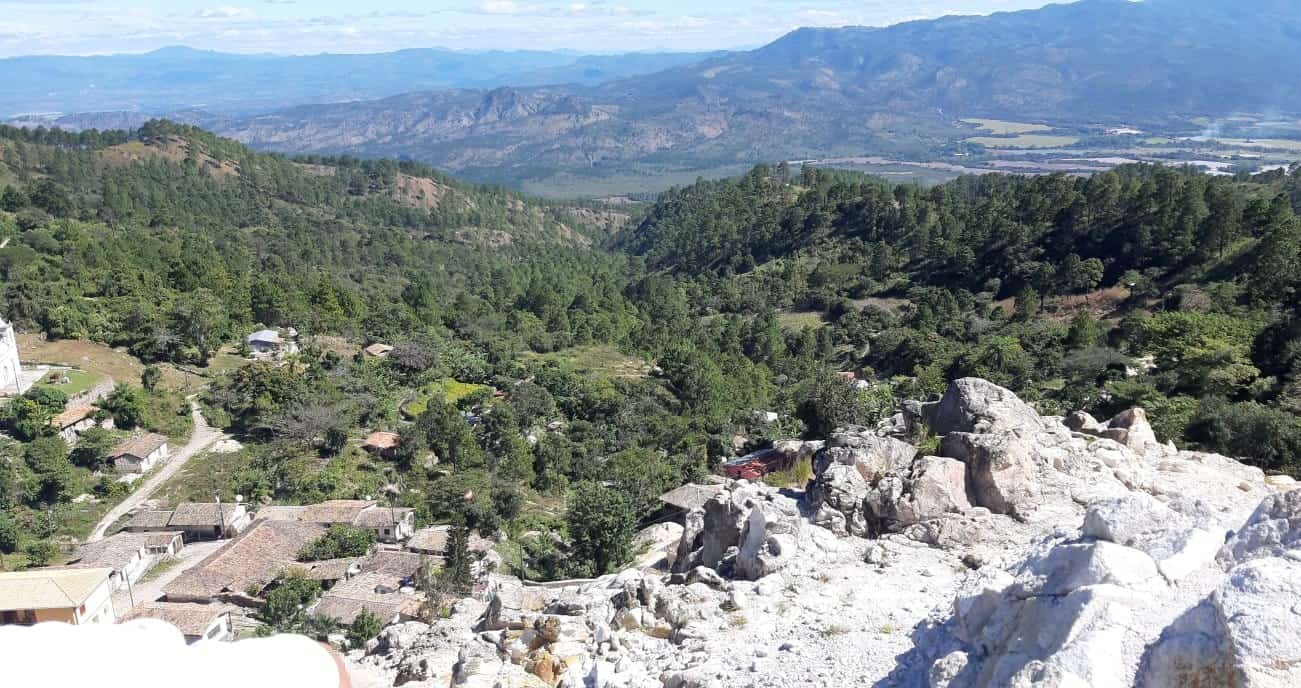 A panoramic view of San Antonio de Oriente, the Honduran town that became a recurring subject for José Antonio Velásquez. Image by AnViLo via Wikimedia Commons, licensed under CC BY-SA 4.0.
- Find the viewpoint. Velásquez raises the viewer above San Antonio de Oriente so that many parts of village life remain visible at once. Leiva places the viewer at the threshold of a staged interior. Vallecillo makes the exhibition site itself part of what must be examined.
- Follow the line and spatial pressure. Zelaya Sierra packs simplified figures into an emotionally concentrated encounter. Padilla breaks continuity and makes the visual field feel unstable. Burchard retains precise outlines even as recognizable reality slips toward surreal or magical logic.
- Measure the scale before reading the subject. López Rodezno’s long mural unfolds through joined copper plates across an architectural surface. Zamora’s Cristo del Picacho depends on monumental volume, elevation, and distant visibility. Their works address public space differently, but neither can be understood as an enlarged easel picture.
- Identify what the material normally does. Mejía redirects comales and tortillas from domestic use into an environment of enclosure. Leiva fills a constructed room with paper airplanes that cannot depart. Vallecillo makes construction blocks, chocolate, and other materials point back to labor, extraction, and exchange.
- Watch for recurring symbols and shapes. Gómez’s pigeons become a later personal signature. Becerra simplifies dancers and workers into rhythmic arrangements. Fortín moves among landscapes, historical and literary narratives, and later scenes shaped by personal memory.
- Ask what role remains for the viewer. Velásquez invites patient visual inventory. Monumental sculpture positions the viewer as a body moving through civic space. Installation may surround, obstruct, or implicate that body, while staged photography gives access to a constructed space that cannot actually be entered.
This method also reveals a deeper continuity. Honduran artists repeatedly convert public history into visual choices: conflict becomes pressure between bodies, migration becomes unstable space, memory becomes an object or room, and systems of labor and extraction become questions about material origin. The decisive difference is how each practice organizes attention. Viewpoint, line, scale, material, repeated symbols, and the viewer’s position offer a more dependable guide than any single national style.
Frequently asked questions
Naïf painting, formal art education, collaborative workshops, and expanded media each mark a different route through Honduran visual art. These answers place the key terms and institutions in context.
Which Honduran artist is best known for naïf painting?
José Antonio Velásquez is the Honduran artist most closely associated with naïf genre painting. His recurring views of San Antonio de Oriente combine an elevated perspective, meticulous detail, and many separately legible elements. Naïf refers here to his self-taught visual language outside formal academic convention, not to a lack of structure or skill.
Who helped establish the National School of Fine Arts in Honduras?
Arturo López Rodezno helped organize the Escuela Nacional de Bellas Artes in 1940 and directed it through 1951. The school involved many artists across its history, but López Rodezno’s organizing and leadership roles make him central to its early institutional development.
What was the Taller de la Merced?
The Taller de la Merced was a collective context that became important to Honduran visual art during the 1970s. It connected artistic experimentation with other creative disciplines and political engagement. Its significance lies in the exchange it enabled, not in the creation of one uniform workshop style.
Are notable Honduran artists known only for painting?
No. Mario Zamora Alcántara worked at the scale of monumental public sculpture. Xenia Mejía used installation, Alma Leiva constructed environments for staged photography, and Adán Vallecillo develops research-led projects from construction materials and other ordinary substances. Together, these practices show that modern and contemporary Honduran art extends well beyond the painted canvas.

Jordan Anthony is a Cape Town-based film photographer, curator, and arts writer. She holds a Bachelor of Art in Fine Arts from the University of the Witwatersrand, Johannesburg, where she explored themes like healing, identity, dreams, and intuitive creation in her Contemporary art practice. Jordan has collaborated with various local art institutions, including the KZNSA Gallery in Durban, the Turbine Art Fair, and the Wits Art Museum. Her photography focuses on abstract color manipulations, portraiture, candid shots, and urban landscapes. She’s intrigued by philosophy, memory, and esotericism, drawing inspiration from Surrealism, Fluxus, and ancient civilizations, as well as childhood influences and found objects. Jordan is working for artfilemagazine since 2022 and writes blog posts about art history and photography.
Learn more about Jordan Anthony and about us.
Cite this Article
Jordan, Anthony, “Honduran Artists: 12 Modern and Contemporary Figures.” artfilemagazine – Your Online Art Source. September 14, 2026. URL: https://artfilemagazine.com/honduran-artists/
Anthony, J. (2026, 14 September). Honduran Artists: 12 Modern and Contemporary Figures. artfilemagazine – Your Online Art Source. https://artfilemagazine.com/honduran-artists/
Anthony, Jordan. “Honduran Artists: 12 Modern and Contemporary Figures.” artfilemagazine – Your Online Art Source, September 14, 2026. https://artfilemagazine.com/honduran-artists/.